Stomach cancer has a protein on its surface that was basically hiding in plain sight for decades - and now three drugs are ganging up on it at once, with results that just dropped in Nature Medicine.
The Protein Nobody Talked About
Claudin 18.2 (CLDN18.2) is a tight junction protein. Its day job? Holding stomach lining cells together like microscopic Velcro. Normally, it sits buried between cells where drugs can't reach it. But when stomach cells go rogue and turn cancerous, the cellular architecture falls apart, and CLDN18.2 gets exposed on the tumor surface like a neon "KICK ME" sign.
About 40% of gastric and gastroesophageal junction (GEJ) cancers flash this protein (Yamamoto et al., 2025). That's a massive patient population walking around with a built-in bullseye that until recently, nobody was shooting at.
Enter zolbetuximab - an antibody engineered to latch onto CLDN18.2 and mark those cancer cells for destruction. It already earned its stripes (and FDA approval) through the SPOTLIGHT and GLOW trials, where adding it to chemotherapy stretched median overall survival to 14-18 months compared to chemo alone (Shitara et al., 2023); (Shah et al., 2023). Good, but oncologists being oncologists, the obvious next question was: can we stack another weapon on top?
Three Drugs Walk Into a Tumor
The ILUSTRO trial's Cohort 4 tested exactly that triple threat: zolbetuximab (the CLDN18.2 sniper), mFOLFOX6 (the chemo backbone that's been beating up cancer cells since your gastroenterologist was in medical school), and nivolumab (a checkpoint inhibitor that rips the invisibility cloak off tumors so your immune system can actually see them).
Seventy-seven patients with metastatic, HER2-negative, CLDN18.2-positive gastric or GEJ cancer enrolled across the safety and expansion phases. Most of them - 85.5% - had CLDN18.2-high tumors, meaning their cancers were practically wallpapered with the target protein (Shitara et al., 2026).
The Numbers That Got People's Attention
After a median follow-up of 11.5 months in the expansion cohort, the results landed well above what anyone sees with chemo alone in this disease:
- Median progression-free survival: 14.8 months overall. In patients with CLDN18.2-high tumors? 18.0 months. For context, chemo-only PFS in this setting typically hovers around 6-7 months. That's not an incremental bump - that's the difference between missing one birthday and making it to two more.
- Objective response rate: 62.1% of patients with measurable disease had their tumors shrink meaningfully. Among CLDN18.2-high patients, that climbed to 68.1% - roughly two out of three people seeing real tumor regression.
Compare that to the SPOTLIGHT trial, where zolbetuximab plus chemo (without nivolumab) delivered a median PFS of 11.0 months. Adding the checkpoint inhibitor appears to have tacked on nearly four more months of disease control, though cross-trial comparisons come with the usual asterisks about different patient populations and study designs.
The Trade-Off Nobody Likes Talking About
Triple therapy means triple the chance of side effects, and this combination didn't sidestep that reality. Nausea hit 80.5% of patients, and 72.7% reported decreased appetite. Zolbetuximab's GI side effects are well-documented from prior trials - the first infusion tends to be the roughest, with nausea and vomiting dropping by 65-69% in subsequent cycles. Aggressive antiemetic protocols helped, but "your stomach will hate you for cycle one" remains an honest conversation oncologists need to have with patients.
No new safety signals popped up beyond what's already known for each individual drug. That's the boring-but-crucial finding - three drugs together didn't produce some unexpected toxic synergy.
Why This Matters Beyond the Data Tables
Metastatic gastric cancer remains one of oncology's toughest opponents. It's the fifth most common cancer globally, with roughly 970,000 new cases per year, and the five-year survival rate for advanced disease stays stubbornly grim. Chemotherapy has been the backbone of treatment for decades, delivering median survival times that barely cracked a year.
The strategy here - hitting tumors simultaneously through a surface target (zolbetuximab), direct DNA damage (chemo), and immune reactivation (nivolumab) - reflects a broader shift in how oncologists think about combo therapy. Each drug attacks through a different mechanism, making it harder for the cancer to evolve resistance to all three at once.
The data from ILUSTRO Cohort 4 has already paved the way for the LUCERNA trial - a randomized phase 3 study now enrolling patients to definitively test whether adding zolbetuximab to chemoimmunotherapy outperforms chemoimmunotherapy alone in CLDN18.2-positive, PD-L1-positive gastric cancer. If LUCERNA confirms what ILUSTRO is suggesting, we could be looking at a new standard of care for a disease that desperately needs one.
References
-
Shitara K, Shoji H, Fazio N, et al. First-line zolbetuximab plus mFOLFOX6 and nivolumab in unresectable CLDN18.2-positive gastric or gastroesophageal junction adenocarcinoma: a phase 2 trial. Nature Medicine. 2026. DOI: 10.1038/s41591-026-04306-9
-
Shitara K, Lordick F, Bang YJ, et al. Zolbetuximab plus mFOLFOX6 in patients with CLDN18.2-positive, HER2-negative, untreated, locally advanced unresectable or metastatic gastric or gastro-oesophageal junction adenocarcinoma (SPOTLIGHT): a multicentre, randomised, double-blind, phase 3 trial. The Lancet. 2023;401(10389):1655-1668. DOI: 10.1016/S0140-6736(23)00620-7
-
Shah MA, Shitara K, Ajani JA, et al. Zolbetuximab plus CAPOX in CLDN18.2-positive gastric or gastroesophageal junction adenocarcinoma: the randomized, phase 3 GLOW trial. Nature Medicine. 2023;29(8):2133-2141. DOI: 10.1038/s41591-023-02465-7
-
Yamamoto K, Nakayama I, Shitara K. Emerging evidence of targeting non-oncogenic drivers for gastric cancer: Claudin18.2 and beyond. Therapeutic Advances in Medical Oncology. 2025. DOI: 10.1177/17588359251344804
-
Zolbetuximab or immunotherapy as the initial targeted therapy in CLDN18.2-positive, HER2-negative advanced gastric cancer: weighing the options. Therapeutic Advances in Medical Oncology. 2025. PMC12650800
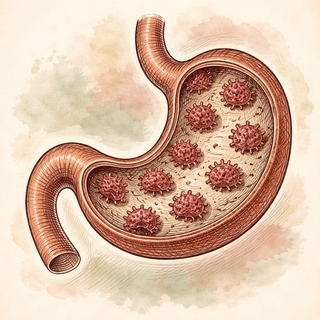
Disclaimer: The image accompanying this article is for illustrative purposes only and does not depict actual experimental results, data, or biological mechanisms.
Get cancer research delivered to your inbox
The best new studies, explained without the jargon. One email per week.