Somewhere in the evolutionary history of wood-rotting fungi, a pair of genes emerged that let mold eat trees. Millions of years later, a team at UCLA looked at those genes and thought: "What if we put these in immune cells to fight cancer?"
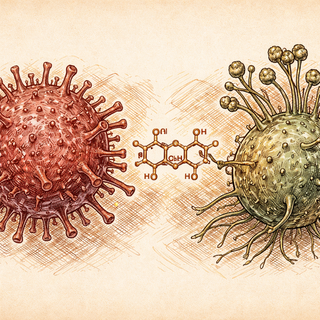
That's exactly what they did. And it worked.
The Fuel Problem Nobody Could Solve
Here's the setup: your immune system's T cells run on glucose. They need it to multiply, produce attack signals, and kill cancer cells. Unfortunately, tumors are glucose vacuums. Solid tumors and their surrounding entourage of cells burn through sugar so aggressively that T cells arriving on the scene find the pantry completely empty. It's like showing up to a potluck where the host ate everything before you walked in.
This metabolic starvation is one of the biggest reasons CAR-T cell therapy - where doctors engineer a patient's own T cells to hunt cancer - has crushed blood cancers but keeps hitting a wall against solid tumors. Over 500 clinical trials are currently testing CAR-T cells in solid tumors, and the hostile, sugar-depleted tumor microenvironment remains a core obstacle [1, 2].
Borrowing From Fungi (Because Mushrooms Had It Figured Out)
Miller and colleagues at UCLA had a beautifully lateral idea: what if T cells could eat a sugar that tumors physically cannot digest? [3]
Enter cellobiose. It's two glucose molecules stuck together with a beta-1,4 bond - the same bond that holds cellulose (wood, cotton, paper) together. Animals don't have the enzymes to crack that bond. Neither do cancer cells. But fungi? Fungi have been eating wood for hundreds of millions of years. They've got the molecular toolkit nailed down.
The researchers grabbed two genes from Neurospora crassa, a common bread mold: CDT-1, a transporter that pulls cellobiose across the cell membrane, and GH1-1, a beta-glucosidase that snaps cellobiose into two usable glucose molecules inside the cell. They engineered mouse T cells and human CAR-T cells to express both proteins, creating immune cells with a private fuel line that tumors can't tap into.
A Private Gas Station for Immune Cells
The results were striking. When the team starved cells of glucose (mimicking what happens inside a tumor), normal T cells sputtered and died. But the engineered T cells supplemented with cellobiose kept right on going - maintaining viability, proliferating, pumping out cytokines like IFN-gamma, and killing cancer cells with the same enthusiasm as well-fed T cells in a glucose-rich environment.
In mouse tumor models, engineered T cells given cellobiose suppressed tumor growth and extended survival. The tumor cells sitting right next to them, bathed in the same cellobiose, couldn't touch it. They lack the transporter to import it and the enzyme to break it down. It's metabolic exclusivity - a VIP buffet where only the T cells have wristbands.
Why This Matters Beyond Cancer
This approach sidesteps a problem that other metabolic engineering strategies have been chipping away at from different angles. Overexpressing FOXO1 can push CAR-T cells toward a metabolically fitter, stem-like state [4]. Acetate has been explored as an alternative fuel that T cells can access when glucose runs low [5]. Blocking the lactate transporter MCT11 can prevent exhausted T cells from drowning in tumor-produced lactic acid [6].
But the cellobiose strategy is different in kind, not just degree. It doesn't try to make T cells tougher in a glucose desert. It gives them their own oasis that nobody else can drink from. And cellobiose is already recognized as safe for human consumption - it's used in food products, including infant formula.
The researchers also noted something with broader scientific implications: this system could be used as a precision tool to study glucose metabolism in any cell type. Engineer the cellobiose pathway into a specific cell population, withdraw glucose, add cellobiose, and now only your cells of interest have fuel. It's a metabolic scalpel.
The Bottom Line
A pair of fungal genes, millions of years old, repurposed to solve one of modern immunotherapy's most stubborn problems. T cells that carry their own food supply into a metabolic war zone where the enemy can't steal their lunch. It's the kind of cross-kingdom molecular borrowing that makes biology feel less like a textbook and more like a heist movie where the good guys actually win.
Clinical trials haven't started yet, but the concept is clean, the biology is elegant, and the sugar is already FDA-safe. Fungi, it turns out, had the answer all along. We just needed to ask the right question.
References
-
McPhedran SJ, Carleton GA, Lum JJ. Metabolic engineering for optimized CAR-T cell therapy. Nature Metabolism. 2024;6(3):396-408. doi:10.1038/s42255-024-00976-2
-
Reinfeld BI, Madden MZ, Wolf MM, et al. Cell-programmed nutrient partitioning in the tumour microenvironment. Nature. 2021;593(7858):282-288. doi:10.1038/s41586-021-03442-1
-
Miller ML, Thauland TJ, Nagarajan SS, et al. Fungal-derived cellobiose metabolic pathway fuels T cells to bypass intratumoral glucose competition. Cell. 2026. doi:10.1016/j.cell.2026.01.015. PMID: 41742411
-
Chan JD, Scheffler CM, Munoz I, et al. FOXO1 enhances CAR T cell stemness, metabolic fitness and efficacy. Nature. 2024;629(8010):201-210. doi:10.1038/s41586-024-07242-1
-
Miller KD, et al. Acetate acts as a metabolic immunomodulator by bolstering T-cell effector function and potentiating antitumor immunity in breast cancer. Nature Cancer. 2023;4(10):1491-1507. doi:10.1038/s43018-023-00636-6
-
Peralta RM, Xie B, Lontos K, et al. Dysfunction of exhausted T cells is enforced by MCT11-mediated lactate metabolism. Nature Immunology. 2024;25(12):2297-2307. doi:10.1038/s41590-024-01999-3
Disclaimer: The image accompanying this article is for illustrative purposes only and does not depict actual experimental results, data, or biological mechanisms.
Get cancer research delivered to your inbox
The best new studies, explained without the jargon. One email per week.