Right now, getting CAR-T cell therapy is a bit like ordering a bespoke suit that costs more than your house, takes weeks to tailor, and might not fit by the time it arrives. Doctors pull your T cells out, FedEx them to a specialized lab, genetically rewire them to hunt cancer, grow a few hundred million of them, then ship them back and drip them into your veins. The price tag? North of $400,000. The wait time? Weeks to months - not ideal when you've got an aggressive cancer that doesn't check its calendar.
A team of researchers just published a study in Nature that could blow this entire process wide open. Instead of the whole extract-modify-reinfuse dance, they figured out how to reprogram your T cells while they're still inside your body. One injection. Done.
The Cellular Software Update Nobody Saw Coming
The research, led by a 35-person squad spanning UCSF, UC Berkeley, Duke, and the Karolinska Institutet, developed a clever two-vector system that essentially performs gene surgery on T cells in vivo (Nyberg et al., 2026).
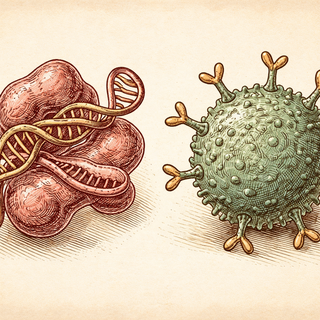
Here's how it works. Vector one: tiny particles called Enveloped Delivery Vehicles, or EDVs - think of them as molecular Uber drivers that know exactly which cells to pick up. These EDVs are decorated with antibody fragments that let them find and dock onto T cells specifically. Their cargo? CRISPR-Cas9 ribonucleoproteins - the molecular scissors that cut DNA at a precise location.
Vector two: adeno-associated viruses (AAVs) carrying the DNA template - the new genetic instructions you want inserted. Specifically, a promoterless CAR transgene designed to slot into a location called the TRAC locus, which is basically the T cell's own control panel for gene expression.
The beauty of TRAC-locus insertion is that the CAR gene ends up under the control of the T cell's own regulatory machinery. No rogue promoters blasting CAR expression at full volume 24/7. Instead, the cell turns the CAR on and off the way it naturally would with its own T cell receptor - like swapping a bootleg remix for the studio master. This builds on earlier work showing that TRAC-targeted CARs outperform randomly integrated ones (Eyquem et al., 2017).
What Happened in the Mice (Spoiler: Tumors Had a Bad Day)
The team first tested this in humanized mice - mice engineered to carry a functioning human immune system. After a single intravenous injection, roughly 20% of splenic T cells became fully functional CAR-T cells. In some organs, CAR-T cells made up 40% of all immune cells.
Then came the really wild part. Mice with aggressive leukemia received the two-vector cocktail, and within two weeks, nearly all of them had zero detectable cancer. No chemotherapy preconditioning required. Just the injection and the immune system doing its newly upgraded job.
This isn't the first time this group has tinkered with in vivo T cell editing - a 2024 Nature Biotechnology paper from the same labs showed that EDVs could deliver CRISPR cargo selectively to T cells in living animals (Hamilton et al., 2024). But that earlier work was more proof-of-concept. This new study goes the full distance: stable gene integration, durable expression, and actual tumor clearance across blood cancers and solid tumors.
Monkeys Got In On It Too
The researchers didn't stop at mice. In non-human primates, a single intravenous dose achieved complete B cell aplasia (a sign that the anti-CD19 CAR-T cells were working) in peripheral blood by day 10. TRAC-CAR T cells expanded to about 35% of all circulating T cells, and by day 13, B cells were gone from lymph nodes and bone marrow too. Tolerability looked favorable - no drama on the safety front.
Why Your Oncologist Should Be Paying Attention
Current CAR-T manufacturing requires GMP facilities, viral vector production costing upwards of $100,000 per patient, and a logistics chain that reads like a spy thriller. The whole process serves fewer than 10% of eligible patients in some countries simply because the infrastructure can't keep up.
An in vivo approach that works from a single injection could slash costs, eliminate manufacturing bottlenecks, and bring this therapy to patients who currently can't access it - including those in lower-resource settings. Three of the study's authors (Eyquem, Hamilton, and Doudna) have already co-founded Azalea Therapeutics to push this toward IND-enabling studies.
We're still in preclinical territory, and the jump from mice to humans has humbled plenty of promising therapies. But the combination of site-specific integration (no random insertion chaos), physiologic expression control, and single-dose simplicity makes this one of the more compelling shots at democratizing cell therapy we've seen.
Cancer's been running the table for a while. Nice to see the T cells finally getting a proper upgrade - no factory visit required.
References
-
Nyberg, W.A., Bernard, P.L., Ngo, W., et al. (2026). In vivo site-specific engineering to reprogram T cells. Nature. DOI: 10.1038/s41586-026-10235-x. PMID: 41851456
-
Hamilton, J.R., Chen, E., Perez, B.S., et al. (2024). In vivo human T cell engineering with enveloped delivery vehicles. Nature Biotechnology, 42, 604-613. DOI: 10.1038/s41587-023-02085-z. PMID: 38212493
-
Eyquem, J., Mansilla-Soto, J., Giavridis, T., et al. (2017). Targeting a CAR to the TRAC locus with CRISPR/Cas9 enhances tumour rejection. Nature, 543, 113-117. DOI: 10.1038/nature21405
-
Roth, T.L., Puig-Saus, C., Yu, R., et al. (2018). Reprogramming human T cell function and specificity with non-viral genome targeting. Nature, 559, 405-409. DOI: 10.1038/s41586-018-0326-5. PMID: 29995861
-
Cappell, K.M. & Kochenderfer, J.N. (2023). High cost of chimeric antigen receptor T-cells: Challenges and solutions. American Society of Clinical Oncology Educational Book, 43, e390912. DOI: 10.1200/EDBK_397912
Disclaimer: The image accompanying this article is for illustrative purposes only and does not depict actual experimental results, data, or biological mechanisms.
Get cancer research delivered to your inbox
The best new studies, explained without the jargon. One email per week.