Bacteria have been crashing the cancer party for longer than anyone realized - and it turns out, where they park themselves determines whether they're helping your immune system or actively sabotaging it.
A team led by Shang Cai at Westlake University just dropped a paper in Cell that reads like a molecular espionage thriller: the exact same bacterial strain can either turbocharge your body's anti-cancer defenses or help tumors spread to your lungs. The difference? Whether those bacteria are hanging out inside or outside the cancer cells (Yao et al., 2026).
Real estate agents were right all along. Location really is everything.
The Tenant From Hell
Here's the setup. We've known for a few years that tumors aren't sterile little lumps - they're teeming with bacteria. A landmark 2022 study from some of the same researchers showed that bacteria living inside tumor cells actually help cancer cells survive the brutal journey through the bloodstream during metastasis, basically serving as tiny structural engineers that reinforce the cellular skeleton (Fu et al., 2022).
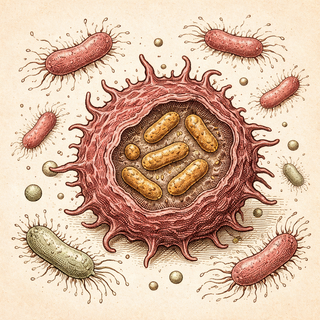
But this new study goes way deeper. Working with PyMT breast tumors in mice, the team discovered that when bacteria set up shop in the cancer cell's cytoplasm - the goopy interior where all the important stuff happens - they trigger a cascade of molecular chaos. The bacteria cause double-stranded DNA to pile up in the cytoplasm, which is basically a five-alarm fire for the cell's security system.
That security system is called the cGAS-STING pathway, and normally it's one of your body's best alarm bells against threats. The enzyme cGAS detects stray DNA floating around where it shouldn't be, produces a signaling molecule called cGAMP, and rings up STING to rally the immune troops (Shen et al., 2025). Under normal circumstances, this pathway cranks out interferons that get your T cells fired up and ready to fight.
But cancer cells, those perpetually scheming overachievers, have figured out how to hijack the alarm. Instead of a normal STING response, the bacteria-triggered DNA accumulation activates a sneaky side pathway - cGAS-STING-IL-17B - that flips neutrophils from their tumor-killing "N1" mode into a protumor "N2" mode. Think of neutrophils as security guards who've been bribed to look the other way while the tumor makes its escape.
These corrupted neutrophils don't just stop fighting - they actively suppress your cytotoxic T cells, the immune system's actual hit squad. It's like the tumor hired the security team to lock the police out of the building.
Plot Twist: The Outdoor Bacteria Are the Good Guys
Here's where it gets wild. The same bacteria, when floating around outside cancer cells in the tumor microenvironment, produce the opposite effect. Extracellular bacteria activate neutrophils into their antitumor state - no STING pathway hijacking, no immunosuppression, just good old-fashioned immune defense doing its job.
Same bacteria. Same tumor. Completely different immune outcome. The spatial relationship between microbe and host cell is the entire ballgame.
From Lab Bench to (Maybe) Your Surgeon's Toolkit
The therapeutic implications are genuinely exciting. The team showed that eliminating intracellular bacteria, or deliberately introducing extracellular bacterial components, reversed the immunosuppression and blocked postsurgical metastatic recurrence in preclinical models. For anyone who's had cancer surgery and spent the following months wondering if rogue cells are setting up shop elsewhere, that sentence should land with some weight.
They also developed a "bacteria invasion signature" - essentially a molecular fingerprint that tracks how deeply bacteria have infiltrated tumor cells. In human breast cancer patients, this signature correlated with worse outcomes, suggesting it could eventually become a prognostic tool.
The broader context matters here too. We're increasingly learning that the tumor microbiome isn't just a passive bystander - it actively shapes cancer progression through DNA mutations, inflammatory pathways, and immune modulation (Yang et al., 2023). This study adds a critical new layer: it's not just which bacteria are present, but where they physically sit relative to cancer cells that determines the immune outcome.
The Bottom Line
Cancer biology keeps reminding us that context is everything. The same molecular pathway can fight cancer or fuel it. The same bacterium can be your immune system's best friend or its worst nightmare. And the difference might come down to something as basic as whether a microbe is inside or outside a cell wall.
If nothing else, this research makes one thing clear: the relationship between bacteria and cancer is way too complicated for simple narratives - and that's exactly what makes it worth studying.
References
-
Yao B, Liu X, Ruan K, et al. Divergent tumor immunity determined by bacteria-cancer cell engagement. Cell. 2026;189(6):1748-1767.e26. DOI: 10.1016/j.cell.2025.12.044. PMID: 41643675.
-
Fu A, Yao B, Dong T, et al. Tumor-resident intracellular microbiota promotes metastatic colonization in breast cancer. Cell. 2022;185(8):1356-1372.e26. DOI: 10.1016/j.cell.2022.02.027. PMID: 35395179.
-
Shen M, Jiang X, Peng Q, et al. The cGAS-STING pathway in cancer immunity: mechanisms, challenges, and therapeutic implications. J Hematol Oncol. 2025. DOI: 10.1186/s13045-025-01691-5. PMID: 40188340.
-
Yang L, Li A, Wang Y, Zhang Y. Intratumoral microbiota: roles in cancer initiation, development and therapeutic efficacy. Signal Transduct Target Ther. 2023;8(1):35. DOI: 10.1038/s41392-022-01304-4. PMID: 36646684.
Disclaimer: The image accompanying this article is for illustrative purposes only and does not depict actual experimental results, data, or biological mechanisms.
Get cancer research delivered to your inbox
The best new studies, explained without the jargon. One email per week.