You know E. coli mostly as the thing that ruins your vacation after a sketchy buffet. But here's a plot twist worthy of a redemption arc: scientists just turned a harmless probiotic strain of E. coli into a microscopic nitric oxide factory that parks itself inside tumors and helps your immune system finally do its job.
Published this month in Nature Biotechnology, a team of researchers engineered Escherichia coli Nissle 1917 - a probiotic that's been safely used in Europe for gut issues since before your grandparents were born - to continuously pump out nitric oxide (NO) right inside solid tumors. And when paired with immunotherapy drugs, the results in mice were, well, let's just say the tumors did not have a good time.
The Problem: Your Immune System Keeps Getting Ghosted
Here's the frustrating thing about cancer. Your immune system is perfectly capable of destroying tumor cells. It does it every day, catching rogue cells before they become a problem. But solid tumors are basically running a con. They build up an immunosuppressive microenvironment - think of it as a VIP lounge where your immune cells' invitations keep getting revoked at the door.
Immune checkpoint inhibitors like anti-PD-L1 drugs were supposed to fix this by ripping up the "do not enter" signs tumors put on their surfaces. And they work spectacularly - for some patients. For many others, the tumor microenvironment is so deeply suppressive that checkpoint therapy alone isn't enough. The T cells show up, but they're exhausted, confused, and outnumbered by immunosuppressive cells that are basically working as bouncers for the tumor (Jeong et al., 2022).
The Fix: A Probiotic With a Nitric Oxide Habit
Enter ECN-NO - E. coli Nissle 1917, now souped up with a synthetic arginine-nitric oxide circuit. The engineering is elegant: the researchers deleted a gene called argR (the arginine repressor) that normally tells the bacterium "hey, you've made enough arginine, chill." Without that brake, the bacteria keep cranking out arginine. Then they plugged in genes for argininosuccinate synthase and lyase (ArgG/ArgH) to keep recycling the arginine supply, plus a nitric oxide synthase borrowed from Bacillus subtilis (BsNOS) that converts all that arginine into a steady stream of NO (Nature Biotechnology, 2026).
It's like giving a factory unlimited raw materials AND removing the manager who keeps telling everyone to take breaks.
The clever part? These bacteria naturally love hanging out in tumors. Solid tumors are hypoxic, nutrient-rich, and immunosuppressed - basically a bacterial Airbnb. Once ECN-NO colonizes the tumor, it starts producing NO at sustained therapeutic levels, turning the tumor's cozy hideout into a hostile environment.
What Nitric Oxide Actually Does in There
NO is one of biology's weirdest molecules. It's a gas. It's a signaling molecule. Your immune cells already use it to kill pathogens. And in the right concentrations inside a tumor, it pulls off a multi-pronged attack:
Vascular normalization: Tumors grow chaotic, leaky blood vessels that make it hard for immune cells to even physically get inside. NO helps normalize these vessels, essentially building proper roads into the tumor for immune cells to travel on.
Dendritic cell recruitment: NO brings in the dendritic cells - your immune system's intelligence agents - that grab tumor antigens and present them to T cells, essentially showing them mugshots of the enemy.
Flipping the immune switch: NO suppresses regulatory T cells and myeloid-derived suppressor cells (the tumor's hired goons) while promoting M1 macrophage polarization (the good guys). It also enhances antigen presentation on tumor cells, making them more visible to the immune system (Vaccines, 2021).
The Results: Tumors Had a Very Bad Day
When the researchers combined ECN-NO with anti-PD-L1 checkpoint therapy in mice bearing multiple types of solid tumors, the combo drove durable tumor regression. We're talking expanded functional CD8+ T cells, reversed T cell exhaustion, and - here's the kicker - memory T cell formation that provided antitumor immunity lasting at least 120 days. That means the mice didn't just beat the cancer; their immune systems remembered how to beat it if it tried to come back.
And before you ask about safety: the bacteria come equipped with kill switches and containment modules. Think of it as a self-destruct button that prevents the bacteria from going rogue once their job is done. This isn't E. coli gone wild; it's E. coli on a very tight leash.
Why This Matters Beyond the Mouse Cage
Bacterial cancer therapy isn't new - doctors noticed over a century ago that some cancer patients improved after bacterial infections. But engineering a well-characterized probiotic strain to produce a specific therapeutic molecule at a specific location? That's synthetic biology earning its keep.
E. coli Nissle 1917 is already being engineered for colorectal cancer detection, therapeutic nanobody delivery, and cytokine production. This NO-producing variant adds a powerful new tool to the "living therapeutics" toolbox - programmable bacteria that can sense, respond to, and reshape the tumor microenvironment in ways that static drugs simply can't.
We're still in mouse territory, and the gap between mouse models and human clinics is littered with promising therapies that didn't pan out. But the logic here is sound, the safety engineering is thoughtful, and the combination of sustained local NO production with checkpoint immunotherapy tackles one of the biggest problems in oncology: making cold tumors hot.
Your gut bacteria might just save your life someday. They're already practicing.
References
-
Nature Biotechnology (2026). Sustained nitric oxide production by engineered E. coli remodels the tumor microenvironment and potentiates immunotherapy. Nat Biotechnol. DOI: 10.1038/s41587-026-03054-y
-
Nature Biotechnology (2026). An engineered E. coli strain sustains intratumoral nitric oxide production to boost effectiveness of tumor immunotherapy. Nat Biotechnol. DOI: 10.1038/s41587-026-03055-x
-
Jeong, S. et al. (2022). Opportunities for Nitric Oxide in Potentiating Cancer Immunotherapy. Pharmacol Rev, 74(4), 1146-1175. PMCID: PMC9553106
-
Choudhari, S.K. et al. (2021). Current Advances of Nitric Oxide in Cancer and Anticancer Therapeutics. Vaccines, 9(2), 94. DOI: 10.3390/vaccines9020094
-
Savage, T.M. et al. (2024). Engineering tumor-colonizing E. coli Nissle 1917 for detection and treatment of colorectal neoplasia. Nat Commun, 15, 646. DOI: 10.1038/s41467-024-44776-4
-
Gurbatri, C.R. et al. (2023). Engineering Probiotic E. coli Nissle 1917 for Release of Therapeutic Nanobodies. ACS Synth Biol. PMID: 38070121
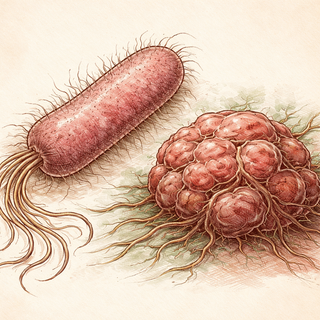
Disclaimer: The image accompanying this article is for illustrative purposes only and does not depict actual experimental results, data, or biological mechanisms.
Get cancer research delivered to your inbox
The best new studies, explained without the jargon. One email per week.