Two patients walked into a clinical trial for MAGE-A3-targeted cancer therapy. Both died within days - not from cancer, but from their own souped-up immune cells attacking their hearts. The engineered T cell receptors, tuned to grip tumor antigens with iron-fist affinity, had a fatal side gig: they also recognized titin, a protein in cardiac muscle (Cameron et al., 2013). That tragedy became a cautionary tale etched into the field of cancer immunotherapy. Crank up the binding strength of a T cell receptor and you might kill the tumor - or the patient.
A team led by Xiang Zhao, publishing in Cell this month, just offered an elegant escape from that trap. And the secret weapon? Histidine - the Switzerland of amino acids (Wang et al., 2026).
The Chinese Finger Trap Inside Your Immune System
To understand why this matters, you need to meet catch bonds - the wonderfully weird molecular handshakes that break every rule you learned in chemistry class.
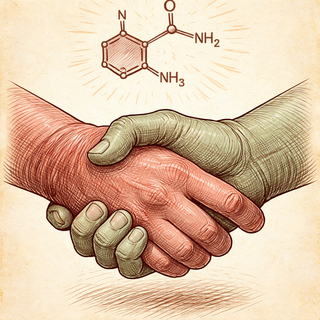
Most molecular bonds are "slip bonds." Pull on them and they come apart, like untying a shoelace. Catch bonds do the opposite. Pull on them and they grip tighter, like a Chinese finger trap at the cellular level (Faust et al., 2023). Only at very high forces do they finally let go.
Your T cell receptors (TCRs) use catch bonds to interrogate suspicious molecules on cell surfaces. When a T cell bumps into a potential threat, it doesn't just passively check the ID badge - it physically tugs on the connection. If the TCR forms a catch bond with the target, the bond strengthens under tension, buying enough time for the signaling cascade to fire up and launch an immune attack. If it's just a slip bond? The connection falls apart and the T cell moves on. It's basically a molecular lie detector test (Zhao et al., 2022).
This is why bond lifetime under force predicts T cell killing power better than plain old binding affinity. A TCR can grip weakly at rest but become a bulldog under tension - low affinity, high potency. That's the sweet spot for cancer therapy.
Why Histidine Is the MVP Nobody Expected
Traditional TCR engineering cranks up affinity - think of it as making the handshake crushingly tight at all times. The problem is that an overly sticky TCR doesn't discriminate well. It'll latch onto anything that remotely resembles its target, including proteins in your heart, brain, or lungs.
Zhao's team flipped the script. Instead of tightening the grip, they asked: what if we just add more catch bonds?
Enter histidine scanning. The researchers systematically swapped amino acids in the TCR's binding interface for histidine, one position at a time, hunting for "hotspots" where histidine could form new force-dependent connections. Histidine is uniquely suited for this job. Its imidazole ring can toggle between forming hydrogen bonds and salt bridges depending on context - particularly under the mechanical stress that catch bonds thrive on. It's like installing extra latches on a door that only engage when someone tries to push through (Wang et al., 2026).
Once they identified the hotspots, they randomized those positions to build TCR libraries, then screened for variants that formed stronger catch bonds while keeping resting affinity low. The whole approach doesn't even need a crystal structure of the TCR-target complex - a massive practical advantage, since solving those structures can take months or years.
From Lab Bench to (Hopefully) Bedside
The proof is in the pudding. The team engineered TCRs targeting MAGE-A3, WT-1, and other tumor antigens. The modified receptors showed enhanced T cell activation and tumor killing - with no off-target toxicity and no on-target toxicity. Remember MAGE-A3, the antigen whose high-affinity TCR killed those two patients? The histidine-scanned version targets the same antigen without the cardiac devastation.
This builds on Zhao's earlier catch bond work in Science (Zhao et al., 2022) and complements recent efforts to overcome T cell tolerance to self-antigens through similar mechanical tuning (Kolawole et al., 2025). Together, these studies suggest that the force-sensing machinery of immune cells isn't just an interesting biophysical curiosity - it's a tunable dial for therapy.
Beyond T Cells
Perhaps the most tantalizing part: histidine scanning isn't limited to TCRs. The paper demonstrates applicability to Notch receptors, Fc receptors, and potentially any mechanosensory ligand-receptor system. Anywhere biology uses physical force to make signaling decisions, histidine might have something to offer.
The immune system has been fighting cancer for millions of years using mechanical tricks we're only now understanding. This paper suggests that instead of trying to out-muscle tumors with brute-force binding, we should take a lesson from evolution: sometimes the smartest grip isn't the strongest one. It's the one that knows when to hold on.
References
-
Wang, Y., Wang, Y., Yuan, W., et al. (2026). Tuning the sensitivity of mechanosensory receptors through histidine scanning. Cell, 189(6), 1680–1700.e48. DOI: 10.1016/j.cell.2025.12.050
-
Zhao, X., Kolawole, E.M., Chan, W., et al. (2022). Tuning T cell receptor sensitivity through catch bond engineering. Science, 376(6591), 411–417. DOI: 10.1126/science.abl5282
-
Faust, M.A., Rasé, V.J., Lamb, T.J., & Evavold, B.D. (2023). What's the Catch? The Significance of Catch Bonds in T cell Activation. Journal of Immunology, 211(3), 333–342. DOI: 10.4049/jimmunol.2300141
-
Cameron, B.J., Gerry, A.B., Dukes, J., et al. (2013). Identification of a titin-derived HLA-A1-presented peptide as a cross-reactive target for engineered MAGE A3-directed T cells. Science Translational Medicine, 5(197), 197ra103. DOI: 10.1182/blood-2013-03-490565
-
Kolawole, E.M., et al. (2025). Overcoming T cell tolerance to tumor self-antigens through catch-bond engineering. Science. DOI: 10.1126/science.adx3162
Disclaimer: The image accompanying this article is for illustrative purposes only and does not depict actual experimental results, data, or biological mechanisms.
Get cancer research delivered to your inbox
The best new studies, explained without the jargon. One email per week.