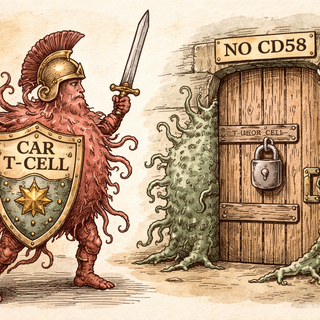
Ever built the perfect security team, only to find out someone changed all the locks? That's basically what happens when tumors lose a protein called CD58 - and it's been making one of cancer's most promising treatments look like a very expensive disappointment.
The Setup: CAR T-Cells Walk Into a Tumor...
CAR T-cell therapy is one of the coolest tricks in modern oncology. Doctors take your own immune cells, genetically soup them up to recognize cancer, and send them back in like a SWAT team with a very specific target. It works brilliantly - until it doesn't. About 30-50% of patients relapse within a year, and researchers have been scrambling to figure out why these engineered warriors keep losing steam (Frontiers in Oncology, 2026).
One major culprit? Tumors that ditch a surface protein called CD58. Think of CD58 as the doorbell on a cancer cell - it lets CAR T-cells know they've arrived at the right address and helps them form what's called an "immune synapse," essentially a cellular handshake that kicks off the killing process. When tumors lose CD58, that handshake turns into an awkward wave from across the room. The T-cells show up, can't properly dock, and just... flounder (Yarber et al., Blood Advances, 2022; PMCID: PMC9649996).
Previous CRISPR screening had already flagged CD58 loss as a big deal. In one study of patients treated with axicabtagene ciloleucel (a CD19-targeted CAR T product), roughly 25% had tumors missing functional CD58, and nearly all of those patients saw their therapy fail (The ASCO Post, 2021). That's a lot of expensive cells sent on a doomed mission.
The Plot Twist: It's Not Just a Bad Handshake
Here's where things get interesting. A new study from Xinran Ma, Weidong Han, and colleagues - published in Signal Transduction and Targeted Therapy - dug deeper into what actually goes wrong inside CAR T-cells when they can't connect properly with CD58-deficient tumors (Ma et al., Signal Transduct. Target. Ther., 2026; DOI: 10.1038/s41392-026-02597-5).
Turns out, it's not just a docking problem. When CD58 is missing, a key transcription factor called AP-1 gets dialed way down in the T-cells. AP-1 is basically the molecular pep talk your immune cells need to stay energized and angry at cancer. Without it, things go south fast: mitochondria - the tiny power plants inside each cell - start falling apart. Energy production tanks. Toxic molecules called reactive oxygen species (ROS) pile up like garbage in a neglected apartment. And then the cells just start dying, not because anything killed them from the outside, but because their own internal self-destruct program kicks in through the mitochondrial apoptosis pathway.
So CD58 loss doesn't just prevent CAR T-cells from attacking. It actively poisons them from within. That's some next-level tumor villainy.
Enter DUSP6: The Brake That Needed Cutting
The team went hunting upstream of AP-1 for something they could target. They tested three different inhibitory phosphatases - enzymes that act like brakes on the AP-1 signaling highway - and found a clear winner: DUSP6 (dual specificity phosphatase 6).
DUSP6 normally keeps AP-1 signaling in check by dephosphorylating ERK in the MAPK pathway (Ahmad et al., Cancer Biol. Med., 2018; PMCID: PMC5842331). Useful under normal circumstances, but when CD58 loss has already throttled AP-1, DUSP6 is basically stomping on the brakes of a car that's already stalled.
When researchers knocked out DUSP6 - both pharmacologically and genetically - CAR T-cells bounced back hard. Less apoptosis. Better mitochondrial function. Stronger proliferation. Improved long-term killing ability. The transcriptomic data backed it up too: DUSP6-ablated CAR T-cells showed ramped-up activation signatures and turbocharged metabolic pathways.
Why This Actually Matters for Patients
Here's the clinical kicker. When the team analyzed RNA-seq data from real patients receiving T-cell immunotherapy, they found that patients who responded well naturally had lower DUSP6 expression. Single-cell RNA-seq data told the same story. DUSP6 isn't just a lab curiosity - it appears to be a genuine marker of whether immunotherapy will work (Ma et al., 2026).
This reframes CD58 from a simple adhesion molecule to something more like a metabolic checkpoint in CAR T-cell biology. And it positions DUSP6 knockout as a realistic engineering strategy - you could potentially build next-generation CAR T-cells with DUSP6 deleted right from the start, making them resistant to the sabotage that CD58 loss creates.
Other groups have explored boosting AP-1 directly - like overexpressing c-Jun to counteract exhaustion (Lynn et al., Science Immunology, 2025). But removing DUSP6 works from the other direction: instead of adding more gas, you release the brake. Both approaches might eventually complement each other.
The Bottom Line
Cancer cells are relentless innovators when it comes to dodging the immune system. Losing CD58 is one of their sneakier moves - it doesn't just hide them from CAR T-cells, it actively wrecks the T-cells' internal machinery. But now we know the wiring diagram, and DUSP6 looks like a very cuttable wire. For the millions of patients whose CAR T-cell therapy hasn't worked as hoped, that's a genuinely promising lead.
References
-
Ma, X., Zhang, Y., Wang, Y., et al. (2026). DUSP6 ablation restores CAR T-cell fitness impaired by tumor CD58 loss through invigoration of AP-1 signaling. Signal Transduction and Targeted Therapy, 11(1), 100. DOI: 10.1038/s41392-026-02597-5
-
Yarber, J.L., Jiang, Z., Wang, Y., et al. (2022). CD58 loss in tumor cells confers functional impairment of CAR T cells. Blood Advances, 6(22), 5844-5856. PMCID: PMC9649996
-
Ahmad, M.K., Abdollah, N.A., Shafie, N.H., et al. (2018). Dual-specificity phosphatase 6 (DUSP6): a review of its molecular characteristics and clinical relevance in cancer. Cancer Biology & Medicine, 15(1), 14-28. PMCID: PMC5842331
-
Deng, Q., Han, G., Puebla-Osorio, N., et al. (2020). Characteristics of anti-CD19 CAR T cell infusion products associated with efficacy and toxicity in patients with large B cell lymphomas. Nature Medicine, 26(12), 1878-1887.
-
Lynn, R.C., Weber, E.W., Sotillo, E., et al. (2025). Modulating AP-1 enables CAR T cells to establish an intratumoral stemlike reservoir and overcomes resistance to PD-1 blockade. Science Immunology. DOI: 10.1126/sciimmunol.adw7685
Disclaimer: The image accompanying this article is for illustrative purposes only and does not depict actual experimental results, data, or biological mechanisms.
Get cancer research delivered to your inbox
The best new studies, explained without the jargon. One email per week.