Cancer cells have exactly one job: grow like they're trying to win some kind of cellular Hunger Games. And HER2-positive cancer cells? They're the overachievers of the bunch, plastering extra copies of a growth receptor all over their surfaces like a teenager with band stickers on their laptop. For years, oncologists have been targeting that receptor with increasingly clever weapons. The latest contender - SHR-A1811, also known as trastuzumab rezetecan - just dropped long-term data from its global Phase 1 trial, and the numbers are turning heads.
A Trojan Horse With Better Engineering
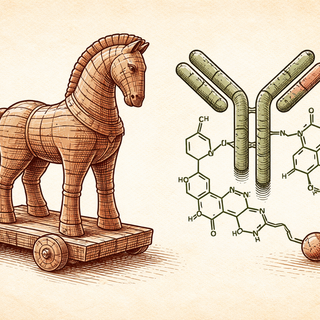
Antibody-drug conjugates (ADCs) are the molecular equivalent of a Trojan horse. You take an antibody that cancer cells happily welcome through their front door - in this case, trastuzumab, the same antibody in Herceptin - and you strap a cell-killing payload to it. Once inside, the payload detaches and wreaks havoc. It's targeted chemotherapy that mostly leaves your healthy cells alone, like a heat-seeking missile instead of carpet bombing.
SHR-A1811 uses a topoisomerase I inhibitor as its warhead, connected through a cleavable linker with a clever twist: a chiral cyclopropyl group engineered between the linker and the toxin that keeps the payload from leaking out prematurely in the bloodstream (Yao et al., 2024). Think of it as a better safety catch on a very powerful weapon.
The Numbers That Matter
The HORIZON-X trial (NCT04446260) enrolled 396 patients across 38 hospitals worldwide - people who had already been through a median of three prior treatment lines and were basically running out of options (Yao et al., 2026).
Here's where it gets interesting:
- HER2-positive breast cancer: Median progression-free survival of 25.0 months. For context, in heavily pretreated patients, that number is genuinely remarkable.
- HER2-low breast cancer: 11.0 months of median PFS, which matters enormously because HER2-low was barely a treatment category a few years ago.
- Non-breast solid tumors: PFS ranging from 3.5 to 17.2 months, depending on tumor type.
The objective response rate hit 79.1% in HER2-positive breast cancer and 62.0% in HER2-low disease. Nearly four out of five heavily pretreated HER2-positive patients saw their tumors shrink. That's not a typo.
The Elephant in the Room: Lung Toxicity
If you know anything about HER2-targeting ADCs, you know the three letters that make oncologists lose sleep: ILD (interstitial lung disease). It's the side effect that has complicated the otherwise spectacular story of trastuzumab deruxtecan (Enhertu/T-DXd), showing up in roughly 12% of patients across various trials (Modi et al., 2020).
SHR-A1811 reported ILD in just 2.5% of patients (10 out of 396). That's not nothing, but it's a dramatic difference from its closest competitor. The engineered linker stability likely deserves some credit here - less premature payload release in the bloodstream means less collateral damage to lung tissue.
Grade 3 or higher treatment-related adverse events occurred in 65.9% of patients, with decreased neutrophil counts being the most common. Serious, but manageable and expected with this drug class.
Why This Isn't Just Another "Me Too" Drug
The ADC landscape in oncology has gotten crowded fast. T-DXd won FDA approval for essentially any HER2-positive solid tumor in 2024, and datopotamab deruxtecan joined the party in January 2025 for HR+/HER2-negative breast cancer (NCI Cancer Currents, 2024). So why should anyone care about SHR-A1811?
Because the best drug isn't always the one with the highest response rate - it's the one patients can stay on long enough to benefit from. If SHR-A1811's lower ILD profile holds up in Phase 3 trials (currently underway), it could become the preferred option for patients where lung toxicity is a particular concern, or as a sequencing option after progression on other therapies.
The HER2-low results also matter. The redefinition of HER2 expression into positive, low, and ultralow categories has opened up ADC therapy to millions more patients (Redefining HER2, 2025). Every new agent with activity in HER2-low disease adds another card to the oncologist's hand.
The Bottom Line
SHR-A1811 isn't rewriting the rules of cancer treatment overnight. What it is doing is adding a potentially safer option to an increasingly powerful class of drugs, backed by the kind of long-term follow-up data that separates hype from hope. For nearly 400 patients who had run out of standard options, that distinction was anything but academic.
References
-
Yao H, Yan M, Tong Z, et al. SHR-A1811, a novel HER2-targeting antibody-drug conjugate, in advanced solid tumors (HORIZON-X): a global phase 1 trial. Signal Transduction and Targeted Therapy. 2026. DOI: 10.1038/s41392-026-02612-9
-
Yao H, Yan M, Tong Z, et al. Safety, Efficacy, and Pharmacokinetics of SHR-A1811 in HER2-Expressing or Mutated Advanced Solid Tumors: A Global Phase I Trial. Journal of Clinical Oncology. 2024;42(36):4282-4295. DOI: 10.1200/JCO.23.02044. PMID: 38900984
-
Modi S, Saura C, Yamashita T, et al. Trastuzumab Deruxtecan in Previously Treated HER2-Positive Breast Cancer. New England Journal of Medicine. 2020;382(7):610-621. DOI: 10.1056/NEJMoa1914510. PMCID: PMC7458671
-
Park SH, Yoon YK, et al. Redefining HER2 in Breast Cancer: From Conventional Positivity to Low and Ultralow in the New Era of Antibody-Drug Conjugates. Cancer Research and Treatment. 2025. PMCID: PMC12800947
-
FDA approves Enhertu for HER2-positive solid tumors. NCI Cancer Currents. 2024. Available at: NCI Cancer Currents
Disclaimer: The image accompanying this article is for illustrative purposes only and does not depict actual experimental results, data, or biological mechanisms.
Get cancer research delivered to your inbox
The best new studies, explained without the jargon. One email per week.