If tumors ever handed out report cards, most cancer biologists would still be getting an Incomplete in "How Cells Actually Spread." We've spent decades studying individual cancer cells sneaking off on their own little field trips through the body, only to discover that the real troublemakers are graduating as a class - moving together, in coordinated groups, like they rehearsed the whole thing at prom.
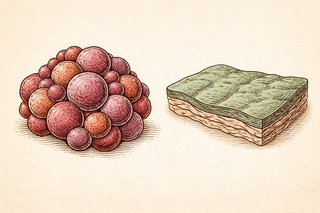
A new study highlighted by Wimalasena and Ewald in Developmental Cell (Wu et al.) is rewriting the textbook on collective cancer invasion, and the lesson plan borrows heavily from an unlikely subject: the physics of spilled coffee.
Spill Theory (But Make It Cancer)
"Active wetting" sounds like something your plumber warns you about, but it's actually a concept borrowed from soft matter physics. When you spill water on a countertop, it either beads up or spreads out depending on surface tension and adhesion. Turns out, clusters of cancer cells do something eerily similar when they encounter tissue surfaces - they can spread across them like a liquid droplet wetting a substrate.
But here's where a healthy dose of skepticism is warranted: these aren't passive droplets obeying simple thermodynamics. Cancer cell collectives are active - they burn energy, reorganize their internal mechanics, and selectively deploy adhesion molecules called integrins to grip whatever surface they're spreading across (Pérez-González et al., 2019). Calling it "wetting" is a useful analogy, not a perfect one. The cells aren't just flowing downhill. They're choosing to flow.
The Integrin Handshake
So what makes these cellular flash mobs stick their landing? Integrins - transmembrane receptors that function as the molecular handshake between a cell and its surroundings. Recent work has shown that during active wetting, cancer spheroids selectively upregulate specific integrin subunits, increasing focal adhesion dynamics to grip extracellular matrix proteins like fibronectin (Lemahieu et al., 2025).
Think of it this way: if the extracellular matrix is the dance floor, integrins are the shoes. And these cancer cells just upgraded from sneakers to tap shoes with grip tape.
The Wu et al. study digs into how these adhesion dynamics aren't random - they're mechanically coordinated across the entire cell collective. The spheroid core softens (confirmed by fancy Brillouin microscopy measurements), compressive forces on the substrate drop, and the whole cluster transitions from a solid-like jammed state to a fluid-like one that can spread outward. It's a phase transition happening inside a tumor, and it's giving the cells permission to move as a unit (Nature Materials, 2026).
Jam Session Gone Wrong
Before you get too impressed, let's pump the brakes. The concept of "cell jamming" - where densely packed epithelial cells lock into place like passengers on a rush-hour subway - has been proposed as inherently tumor-suppressive (Venhuizen & Bhatt, 2025). When cells are jammed, they stay put. Nobody invades anything.
The alarming part of this research is identifying what unjams them. Molecular players like RAB5A have been shown to flip the switch, softening cells internally and rewiring adhesion mechanics so that a previously well-behaved spheroid suddenly starts spreading like butter on warm toast (Lemahieu et al., 2025). Leader cells at the invasion front don't just blaze a trail solo - they drag the collective along through coordinated mechanical signaling (Gomez et al., 2021).
Now, I've seen enough "breakthrough" headlines to know that mechanistic elegance in a dish doesn't always translate to clinical relevance. But the sheer convergence of evidence here - from ovarian cancer models to breast cancer spheroids - suggests we're not looking at an artifact. We're looking at a conserved invasion strategy.
Why Your Oncologist Should Care About Physics
The real punch line of this research isn't that cancer cells spread (we knew that). It's that they spread as a material undergoing a phase transition, and that transition can potentially be targeted. If you can keep the tumor jammed - locked in its solid-like state - you might prevent invasion without killing a single cell. That's a fundamentally different therapeutic philosophy than "poison everything and hope for the best."
Of course, "just prevent unjamming" is about as straightforward as "just prevent earthquakes," but identifying the molecular triggers (integrins, RAB5A, cytoskeletal remodeling) at least gives us a syllabus. Whether we pass the final exam remains to be seen.
References:
-
Wimalasena VK, Ewald AJ. Active wetting and mechanics of collective cancer invasion. Developmental Cell. 2026. DOI: 10.1016/j.devcel.2026.03.007
-
Pérez-González C, et al. Active wetting of epithelial tissues. Nature Physics. 2019;15:79-88. DOI: 10.1038/s41567-019-0646-9. PMID: 31537984
-
Lemahieu G, Moreno-Layseca P, et al. RAB5A Promotes Active Fluid Wetting by Reprogramming Breast Cancer Spheroid Mechanics. Advanced Science. 2025;12(34):e2503569. DOI: 10.1002/advs.202503569. PMID: 40712149
-
Mechanisms of active wetting and fluidification in epithelial cell collectives. Nature Materials. 2026. DOI: 10.1038/s41563-026-02553-2
-
Gomez EW, et al. Decoding leader cells in collective cancer invasion. Nature Reviews Cancer. 2021;21:592-604. DOI: 10.1038/s41568-021-00376-8. PMID: 34239104
-
Venhuizen JH, Bhatt T, et al. Collective cell migration modes in development, tissue repair and cancer. Nature Reviews Molecular Cell Biology. 2025. DOI: 10.1038/s41580-025-00858-9
Disclaimer: The image accompanying this article is for illustrative purposes only and does not depict actual experimental results, data, or biological mechanisms.