You have surgery. The tumor comes out. The margins are clear. The scans look clean. Your oncologist says the reassuring words: "We got it all." But did they? In a meaningful number of cases, microscopic cancer cells remain - too few to see on any scan, lurking in tissue or circulation, waiting to regroup. This is minimal residual disease (MRD), and circulating tumor DNA is becoming the best way to find it before it finds you.
What Is ctDNA, Exactly?
When cells die - normal or cancerous - they release fragments of their DNA into the bloodstream. This cell-free DNA (cfDNA) is mostly from normal cells (white blood cells, in particular). But if a tumor is present, some fraction of that cfDNA carries tumor-specific mutations. That fraction is called circulating tumor DNA (ctDNA).
In advanced cancer, ctDNA can represent 5-10% or more of total cfDNA. Easy to detect. In early-stage cancer or after surgery, it might be 0.01% or less - a few mutant molecules among tens of thousands of normal ones. Detecting that requires technology that is both incredibly sensitive and incredibly specific. Miss the signal and you give false reassurance. Detect noise and you give false alarm.
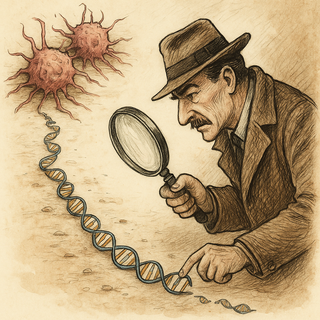
The MRD Problem
After curative-intent treatment (surgery, sometimes with chemo or radiation), the standard approach is surveillance: periodic scans, blood tests for protein tumor markers (like CEA for colorectal cancer or CA-125 for ovarian cancer), and clinical follow-up. If cancer recurs, you catch it when it becomes visible on imaging - by which point it has already re-established itself.
This is reactive medicine. MRD detection via ctDNA aims to be predictive: finding the cancer before it is big enough to image, while it is still small enough to treat effectively.
How ctDNA MRD Testing Works
The most common approach is tumor-informed: sequence the patient's tumor, identify 16-50 unique mutations, and design a personalized assay to hunt for those mutations in post-treatment blood draws. Because you know exactly what you are looking for, sensitivity reaches one mutant molecule per 100,000 normal ones.
Platforms like Signatera (Natera) and FoundationOne Tracker use this approach. Turnaround from tumor sequencing to personalized assay takes a few weeks, but once built, each blood test takes days. Tumor-agnostic approaches also exist - looking for methylation patterns or DNA fragmentation patterns without needing the original tumor sequence.
The Evidence Is Stacking Up
Colorectal cancer has the most mature data. The CIRCULATE and DYNAMIC trials showed that ctDNA status after surgery is a powerful predictor of recurrence. Patients who are ctDNA-positive after surgery have recurrence rates of 70-80%, while ctDNA-negative patients recur at only 10-15%. That is a dramatically better risk stratification than any traditional clinical or pathological feature.
More importantly, ctDNA is being used to guide adjuvant chemotherapy decisions. The DYNAMIC trial demonstrated that a ctDNA-guided approach - giving chemo only to ctDNA-positive patients and sparing ctDNA-negative patients - produced equivalent outcomes to standard management. Translation: you can safely avoid toxic chemotherapy in a large fraction of patients without compromising survival. That is a genuine quality-of-life improvement for thousands of people.
Similar data is emerging in lung cancer, breast cancer, bladder cancer, and esophageal cancer. The consistent finding: post-treatment ctDNA positivity is one of the strongest predictors of recurrence across cancer types.
The Clearance Question
Serial ctDNA monitoring adds another dimension. Patients whose ctDNA clears during neoadjuvant therapy tend to have better outcomes. Patients whose ctDNA rises during surveillance are likely recurring, often months before imaging confirms it.
This lead time between molecular detection and clinical recurrence is where the therapeutic opportunity lives. Detect recurrence six months early, intervene when disease burden is minimal. Whether early intervention on molecular relapse improves survival over waiting for clinical relapse is being tested in ongoing trials, and early signals are encouraging.
What ctDNA Cannot Do (Yet)
It is not a perfect test. False negatives happen, particularly in tumors that shed little ctDNA (some brain tumors, certain renal cell carcinomas). A negative result reduces recurrence risk but does not eliminate it.
The biology is also complex. Not all ctDNA comes from viable cancer - dying cells from treatment release DNA too, creating confusing signals in the immediate post-treatment period. Clonal hematopoiesis (age-related mutations in blood cells) can produce false positives if not properly filtered. Cost remains a barrier, and if you are managing a research project tracking ctDNA across multiple timepoints and cohorts, pdfb2.io helps keep the paper trail manageable when you are juggling dozens of clinical protocol PDFs.
Where This Goes
Within five years, ctDNA MRD testing will likely be standard of care in colorectal and lung cancer, and increasingly adopted in breast, bladder, and other solid tumors. The shift from "treat everyone the same after surgery" to "test and treat based on molecular residual disease" is already happening.
The cancer does leave crumbs. We are finally getting good at finding them.
References
- Tie J, Cohen JD, Lahouel K, et al. Circulating tumor DNA analysis guiding adjuvant therapy in stage II colon cancer. N Engl J Med. 2022;386(24):2261-2272. DOI: 10.1056/NEJMoa2200075 | PMID: 35657320
- Abbosh C, Birkbak NJ, Wilson GA, et al. Phylogenetic ctDNA analysis depicts early-stage lung cancer evolution. Nature. 2017;545(7655):446-451. DOI: 10.1038/nature22364 | PMID: 28445469
Disclaimer: This blog post is for informational and educational purposes only. It is not medical advice. Always consult a qualified healthcare professional for clinical decisions.
Get cancer research delivered to your inbox
The best new studies, explained without the jargon. One email per week.