Somewhere in Beijing, a team of researchers looked at patients with gastric cancer that had basically told immunotherapy to get lost, and thought: "What if we gave them capsules full of someone else's gut bacteria first?" And honestly? It kind of worked.
The Problem With Stubborn Stomachs
Microsatellite-stable (MSS) gastric cancer is the kid in class who refuses to participate. While some cancers respond beautifully to checkpoint inhibitors like anti-PD-1 drugs, MSS gastric cancer just sits there, arms crossed, immune system thoroughly suppressed. These patients had already failed previous rounds of immunotherapy - their tumors were, in clinical terms, refractory. In bar terms, these cancers were not having it.
So Zhang et al. published a phase I trial in the Journal for ImmunoTherapy of Cancer that asked a genuinely wild question: can we remodel a patient's gut microbiome using fecal microbiota transplantation (FMT) and then re-try immunotherapy?
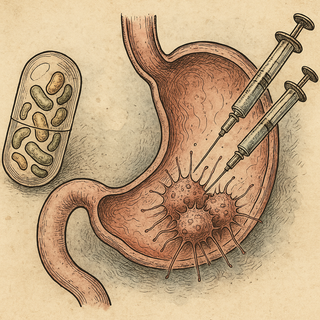
60 Capsules of Courage
The trial design (NCT04130763) was straightforward in that "this is either brilliant or bananas" kind of way. Ten patients with advanced, unresectable GI cancers - eight gastric, two colorectal - who had already struck out on anti-PD-(L)1 therapy were enrolled. Each patient swallowed 60 capsules of donor-derived fecal microbiota upfront. Sixty. Six-zero. That is a commitment to science.
After the initial loading dose, patients received maintenance FMT (a more reasonable 10 capsules per session) combined with nivolumab at 3 mg/kg every two weeks for six cycles. The team tracked everything - stool samples, blood draws, tumor measurements.
The Numbers That Actually Matter
The objective response rate hit 20%, and the disease control rate reached 40%. Now, before you shrug at those numbers, remember: these patients had already failed immunotherapy. Getting any response at all in this population is like getting your cat to come when you call it - technically possible but requires specific conditions.
No serious adverse events showed up either, which in a phase I trial is the real headline. Safety first, as they say, especially when you are literally transplanting someone else's intestinal ecosystem into another person.
The Bacteria Behind the Curtain
What makes this study more than just a quirky headline is the mechanistic data. The clinical responses correlated with successful colonization of donor-derived immunogenic microbes. Translation: the transplanted bacteria actually took up residence and started doing useful things. Patients who responded showed activated immune cell populations in their blood, suggesting the new gut tenants were essentially waking up the immune system.
Even better, the researchers identified specific microbial signatures associated with anti-PD-1 responsiveness and validated them in an independent cohort. That last part matters enormously - it means these findings are not just noise from ten patients. There is a reproducible biological signal here.
Why This Is Not Just a Weird Headline
The gut microbiome's relationship with immunotherapy response has been building for years. Multiple studies have shown that patients with diverse, healthy gut flora respond better to checkpoint inhibitors. Antibiotics before immunotherapy? Bad idea. Certain bacterial species present? Better outcomes.
This trial takes that observational data and turns it into an intervention. Instead of just noting that good bacteria correlate with good outcomes, they actively installed good bacteria and watched what happened. It is the difference between noticing that houses with gardens have happier residents and actually planting a garden.
What Comes Next
Phase I trials exist to answer two questions: is this safe, and is there any signal worth chasing? On both counts, this study delivers. The safety profile was clean, and a 20% response rate in a previously refractory population is more than enough to justify larger trials.
The microbial signature work is particularly promising for future patient selection. If you can predict who will benefit from FMT-enhanced immunotherapy based on their baseline microbiome, you avoid giving 60 capsules to patients who will not respond. And if you are organizing clinical data across studies like these, tools like pdfb2.io can help wrangle the mountain of supplementary PDFs that come with microbiome papers.
The big questions remain: which bacteria matter most, how long does colonization last, and will this scale beyond ten patients? But for now, this is a genuinely interesting proof of concept that your gut bugs might hold the key to making immunotherapy work in cancers where it currently does not.
References
- Zhang Y, Xu X, Wang S, et al. Fecal microbiota transplantation combined with anti-PD-1 therapy in refractory microsatellite-stable gastric cancer: a phase I feasibility and safety study. J Immunother Cancer. 2026;14(3). DOI: 10.1136/jitc-2025-013823 | PMID: 41871875
Disclaimer: This blog post is for informational and educational purposes only. It is not medical advice. Always consult a qualified healthcare professional for clinical decisions. Content based on published research retrieved from PubMed.
Get cancer research delivered to your inbox
The best new studies, explained without the jargon. One email per week.