BULLETIN - University of Virginia, 2026: A research team has just announced the development of the first drug ever designed to target a protein called advillin - and it shrank brain tumors in mice without apparent side effects. The compound crosses the blood-brain barrier. It could potentially be taken as a pill. And glioblastoma, the deadliest brain cancer known to medicine, finally has reason to look over its shoulder.
The Villain in This Story Has Been Hiding in Plain Sight
Every good story needs a villain, and glioblastoma multiforme (GBM) is one of the most ruthless characters in all of oncology. Median survival after diagnosis: 12 to 15 months. Five-year survival rate for patients over 55: about 6%. The standard treatment - surgery, radiation, temozolomide - hasn't fundamentally changed in two decades. GBM doesn't just resist treatment; it laughs at it, recruits your own immune system as a shield, and sets up camp behind the blood-brain barrier where most drugs can't reach.
But here's where the plot thickens: a protein called advillin (gene name: AVIL) has been quietly running the whole operation.
Meet Advillin: The Henchman With a Day Job
Advillin belongs to the gelsolin/villin family - a group of proteins whose normal job is to manage your cell's internal scaffolding (the actin cytoskeleton). In healthy adults, advillin mostly hangs out in sensory neurons, helping with things like nerve repair after injury. In the brain? It's basically undetectable. It has no business being there (Bhatt et al., Nature Communications, 2020; DOI: 10.1038/s41467-020-17279-1).
And yet, in nearly 100% of glioblastoma tumors tested, advillin is cranked up to maximum volume. It's overexpressed in GBM stem cells, in temozolomide-resistant samples, in every molecular subtype. The protein that should be minding its own business in your fingertips is instead helping brain tumors proliferate, migrate, dodge the immune system, and build their own blood supply (Li et al., International Journal of Molecular Sciences, 2021; PMCID: PMC8706274).
The downstream mechanics read like a crime syndicate's org chart: advillin stabilizes a transcription factor called FOXM1, which activates LIN28B, which suppresses tumor-killing microRNAs called let-7. Knock out advillin, and the whole operation collapses.
The Weapon: A First-in-Class Pill That Crosses Enemy Lines
Dr. Hui Li's team at the University of Virginia - the same group that unmasked advillin as an oncogene back in 2020 - spent years doing what the field said couldn't be done: building a small-molecule drug against a cytoskeletal protein. Conventional wisdom held that actin-binding proteins lack the nice little pockets where drugs typically latch on. Conventional wisdom, it turns out, needed to sit down.
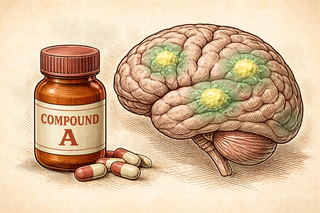
Their compound (referred to as "Compound A" in the literature, because naming drugs is apparently the last step) did something remarkable in preclinical testing: it crossed the blood-brain barrier, shrank tumors in multiple mouse models of GBM - including orthotopic xenografts, patient-derived tumors, and the notoriously stubborn temozolomide-resistant variety - and extended survival. The kicker? It didn't appear to harm healthy cells, including astrocytes (Xie et al., Science Translational Medicine, 2026; DOI: 10.1126/scitranslmed.adt1211).
This selectivity makes biological sense. Mice engineered to lack advillin entirely showed no adverse effects - the protein is apparently expendable in normal tissue. For glioblastoma cells, though, losing advillin is catastrophic. That's about as clean a therapeutic window as cancer research ever gets.
Why This Chapter Matters
GBM has humiliated nearly every promising therapy thrown at it. Immunotherapies that revolutionized melanoma and lung cancer? Mostly failed here. Targeted therapies against well-known pathways like EGFR? Disappointing. The tumor microenvironment is essentially a fortress with a moat.
An oral drug that slips past the blood-brain barrier, targets a protein the tumor depends on but normal tissue doesn't, and works even in drug-resistant cases - that's the kind of plot twist patients have been waiting for. Dr. Li has founded AVIL Therapeutics to push toward clinical trials, though he's careful to note that extensive work remains before human testing begins (Crunkhorn, Nature Reviews Drug Discovery, 2026; DOI: 10.1038/d41573-026-00037-1).
The story isn't over. But for the first time in a long time, the hero might actually have the right weapon.
References
-
Crunkhorn, S. Inhibiting advillin in glioblastoma. Nature Reviews Drug Discovery (2026). DOI: 10.1038/d41573-026-00037-1
-
Xie, Z. et al. A first-in-class small-molecule inhibitor targeting AVIL exhibits safety and antitumor efficacy in preclinical models of glioblastoma. Science Translational Medicine 18, eadt1211 (2026). DOI: 10.1126/scitranslmed.adt1211 | PMID: 41604465
-
Bhatt, D.K. et al. A cytoskeleton regulator AVIL drives tumorigenesis in glioblastoma. Nature Communications 11, 3673 (2020). DOI: 10.1038/s41467-020-17279-1
-
Li, H. et al. Targeting AVIL, a New Cytoskeleton Regulator in Glioblastoma. International Journal of Molecular Sciences 22, 13745 (2021). PMCID: PMC8706274
-
Bhatt, D.K. et al. The discovery of AVIL as a bona fide oncogene in glioblastoma. Molecular & Cellular Oncology 7(5), 1804309 (2020). DOI: 10.1080/23723556.2020.1804309
Disclaimer: The image accompanying this article is for illustrative purposes only and does not depict actual experimental results, data, or biological mechanisms.