KARLSRUHE, GERMANY - A team of researchers has reportedly convinced silicon-based nanoparticles to cosplay as enzymes, perform chemistry in water without any metals, and then - in a move nobody asked for but everyone needed - sneak into brain and skin cancer cells to activate a cancer-killing drug. Authorities say the nanoparticles are "ultrasmall" and "water-stable," which, frankly, is more than most of us can claim on a Monday morning.
Wait, What's a Nanozyme and Why Should You Be Suspicious?
Let's back up. Enzymes are the biological workhorses that make every chemical reaction in your body happen at speeds that would make a Formula 1 pit crew jealous. Nanozymes are synthetic nanoparticles that mimic what enzymes do - except they're built in a lab, they don't need to be kept at body temperature in a cozy cellular environment, and they won't throw a tantrum if you look at them wrong.
The catch? Most nanozymes rely on metals like iron, cerium, or copper to do their thing [1]. Metals that, while great at catalysis, come with baggage - think toxicity concerns, environmental persistence, and the kind of stability issues that make pharmaceutical regulators lose sleep.
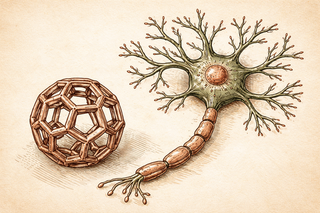
So when Zahid and colleagues at the Karlsruhe Institute of Technology say they've built a metal-free nanozyme out of silsesquioxanes - cage-like silicon-oxygen structures that sound like a Pokémon but are actually well-known in materials science - that's worth raising an eyebrow. The good kind of eyebrow raise [2].
The "Too Good to Be True" Checklist
Here's where my inner skeptic kicks in. The paper, published in Angewandte Chemie (not exactly a journal that publishes your weekend hobby experiments), claims these tiny silicon cages can:
- Catalyze aldol reactions in water - no organic solvents, no metal catalysts, no phase-transfer tricks. Just drop them in water and watch them work like an aldolase enzyme.
- Switch ON and OFF - by triggering supramolecular aggregation and disaggregation with specific chemical signals, you can dial catalytic activity up or down. It's like a dimmer switch for chemistry.
- Get inside living cancer cells - with high biocompatibility and efficient uptake, no less.
- Activate a doxorubicin prodrug inside glioblastoma and metastatic melanoma cells, selectively killing them while leaving healthy cells relatively unbothered.
I've seen plenty of "revolutionary nanoplatforms" that quietly vanish after their publication party. But this one has a few things going for it that make me cautiously optimistic.
Why This Might Actually Matter
The prodrug angle is where things get genuinely clever. Doxorubicin is one of oncology's heavy hitters - it's been battling cancer since the 1960s - but it's also notorious for side effects, particularly heart damage [3]. The prodrug strategy is basically giving cancer cells a gift-wrapped bomb: the drug stays inactive until something at the tumor site flips the switch.
Traditionally, that "something" is a metal-containing catalyst or an endogenous enzyme. Zahid's team uses a retro-aldol reaction - running the aldol reaction in reverse - to cleave the prodrug and release active doxorubicin right where it's needed. No metals required. The nanozyme does the work using plain old amine-based organocatalysis, the same kind of chemistry that won Benjamin List and David MacMillan the 2021 Nobel Prize [4].
The stimuli-responsive bit deserves attention too. Most nanozymes are permanently "on," which is about as useful as a smoke alarm that can't be silenced. These silsesquioxane nanozymes can be toggled between active and inactive states through reversible aggregation - giving researchers a level of control that's rare in this field [5].
The Fine Print
Before we start planning the victory parade: this is early-stage work. Cell culture experiments in glioblastoma and melanoma lines are encouraging, but cells in a dish are notoriously easy to impress. The real gauntlet - animal models, pharmacokinetics, blood-brain barrier penetration for glioblastoma, long-term toxicity - hasn't been run yet. And the jump from "works beautifully in a well plate" to "works in an actual human" has humbled many a promising nanoparticle before.
That said, the simplicity of the system is its strongest selling point. One-step sol-gel synthesis. No expensive metals. Water-compatible. Scalable. If those claims hold up under further scrutiny, this platform could genuinely lower the barrier for nanozyme-based therapies.
The nanozyme field has exploded in recent years, with over 1,200 types reported and even a few inching toward clinical trials [6]. But most remain metal-dependent. A metal-free, organocatalytic alternative that plays nicely with biology? That's not just another entry in the nanozyme catalog - it's a different chapter entirely.
I'll keep my skepticism warm for the in vivo data. But for now? This one earned its spot in Angewandte Chemie.
References
-
Hou, G. et al. "Nanozyme-Based Strategies in Cancer Immunotherapy." Aging and Disease (2025). DOI: 10.14336/AD.2025.0011. PMCID: PMC12727090.
-
Zahid, R. et al. "Stimuli-Responsive Silsesquioxane Nanozymes for Organocatalysis in Water and Prodrug Activation in Cells." Angewandte Chemie Int. Ed. (2026). DOI: 10.1002/anie.8446184. PMID: 41937695.
-
Wu, Y. et al. "Nanozyme-Activating Prodrug Therapies: A Review." Chinese Chemical Letters 35(2), 109096 (2024). DOI: 10.1016/j.cclet.2023.109096.
-
Zhong, X. et al. "Polyhedral Oligomeric Silsesquioxane-Based Nanoparticles for Efficient Chemotherapy of Glioblastoma." Small 19(18), e2207248 (2023). DOI: 10.1002/smll.202207248. PMID: 36725316.
-
Gupta, A. et al. "Light-Triggered Bioorthogonal Nanozyme Hydrogels for Prodrug Activation." ACS Applied Materials & Interfaces 17(18), 26361-26370 (2025). DOI: 10.1021/acsami.5c02074. PMID: 40275431.
-
"Can Nanozymes Achieve More Than Enzymes?" Nature Reviews Materials (2026). DOI: 10.1038/s41578-026-00898-3.
Disclaimer: The image accompanying this article is for illustrative purposes only and does not depict actual experimental results, data, or biological mechanisms.