For years, oncologists operated under a tidy assumption: HER2-positive breast cancer and hormone receptor-positive breast cancer were essentially separate problems requiring separate playbooks. Target HER2 with trastuzumab and pertuzumab, treat HR+ disease with endocrine therapy and CDK4/6 inhibitors, and never the twain shall meet. Turns out, that neat little division was leaving about 10% of breast cancer patients - those with both HER2+ and HR+ tumors - without the full arsenal they deserved.
The "Pick One Lane" Problem
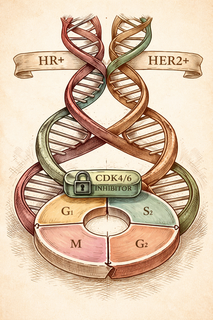
Here's where it gets interesting, and a little embarrassing for the field. CDK4/6 inhibitors like palbociclib, ribociclib, and abemaciclib have been absolute rockstars in HR+/HER2-negative breast cancer for nearly a decade. These drugs jam a wrench into the cell cycle machinery right at the G1-to-S phase checkpoint - think of it as slamming the brakes on a cancer cell that's trying to run a red light into DNA replication. They've reshaped treatment guidelines and extended lives.
But patients whose tumors were both HR+ and HER2+? They mostly got shunted into HER2-directed treatment protocols. The hormone receptor positivity was acknowledged with a polite nod and maybe some endocrine therapy on the side, but CDK4/6 inhibitors were rarely part of the conversation. Nobody had run a big enough trial to prove they'd help. Until now.
PATINA Changes the Math
The phase 3 PATINA trial, published in the New England Journal of Medicine in January 2026, enrolled 518 patients across 109 sites in the U.S., Europe, New Zealand, and Australia (Metzger et al., NEJM 2026). The setup was straightforward: after first-line induction with anti-HER2 therapy, patients were randomized to maintenance with palbociclib plus anti-HER2 and endocrine therapy, or anti-HER2 and endocrine therapy alone.
The results? At a median follow-up of 53.5 months, median progression-free survival hit 44.3 months in the palbociclib group versus 29.1 months in the control arm (HR 0.75; P = 0.02). That's more than 15 extra months before disease progression. In oncology, where we celebrate improvements measured in weeks, 15 months is not a rounding error.
As highlighted by David Killock in Nature Reviews Clinical Oncology (DOI: 10.1038/s41571-026-01133-2), PATINA is the first large randomized trial to demonstrate a clear clinical benefit for CDK4/6 inhibition in this double-positive population. That's a sentence the field has been waiting to write.
Not the First Hint, But the Loudest
PATINA didn't emerge from nowhere. The earlier monarcHER trial had already shown that abemaciclib combined with trastuzumab and fulvestrant could improve progression-free survival in heavily pretreated HR+/HER2+ patients - 8.3 months versus 5.7 months for trastuzumab plus chemo (Tolaney et al., JCO 2020). Respectable, but in a late-line setting with a smaller sample, the skeptics (myself included) could dismiss it as suggestive rather than definitive. A 2026 meta-analysis pooling data across CDK4/6 inhibitor trials in HER2+ disease found clinical benefit rates around 69%, with objective response rates of 33% (CDK4/6i meta-analysis, Targeted Oncology 2025).
PATINA, though, is the phase 3 data that's hard to argue with. First-line setting, large enrollment, clean design, statistically significant result.
The Fine Print (Because There's Always Fine Print)
Before anyone starts engraving palbociclib's name on a trophy, a few caveats. Overall survival data from PATINA aren't mature yet - PFS is encouraging, but OS is the number that truly counts. The main toxicity trade-off was neutropenia, which is palbociclib's well-known calling card and manageable but not trivial. And molecular subtyping through PAM50 analysis suggests that patients with luminal-type tumors may benefit more than others, meaning this isn't necessarily a one-size-fits-all upgrade (Gianni et al., Cancers 2026).
There's also the question of sequencing. With trastuzumab deruxtecan reshaping second-line HER2+ treatment and newer agents entering the pipeline, figuring out when to deploy CDK4/6 inhibitors in the treatment timeline is going to keep tumor boards busy for a while.
Why This Actually Matters
About 10% of breast cancers fall into the HR+/HER2+ category. These patients have historically occupied an awkward middle ground - biologically distinct from pure HER2+ or pure HR+ disease, but often treated with borrowed protocols from one camp or the other. PATINA provides evidence that acknowledging both drivers simultaneously, rather than picking a favorite, yields better outcomes.
It's the kind of finding that seems obvious in hindsight: if a tumor is being fueled by two pathways, maybe block both. But "obvious in hindsight" and "proven in a phase 3 trial" are very different things in medicine, and only the latter changes practice.
References:
-
Metzger O, et al. Palbociclib for Hormone-Receptor-Positive, HER2-Positive Advanced Breast Cancer. N Engl J Med. 2026. DOI: 10.1056/NEJMoa2511218
-
Killock D. CDK4/6 inhibition provides additional efficacy in HER2+, HR+ breast cancer. Nat Rev Clin Oncol. 2026. DOI: 10.1038/s41571-026-01133-2. PMID: 41703320.
-
Tolaney SM, et al. Abemaciclib plus trastuzumab with or without fulvestrant versus trastuzumab plus standard-of-care chemotherapy in HR+, HER2+ advanced breast cancer (monarcHER). J Clin Oncol. 2020. DOI: 10.1200/JCO.19.02514
-
CDK4/6 Inhibition in the Management of Metastatic HR+/HER2+ Breast Cancer: Systematic Review and Meta-analysis. Targeted Oncology. 2025. DOI: 10.1007/s11523-025-01195-9
-
Gianni L, et al. Cyclin-Dependent 4/6 Kinase Inhibitors for Treatment of HER2-Positive Breast Cancer: 2026 Update. Cancers. 2026;18(3):533. DOI: 10.3390/cancers18030533
Disclaimer: The image accompanying this article is for illustrative purposes only and does not depict actual experimental results, data, or biological mechanisms.