Meet CDK4/6 - a pair of molecular enforcers that tell your cells when it's time to divide. In healthy tissue, they're obedient middle managers, only green-lighting cell division when they get the right signals. But in cancer, they've gone full rogue employee: ignoring every memo from headquarters, rubber-stamping division orders around the clock, and essentially running an unauthorized cell-copying operation out of the back office.
The Brake Pads That Became a Drug Target
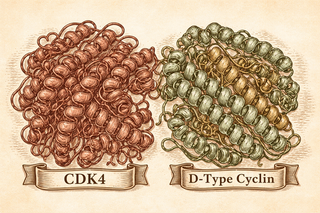
Here's how it works in the non-broken version of your body: CDK4 and CDK6 team up with proteins called D-type cyclins to phosphorylate the retinoblastoma protein (Rb). Think of Rb as the bouncer at the G1/S checkpoint nightclub. When CDK4/6 slaps enough phosphate groups onto Rb, the bouncer steps aside, the cell enters S phase, and DNA replication begins. Orderly. Regulated. Boring in the best possible way.
In many cancers - particularly hormone receptor-positive (HR+) breast cancer - this system gets hijacked. The CDK4/6-cyclin D complex goes into overdrive, phosphorylating Rb whether or not anyone asked it to, and suddenly your cells are dividing like they're trying to set a world record (Safaroghli-Azar et al., 2026).
Three Drugs Walk Into a Clinic
The first generation of CDK4/6 inhibitors - palbociclib, ribociclib, and abemaciclib - landed like a thunderclap in breast cancer treatment. Combined with endocrine therapy for HR+/HER2- metastatic breast cancer, they genuinely changed outcomes. Progression-free survival improved dramatically. Oncologists were, dare I say, cautiously optimistic (which is their version of doing backflips) (Goel et al., 2018).
But here's where the story gets less triumphant: these drugs hit both CDK4 and CDK6 simultaneously. And CDK6, it turns out, has a day job that nobody appreciated enough. CDK6 is critically important for hematopoiesis - the process by which your bone marrow makes blood cells. Knock it out alongside CDK4, and you get neutropenia: a dangerous drop in white blood cells that affects up to 80% of patients on some of these drugs (Belz et al., 2021). It's the pharmaceutical equivalent of trying to evict one noisy tenant and accidentally shutting off water to the entire building.
Beyond Breast Cancer: The Expansion That... Didn't
The other uncomfortable truth? Despite strong biological rationale, CDK4/6 inhibitors haven't conquered much territory beyond HR+ breast cancer. Lung cancer, glioblastoma, melanoma - researchers brought these drugs to the fight with reasonable optimism, and the results have been, let's say, humbling. Resistance mechanisms pop up like weeds, tumors find workarounds through CDK2 pathway activation or Rb loss, and the therapeutic window stays frustratingly narrow (Schiavon et al., 2022).
Enter the New Kid: Selective CDK4 Inhibitors
This is where the plot takes a genuinely interesting turn. Scientists noticed something: HR+ breast cancer cells are heavily dependent on CDK4 but barely care about CDK6. Meanwhile, bone marrow cells rely primarily on CDK6, with CDK4 being largely dispensable. The implication is almost too elegant - if you could inhibit only CDK4 and leave CDK6 alone, you might kill the tumor while sparing the blood cell factory.
Pfizer's atirmociclib is the furthest along in this new wave. In the Phase 2 FOURLIGHT-1 trial, it showed a 40% reduction in the risk of disease progression or death when combined with fulvestrant in patients who had already progressed on standard CDK4/6 inhibitors. Only 6.4% discontinued due to adverse events. For a second-line therapy in a notoriously difficult population, those are numbers worth paying attention to.
Why This Actually Matters
The significance here isn't just incremental drug development. It's a proof of concept that understanding the specific biology of each kinase - rather than carpet-bombing the whole family - can produce meaningfully better therapeutics. CDK4 selectivity could potentially unlock activity in tumor types where dual inhibitors failed, precisely because you can push the dose higher without cratering someone's immune system.
The next few years will tell us whether selective CDK4 inhibition is a genuine paradigm shift or a modest refinement. But the logic is sound, the early data is encouraging, and for once, the phrase "next-generation" might actually mean something beyond marketing.
References:
-
Safaroghli-Azar A, Mekonnen LB, Lenjisa J, Milne R, Wang S. Cell-cycle targeted cancer therapy: clinical advances, biological gaps, and the emergence of selective CDK4 inhibitors. J Hematol Oncol. 2026. DOI: 10.1186/s13045-026-01794-7
-
Goel S, Bergholz JS, Zhao JJ. Targeting CDK4 and CDK6 in cancer. Nat Rev Cancer. 2022;22:356-372. DOI: 10.1038/s41568-022-00456-3
-
Goel S, DeCristo MJ, McAllister SS, Zhao JJ. CDK4/6 inhibition in cancer: beyond cell cycle arrest. Trends Cell Biol. 2018;28(11):911-925. PMCID: PMC6689321
-
Belz K, Schonung M, Clancon L, et al. Inducible deletion of CDK4 and CDK6 - deciphering CDK4/6 inhibitor effects in the hematopoietic system. Haematologica. 2021;106(10):2614-2625. PMCID: PMC8485667
-
Pfizer Inc. Pfizer Announces Positive Topline Phase 2 Results for Next-Generation CDK4 Inhibitor, Atirmociclib. Press Release.
Disclaimer: The image accompanying this article is for illustrative purposes only and does not depict actual experimental results, data, or biological mechanisms.