We were so proud of the Warburg effect - this tidy narrative that tumor cells ditch oxidative phosphorylation for quick-and-dirty glycolysis like college students living on ramen instead of cooking a proper meal. Textbooks printed it. Professors taught it. And while it wasn't exactly wrong, it was about as complete as saying "birds fly" while ignoring penguins.
Turns out, many tumors are quietly running their mitochondrial engines at full throttle. And that opens the door to a wild new approach: what if we could cut the power?
Bacteria: Not Just Making You Sick Since Forever
Here's where it gets weird. A team led by researchers at the University of Illinois published a new study in Signal Transduction and Targeted Therapy showing that a peptide borrowed from photosynthetic bacteria can waltz into cancer cells, park itself at the mitochondria, and shut down ATP production like a bouncer pulling the plug on a house party (Naffouje et al., 2026).
The backstory: the same group previously discovered that azurin, a copper-containing protein from Pseudomonas aeruginosa (yes, the same bug that haunts hospital wards), has a strange moonlighting gig as a cancer fighter. They even derived a peptide called p28 that went through Phase I clinical trials in both adults and kids with solid tumors, showing safety and early signs of activity (Jia et al., 2013; Mehta et al., 2020). The FDA gave p28 orphan drug designation for glioma. Not bad for something that came from an infection-causing bacterium.
From Swamp Bacteria to Cancer's Off Switch
Now, the team went digging through the tumor microbiome - because yes, tumors have their own little bacterial ecosystems, which is a sentence that would have gotten you strange looks at an oncology conference fifteen years ago. They found photosynthetic bacteria from the phylum Chloroflexota hanging out inside tumors, carrying genes for a cousin protein called auracyanin.
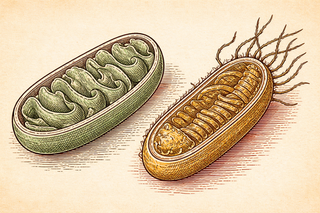
The clever bit: chloroplasts in plants evolved from ancient bacterial endosymbionts, and they share key proteins with mitochondria - both descended from the same evolutionary playbook for making ATP. The researchers reasoned that if auracyanin works with the bacterial/chloroplast energy machinery, maybe a peptide from it could mess with the mitochondrial version too.
They designed a cell-penetrating peptide called aurB from auracyanin B. And it did exactly what they hoped, with a precision that should make pharmaceutical chemists jealous.
What aurB Actually Does (The Good Stuff)
In prostate cancer cells, aurB:
- Snuck inside and headed straight for the mitochondria - no GPS required
- Blocked ATP synthase - the molecular turbine that spins to produce ATP - essentially cutting the power supply
- Significantly inhibited tumor growth in animal models
But here's where the skeptic in me starts paying real attention: when they combined aurB with radiation therapy in a bone metastasis model (tibial, specifically), tumor growth dropped significantly more than either treatment alone. Even more striking, the number of lung metastases fell in aurB-treated animals. That's not just slowing the car down; that's taking out the engine AND the spare tire.
RNA profiling revealed the mechanism behind the combination punch: aurB's energy blockade ramped up HIF-1α-related pathways, essentially making radiation therapy more effective through multiple signaling cascades. When you starve the cell's power plant while simultaneously hitting it with radiation, it doesn't have the energy reserves to mount its usual repair response.
Should You Be Excited? (My Honest Take)
Look, I've seen enough "promising peptides" to fill a cemetery of abandoned drug candidates. But a few things make this one worth watching.
First, the evolutionary logic is genuinely elegant. Exploiting the shared ancestry between chloroplasts and mitochondria to design targeted therapeutics isn't just clever - it's the kind of approach that opens an entirely new class of potential drugs. The researchers call them "electron transfer protein-derived peptides," and there could be a whole family waiting to be explored.
Second, the combination with radiation is clinically meaningful. Bone metastases from prostate cancer are a major source of suffering, and any approach that makes radiation work better in that setting deserves serious attention (Pan et al., 2021; Gao et al., 2017).
Third, we now understand that many cancers depend heavily on mitochondrial oxidative phosphorylation - melanoma, triple-negative breast cancer, certain prostate cancers - which means the target isn't niche (Grasso et al., 2025). The old "cancer only does glycolysis" story was always too simple.
The caveats are real: this is preclinical. Animal models of cancer have humbled every generation of researchers. And peptide drugs face their own challenges with stability, delivery, and manufacturing. But as a proof of concept that the tumor microbiome can inspire genuinely novel therapeutic mechanisms? That's not hype. That's a new door.
References
-
Naffouje SA, Tran DB, Rademacher DJ, et al. Suppression of mitochondrial energy production by a photosynthetic bacterial cupredoxin peptide inhibits tumor growth. Signal Transduct Target Ther. 2026. DOI: 10.1038/s41392-026-02703-7. PMID: 41946681
-
Jia L, Gorman GS, Coward LU, et al. A first-in-class, first-in-human, phase I trial of p28, a non-HDM2-mediated peptide inhibitor of p53 ubiquitination in patients with advanced solid tumours. Br J Cancer. 2013;108(5):1061-1070. DOI: 10.1038/bjc.2013.74. PMCID: PMC3619078
-
Mehta RR, Yamada T, Taylor BN, et al. Anticancer Actions of Azurin and Its Derived Peptide p28. Protein J. 2020;39(5):487-511. DOI: 10.1007/s10930-020-09891-3. PMID: 32180097
-
Gao M, Cheng K, Bhargava R. Bacterial cupredoxin azurin hijacks cellular signaling networks: Protein-protein interactions and cancer therapy. Protein Sci. 2017;26(12):2334-2341. DOI: 10.1002/pro.3310. PMCID: PMC5699490
-
Grasso D, Caruana L, et al. Mitochondrial metabolism and cancer therapeutic innovation. Signal Transduct Target Ther. 2025. DOI: 10.1038/s41392-025-02311-x
-
Pan Y, Cao M, You D, et al. Defueling the cancer: ATP synthase as an emerging target in cancer therapy. Mol Ther Oncolytics. 2021;23:82-95. DOI: 10.1016/j.mset.2021.08.006. PMCID: PMC8517097
Disclaimer: The image accompanying this article is for illustrative purposes only and does not depict actual experimental results, data, or biological mechanisms.