Twenty-four protein subunits. One hollow cage. That's all ferritin is - a tiny, self-assembling sphere your body already makes by the billions to store iron. Now multiply that simplicity by the sheer stubbornness of leukemia, where over 50% of patients relapse after CAR T cell therapy, and you've got the equation that a team of Chinese researchers just cracked wide open in Cell (Li et al., 2026).
CAR T Cells: Amazing, But With a Homework Problem
CAR T cell therapy is one of the most electrifying advances in cancer treatment. Doctors extract a patient's T cells, genetically engineer them to recognize cancer, and send them back in like a SWAT team with a photo of the suspect. The problem? Leukemia cells are sneaky little shapeshifters. They can downregulate or straight-up ditch the surface antigens that CAR T cells are trained to spot - a phenomenon called antigen modulation. It's like a fugitive shaving their head and getting new glasses. Between 16% and 68% of B-ALL relapses after CAR T therapy involve this kind of antigen escape (Maude et al., 2018; Orlando et al., 2018), and once it happens, treatment options get desperately thin.
Enter FACE: The Molecular Wingman
Here's where it gets absolutely wild. The research team noticed something hiding in plain sight during clinical work: both leukemia cells AND CAR T cells crank out high levels of CD71, the transferrin receptor that normally grabs ferritin to import iron. Both sides of the battlefield are wearing the same jersey.
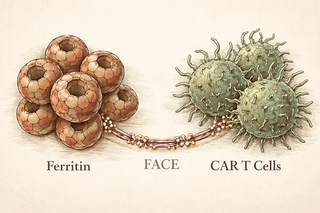
So they engineered a Ferritin Aggregation Cell Engager - FACE - by controlling solvent conditions to make ferritin proteins self-assemble into ordered aggregates. Picture a cluster of tiny hollow soccer balls made of protein, each one naturally attracted to CD71. During CAR T cell manufacturing, FACE gets added to the culture like a supplement. It latches onto CD71 on the CAR T cells. After infusion, those same FACE clusters also grab CD71 on leukemia cells. The result? A molecular bridge that physically pulls CAR T cells and their targets together, forcing a face-to-face encounter (the name is absolutely intentional and I am here for it).
The Numbers Are Bananas
This isn't a marginal improvement. In patient-derived xenograft mouse models with normal antigen expression, FACE-CAR T cells achieved the same therapeutic effect as conventional CAR T cells at one-fifth the dose. Lower dose means less cytokine release syndrome - that dangerous inflammatory storm that's one of CAR T therapy's scariest side effects.
But here's where jaws hit the floor: when antigen levels dropped below 10% of normal - conditions where regular CAR T cells basically throw up their hands - FACE-CAR T cells still eliminated leukemia cells and achieved 100% survival in the mouse models.
Wait, It Also Carries Drugs?
Because ferritin is literally a hollow cage, the team loaded chemotherapy drugs inside it, creating FACED (the D is for drug, and yes, they're having fun with this). These drug-loaded versions treated models with initial leukemia burdens up to 40% and - buckle up - killed antigen-negative leukemia cells. The ones that escaped by ditching their surface markers entirely. The cells that are usually the whole reason relapse happens. Gone.
Why This Is a Big, Beautiful Deal
Most strategies for beating antigen escape involve complex genetic re-engineering: dual-targeting CARs, tandem receptors, logic-gated circuits (Loff et al., 2020). FACE sidesteps all of that. It's made from an endogenous human protein and FDA-approved polymer derivatives. It requires zero genetic modification beyond the standard CAR construct. You literally add it during manufacturing like you're seasoning soup. That means it could theoretically work with ANY existing CAR T product against ANY leukemia subtype, since CD71 overexpression is a shared feature across diverse leukemias (Daniels et al., 2006).
The platform represents what the authors call "avidity engineering" - rather than redesigning the lock or the key, they're just making sure the key gets jammed into the lock with more force and frequency. It's elegant, it's scalable, and it's sitting in one of the most prestigious journals on the planet.
What Comes Next
Mouse models aren't humans, and the road from PDX data to bedside is long and full of regulatory speed bumps. But the simplicity of the FACE platform - biocompatible materials, easy manufacturing, no new genetic modifications - makes the translational path unusually smooth. For the millions living with refractory leukemias who've run out of options after relapse, this kind of creative, outside-the-box thinking is exactly what the field needs.
Twenty-four subunits. One cage. Maybe one answer.
References
-
Li, F., Hu, Y., Wang, Y., et al. (2026). Ferritin aggregation cell engager for CAR T avidity engineering against refractory leukemias. Cell. DOI: 10.1016/j.cell.2026.02.005. PMID: 41806835.
-
Maude, S.L., Laetsch, T.W., Buechner, J., et al. (2018). Tisagenlecleucel in children and young adults with B-cell lymphoblastic leukemia. New England Journal of Medicine, 378(5), 439-448. DOI: 10.1056/NEJMoa1709866. PMID: 29385370.
-
Orlando, E.J., Han, X., Tribouley, C., et al. (2018). Genetic mechanisms of target antigen loss in CAR19 therapy of acute lymphoblastic leukemia. Nature Medicine, 24, 1504-1506. DOI: 10.1038/s41591-018-0146-z. PMID: 30275569.
-
Loff, S., Dietrich, J., Meyer, J.E., et al. (2020). Rapidly switchable universal CAR-T cells for treatment of CD123-positive leukemia. Cancer Gene Therapy, 27, 699-711. DOI: 10.1038/s41417-020-0184-z.
-
Daniels, T.R., Delgado, T., Rodriguez, J.A., et al. (2006). The transferrin receptor and the targeted delivery of therapeutic agents against cancer. British Journal of Haematology, 137(2), 132-146. DOI: 10.1111/j.1365-2141.2006.06070.x. PMID: 16594505.
Disclaimer: The image accompanying this article is for illustrative purposes only and does not depict actual experimental results, data, or biological mechanisms.