Are you tired of your tissue barriers failing to keep out invasive cancer cells? Do your mesothelial linings crumble under the slightest pressure? Well, have we got the study for you! Except, plot twist - the barrier itself is partly to blame. A team of researchers just showed that when ovarian cancer cells invade surrounding tissue, they don't just push their way through like tiny battering rams. They basically trick the barrier into tearing itself apart.
The Old Story: Brute Force
For years, the prevailing model of collective cell invasion went something like this: cancer cells "unjam" - basically, they go from a solid, stuck-together state to a fluid, sloshy one - and then bulldoze through whatever's in their way. Extracellular matrix? Tissue barriers? Just obstacles to be shoved aside. In other words, scientists pictured invasion as a one-sided affair: aggressive cells doing all the work, passive barriers sitting there taking it.
The jamming-to-unjamming framework has been hugely influential. Research has shown that cancer cells can shift between solid-like and liquid-like behavior depending on adhesion molecules and the surrounding matrix (Oswald et al., 2017; Ilina et al., 2020). It's a genuinely elegant idea. But Wu and colleagues looked at it and said, basically, "What if the wall is helping?"
The New Story: It Takes Two to Rupture
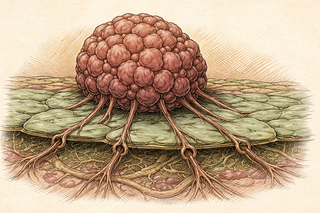
The team, led by Selwin Wu and Boon Chuan Low, used ovarian adenocarcinoma spheroids - little balls of cancer cells - and placed them on mesothelium, the thin tissue lining that covers organs in the abdominal cavity. The mesothelium is basically your organs' cling wrap. It's slippery, protective, and normally does a great job keeping things where they belong. In ovarian cancer, tumor spheroids floating in peritoneal fluid land on this lining and need to punch through it to metastasize.
Here's where it gets wild. The researchers zoomed in across multiple scales - from individual molecules to groups of cells - and found something nobody expected. The invading "leader cells" at the front of the cancer cluster don't just push. They reach out and physically link to the barrier cells using integrins, which are basically molecular grappling hooks that cells use to grab onto things.
Once those integrin connections snap into place between the cancer cell and the barrier cell, something remarkable happens: the barrier cell starts constricting at its top surface. In other words, the barrier cell squeezes itself. This apical constriction - think of it like someone sucking in their stomach, but at the cellular level - shrinks the junctions between neighboring barrier cells. Keep squeezing, and eventually those cell-cell contacts snap. The barrier literally tears open.
Basically, the Security Guard Opens the Door
To translate this into human terms: imagine a bouncer at a club. The old model says rowdy partygoers (cancer cells) overwhelm the bouncer by sheer force. The new model says the partygoers shake the bouncer's hand in a very specific way that makes the bouncer involuntarily step aside and open the velvet rope. The bouncer is mechanically active in the process - not a passive victim.
This is a tensile fracture, the same kind of failure you get when you pull a material apart rather than crushing it. The cancer cells aren't compressing their way through. They're creating tension that rips the barrier from within. And critically, this happens without the cancer cells needing to undergo a jamming transition at all. The whole unjamming paradigm? Not required here.
Why This Matters Beyond the Lab
Ovarian cancer is notoriously lethal partly because of how efficiently it spreads through the peritoneal cavity. Understanding that the tissue barrier is an active participant in its own breach - not just a passive speed bump - opens up entirely new therapeutic angles. If you could block those integrin connections between leader cells and barrier cells, or prevent the apical constriction response, you might stop invasion at the mechanical level, rather than only targeting the cancer cells themselves.
Recent work has also shown that mesothelial cells aren't innocent bystanders in other ways, either - they secrete fibronectin that helps cancer cells stick and invade, and can even get incorporated into cancer spheroids (Kenny et al., 2014). The picture emerging is one where metastasis is a collaborative catastrophe, not a solo act.
The Bottom Line
Wu et al. didn't just add a footnote to cancer biology. They flipped the script on how we think about tissue invasion. The barrier isn't sitting there waiting to be overrun. It's being recruited into its own destruction through a precise mechanical conversation between invading cells and the tissue they're invading. In other words, it's not a siege. It's a con job.
References
-
Wu SK, Sun F, Ho CZ, et al. Multiscale mechanisms driving tissue rupture by invading cells. Developmental Cell. 2026. DOI: 10.1016/j.devcel.2026.01.016. PMID: 41785856
-
Oswald L, Grosser S, Smith DM, Käs JA. Jamming transitions in cancer. Journal of Physics D: Applied Physics. 2017;50(48):483001. DOI: 10.1088/1361-6463/aa8e83. PMCID: PMC5884432
-
Ilina O, Gritsenko PG, Syber S, et al. Cell-cell adhesion and 3D matrix confinement determine jamming transitions in breast cancer invasion. Nature Cell Biology. 2020;22(9):1103-1115. DOI: 10.1038/s41556-020-0552-6
-
Kenny HA, Chiang CY, White EA, et al. Mesothelial cells promote early ovarian cancer metastasis through fibronectin secretion. Journal of Clinical Investigation. 2014;124(10):4614-4628. DOI: 10.1172/JCI74778. PMCID: PMC4191047
-
Davidowitz RA, Selfors LM, Iwanicki MP, et al. Therapeutic targeting of collective invasion in ovarian cancer. International Journal of Molecular Sciences. 2019;20(6):1466. DOI: 10.3390/ijms20061466. PMCID: PMC6471817
Disclaimer: The image accompanying this article is for illustrative purposes only and does not depict actual experimental results, data, or biological mechanisms.