Every building has a security team - guards posted at doors, patrolling hallways, checking credentials. Your immune system runs a similar operation, with neutrophils acting as the first responders on site whenever something goes wrong. But here's the architectural nightmare nobody planned for: when neutrophils show up to a tumor, the tumor hands them a fake blueprint and puts them to work for the wrong side.
The Rogue Contractors
Neutrophils are the most abundant white blood cells in your body, and they're usually great at their jobs. Infection? They're there. Tissue damage? First on the scene. Radiotherapy blasting a tumor? Neutrophils flood the area like an eager demolition crew.
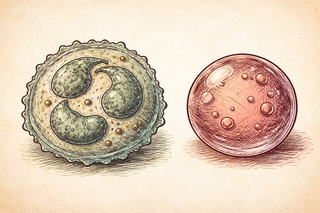
The problem? Tumors are master manipulators. Once neutrophils arrive at the tumor site, the local environment - think of it as a very corrupt neighborhood HOA - convinces them to switch allegiance. These once-heroic cells get "polarized" toward what scientists call the N2 phenotype: pro-tumor, immunosuppressive, and basically running interference for cancer. They even start laying down sticky DNA webs called neutrophil extracellular traps (NETs), which - and this is the really annoying part - help cancer cells spread to new locations (Albrengues et al., Science, 2018; Yang et al., Theranostics, 2025).
So radiotherapy calls in reinforcements, and those reinforcements immediately defect? Yeah. That's been a bit of an issue.
Flipping the Script with Tiny Gel Balls
A team led by Xulu Yang and colleagues decided to stop complaining about the problem and actually fix the wiring. Their solution, published in Advanced Materials, involves injectable hydrogel microspheres (HMPs) loaded with two clever ingredients: lipopolysaccharide (a TLR4 agonist that basically screams "DANGER!" to immune cells) and GSK484 (a PAD4 inhibitor that blocks NET formation) (Yang et al., Adv. Mater., 2026).
The logic is beautifully straightforward. Step one: use LPS to flip neutrophils from their traitorous N2 state back to the tumor-fighting N1 phenotype. Step two: use GSK484 to shut down the DNA-web factory so those reprogrammed neutrophils can't accidentally help cancer metastasize. Step three: extend neutrophil lifespan beyond 72 hours, because normally these cells have the longevity of a mayfly at a bonfire.
The resulting combo - called L/G@HMPs, which sounds like a rejected Wi-Fi password - gets injected right at the tumor site alongside radiotherapy.
What Actually Happened in the Mice
Right, the results. In murine tumor models, combining radiotherapy with L/G@HMPs triggered what you'd call a full immunological uprising. N1-polarized neutrophils flooded the tumor. CD8+ T cells - the special forces of adaptive immunity - showed up in force. The innate and adaptive arms of the immune system were finally working together instead of tripping over each other.
The tumors didn't just slow down. The combination therapy produced robust anti-tumor responses that neither radiotherapy alone nor the microspheres alone could match. It's the difference between sending in one shift of security guards versus coordinating the entire building's defense system.
Why Should You Care About Neutrophil Politics?
Here's the bigger picture. For years, cancer immunotherapy has been obsessed with T cells - checkpoint inhibitors, CAR-T therapy, the whole highlight reel. Neutrophils were kind of the overlooked background characters. But recent research has revealed that these cells are wildly influential in determining whether immunotherapy works or fails (Wang et al., Signal Transduct. Target. Ther., 2025; Yao et al., Cancer Commun., 2025).
The N1/N2 polarization framework shows that neutrophils aren't just passive bystanders - they're active decision-makers in the tumor microenvironment. TGF-beta pushes them toward the dark side (N2), while interferons and TLR agonists can yank them back (Jaillon et al., Nat. Rev. Cancer, 2020). The idea that you can pharmacologically reprogram these cells after they've already been recruited to the tumor is genuinely exciting.
The Road Ahead
This is still mouse work - nobody's injecting gel microspheres into human tumors yet. But the approach is elegant because it works with the body's existing response to radiotherapy rather than against it. Neutrophils are already rushing to the tumor post-radiation. Why fight that? Just make sure they show up as allies, not double agents.
If this translates to humans, it could transform how we think about combination therapy: not just adding more drugs, but reprogramming the immune cells that are already on scene (Zhang et al., Oncol. Rep., 2025).
References:
- Yang X, Lang S, Liu T, et al. Reprogramming Tumor-Associated Neutrophils to Enhance Radio-Immunotherapy. Adv. Mater. 2026. DOI: 10.1002/adma.73042. PMID: 41958445
- Wang Y, et al. Therapeutic potential of tumor-associated neutrophils: dual role and phenotypic plasticity. Signal Transduct. Target. Ther. 2025. DOI: 10.1038/s41392-025-02242-7
- Yao J, et al. Effect of neutrophils on tumor immunity and immunotherapy resistance with underlying mechanisms. Cancer Commun. 2025. DOI: 10.1002/cac2.12613. PMCID: PMC11758154
- Albrengues J, et al. Neutrophil extracellular traps produced during inflammation awaken dormant cancer cells in mice. Science. 2018;361(6409):eaao4227. DOI: 10.1126/science.aao4227
- Jaillon S, et al. Neutrophil diversity and plasticity in tumour progression and therapy. Nat. Rev. Cancer. 2020;20(9):485-503. DOI: 10.1038/s41568-020-0281-y
- Zhang Y, et al. Tumor-associated neutrophils: critical regulators in cancer progression and therapeutic resistance (Review). Oncol. Rep. 2025. DOI: 10.3892/or.2025.8878. PMCID: PMC11900975
Disclaimer: The image accompanying this article is for illustrative purposes only and does not depict actual experimental results, data, or biological mechanisms.