Teamwork makes the dream work. At least, that's what scientists just discovered is happening inside your lymph nodes when your body tries to fight cancer.
For years, we've known that CD8+ T cells are the heavy hitters of tumor destruction - they're the assassins, the terminators, the cells that show up to a tumor and start throwing punches. But every good action hero needs a support team, and a new study published in Nature Communications just revealed who's been running backup this whole time: a specific gang of CD4+ T cells that nobody was paying attention to.
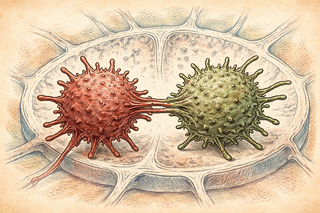
The Sidekick Nobody Knew Was Important
Here's the setup: inside tumors, there's a special population of CD8+ T cells called "precursor exhausted T cells" (Tpex, because scientists love abbreviations that sound like rejected startup names). These Tpex cells are basically stem cell-like heroes that can keep reproducing and supplying fresh cytotoxic T cells to fight the cancer. They're the renewable resource in an otherwise exhausting battle.
But Tpex cells don't work alone. They need help from CD4+ T cells - the coordinators, the managers, the ones who make sure everyone's doing their job. The problem? Nobody could figure out exactly which CD4+ T cells were doing the helping.
Enter Shota Takei and colleagues from multiple Japanese institutions, who decided to go hunting through blood, tumors, and lymph nodes from lung cancer patients (and some kidney cancer patients for good measure) using some seriously fancy technology: single-cell RNA sequencing, T cell receptor sequencing, and mass cytometry [1].
Meet the IL-7R+ CXCL13+ Squad
What they found is genuinely exciting. There's a specific subset of CD4+ T cells marked by IL-7R (a receptor that helps T cells survive) and CXCL13 (a chemical signal that helps organize immune responses). These cells appear to be the crucial partners that help Tpex cells do their thing.
Think of it like this: if Tpex cells are the soldiers, these IL-7R+ CXCL13+ CD4+ T cells are the supply chain managers making sure weapons, food, and reinforcements keep flowing. Without the supply chain, even the best soldiers eventually run out of ammunition.
The researchers traced these interactions happening in lymph nodes - the small bean-shaped organs scattered throughout your body where immune cells meet, greet, and strategize. It's basically the war room where the anti-tumor campaign gets coordinated.
Why Should You Care About This Cellular Bromance?
Immunotherapy has revolutionized cancer treatment. Drugs like checkpoint inhibitors work by taking the brakes off your immune system so it can attack tumors more effectively. But here's the catch: immunotherapy doesn't work for everyone. Some patients respond beautifully; others don't respond at all.
Understanding why some immune responses work better than others is the key to fixing this problem. If we know that Tpex cells need specific CD4+ T cell partners to function properly, we might be able to boost those partnerships therapeutically.
Previous research has established that CD4+ T cells support CD8+ T cells through interactions with dendritic cells - the messenger cells that carry tumor information to the immune system [2]. But this study narrows down the specific players involved, which is crucial for developing targeted therapies.
The tumor microenvironment is notoriously hostile to immune cells. Tumors create conditions that exhaust T cells, suppress immune responses, and generally make everything harder [3]. Finding ways to maintain productive T cell partnerships despite these challenges could dramatically improve patient outcomes.
The Bigger Picture
This research adds another piece to the increasingly complex puzzle of cancer immunology. We're learning that effective anti-tumor immunity isn't just about having the right killer cells - it's about having the right teams of cells working together in the right places.
The lymph node, it turns out, is more than just a waystation. It's where critical immune partnerships form that determine whether your body can mount a sustained attack against cancer. The IL-7R+ CXCL13+ CD4+ T cells identified in this study represent a potential new target for enhancing immunotherapy responses.
Of course, this is early-stage research primarily in lung cancer patients, and translating findings into actual treatments takes time. But every successful therapy starts with someone asking "which cells are actually doing the work here?" - and now we have a much better answer.
The immune system: still surprising us after all these years.
References
-
Takei S, Yamasaki S, Yamaguchi O, et al. The CD4+ T cell partners of precursor exhausted T cells in the tumor microenvironment. Nature Communications. 2026. DOI: 10.1038/s41467-026-71161-0
-
Borst J, Ahrends T, Bąbała N, Melief CJM, Kastenmüller W. CD4+ T cell help in cancer immunology and immunotherapy. Nature Reviews Immunology. 2018;18(10):635-647. DOI: 10.1038/s41577-018-0044-0
-
Philip M, Schietinger A. CD8+ T cell differentiation and dysfunction in cancer. Nature Reviews Immunology. 2022;22(4):209-223. DOI: 10.1038/s41577-021-00574-3
Disclaimer: The image accompanying this article is for illustrative purposes only and does not depict actual experimental results, data, or biological mechanisms.