Most photosensitizers - those light-activated molecules designed to torch cancer cells - never make it past the front door. They float around the cytoplasm like a security team that can't get into the building they're supposed to protect. P-NO3, the molecule at the center of a new study published in Angewandte Chemie International Edition, doesn't just get inside the building. It picks two locks, walks straight into the command center, and detonates the filing cabinet where the enemy keeps its playbook (Wang et al., 2026).
The Nuclear Fortress Problem
Here's the tactical situation: metastatic breast cancer is notoriously difficult to beat, partly because its DNA - the operational headquarters - sits behind the nuclear envelope, a membrane barrier that most therapeutic agents simply cannot breach. Traditional photodynamic therapy (PDT) works by flooding cancer cells with reactive oxygen species (ROS) when a photosensitizer absorbs light, essentially carpet-bombing the cell's interior (Gunaydin et al., 2021). The problem? Carpet-bombing the lobby doesn't take out the generals upstairs. Cytoplasmic damage alone often lets cancer cells repair and regroup. To truly checkmate metastatic breast cancer, you need to strike the DNA directly - and that means getting through the nuclear door.
Two Keys, One Brilliant Play
Wang and colleagues at Anhui University engineered P-NO3 with a dual-key gating strategy that reads like a heist movie script.
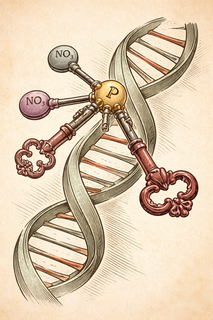
Key #1 - The Disguise: P-NO3 carries bilateral pyridinone units that bind to CDK4/6 - cyclin-dependent kinases that breast cancer cells chronically overactivate to fuel their relentless division. By hitching a ride on these overworked enzymes, P-NO3 essentially flashes a VIP badge and gets escorted right through the nuclear envelope. It's exploiting the enemy's own supply chain against them.
Key #2 - The Anchor: Once inside the nucleus, P-NO3 reveals dual-positive pyridine groups that competitively bind to DNA itself. The photosensitizer doesn't just visit the nucleus - it parks on the double helix and refuses to leave. Think of it as a spy who not only infiltrates headquarters but handcuffs themselves to the war table.
Scorched Earth, Even Without Oxygen
Here's where the tactical advantage gets nasty. When light hits the now-anchored P-NO3, it generates hydroxyl radicals (·OH) directly at the DNA. Most PDT agents rely on singlet oxygen, which means they underperform in the hypoxic wastelands that tumors love to create. P-NO3 sidesteps that weakness entirely - it makes hydroxyl radicals, which are arguably the most destructive ROS in biology, and it does so right next to the most critical target in the cell (Agostinis et al., 2011).
The DNA damage upregulates stress response genes - DDI2, KDM4D, and RGCC - essentially triggering the cell's own alarm system so loudly that it can't be ignored.
Calling In Reinforcements
But P-NO3 isn't playing for just a local victory. The nuclear DNA damage forces dying cancer cells to spill their molecular distress signals - calreticulin (CRT) on their surface and HMGB1 protein into the surroundings. These are the biological equivalent of lighting a flare for the immune system. Dendritic cells pick up the signal, mature, and train cytotoxic T cells to hunt down cancer cells throughout the body, including distant metastases that never saw a photon of therapeutic light (Castano et al., 2006).
This is immunogenic cell death turned up to eleven - photodynamic therapy creating a systemic anti-tumor immune response, or what the field calls photodynamic immunotherapy (PDIT). Previous work has shown that combining PDT with immune checkpoint inhibitors can suppress distant tumors, but P-NO3's nuclear-targeted approach amplifies the immune alarm at its source (Duan et al., 2023).
Why This Matters on the Chessboard
CDK4/6 inhibitors like palbociclib are already staples in breast cancer treatment, but resistance develops and the game shifts. This study flips the script by weaponizing the very overactivation of CDK4/6 that makes breast cancer aggressive - turning the tumor's own strength into a targeting mechanism. It's the molecular equivalent of using your opponent's momentum to throw them.
The dual-key approach also means healthy cells, which don't overexpress CDK4/6 and won't usher P-NO3 into their nuclei, remain largely unscathed. Selectivity and lethality in one package - that's a rare combination in oncology's playbook.
We're still in preclinical territory, and mouse models aren't humans. But the strategy here - hijacking a cancer-specific vulnerability to deliver a precision nuclear strike that then rallies the immune system for a full-body counteroffensive - is the kind of multi-layered approach that metastatic breast cancer demands.
The cancer cells built a fortress. P-NO3 brought lockpicks.
References:
-
Wang, T., Bu, Y., Zhao, X., Ni, Y., Wang, W., Zhang, Q., Zhu, X., Chen, X., Shi, S., & Zhou, H. (2026). A Dual-Key Gated Nuclear-DNA-Targeted Photogenerator for Amplified Photodynamic Immunotherapy of Breast Cancer. Angewandte Chemie International Edition, 65(15), e202523661. DOI: 10.1002/anie.202523661 | PubMed
-
Gunaydin, G., Gedik, M. E., & Ayan, S. (2021). Photodynamic Therapy Combined With Immunotherapy: Current Strategies. Frontiers in Oncology, 11, 738323. DOI: 10.3389/fonc.2021.738323 | PMCID: PMC8635494
-
Agostinis, P., Berg, K., Cengel, K. A., et al. (2011). Photodynamic therapy of cancer: An update. CA: A Cancer Journal for Clinicians, 61(4), 250-281. DOI: 10.3322/caac.20114
-
Castano, A. P., Mroz, P., & Hamblin, M. R. (2006). Photodynamic therapy and anti-tumour immunity. Nature Reviews Cancer, 6, 535-545. DOI: 10.1038/nrc1894
-
Duan, H., Liu, Y., Gao, Z., & Huang, W. (2023). Insight into the Crosstalk between Photodynamic Therapy and Immunotherapy in Breast Cancer. Cancers, 15(5), 1532. DOI: 10.3390/cancers15051532 | PMCID: PMC10000728
Disclaimer: The image accompanying this article is for illustrative purposes only and does not depict actual experimental results, data, or biological mechanisms.