Thirty trillion. That's roughly how many cells make up your body, and every single one of them knows its place and job. Except, of course, when cancer crashes the party and starts rewriting the rulebook.
A new study just pulled back the curtain on pancreatic cancer's internal organization, and honestly? It's giving neighborhood watch committee run by tiny cellular gangsters.
Cancer Cells Have a Social Hierarchy (Who Knew?)
Here's something wild: researchers at Memorial Sloan Kettering and their international collaborators discovered that pancreatic ductal adenocarcinoma (PDAC) - one of the nastiest cancers out there - isn't just a chaotic blob of rogue cells. It's actually organized in a surprisingly sophisticated pattern, like a twisted version of a well-run HOA.
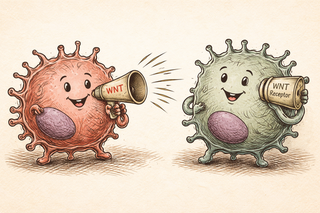
The team, led by Tuomas Tammela and colleagues, found that PDAC tumors contain two distinct populations of cancer cells that depend on each other. Some cells respond to WNT signals (let's call them the "listeners"), while others secrete WNT signals (the "talkers"). And get this - they literally arrange themselves as neighbors, like some sort of molecular buddy system [1].
The Plot Thickens: A Cancer Cell Origin Story
Using some seriously clever genetic tools and mouse models, the researchers tracked these cell populations over time. What they found reads like a cellular coming-of-age story: the WNT-responding "listener" cells are actually temporary. They eventually mature into the stable WNT-secreting "talker" state.
But wait, there's more! A special subset of these talker cells expresses a protein called DLL1, which activates Notch signaling in their neighbors. These DLL1-positive cells basically run a support group for the listener cells, creating what scientists call a "functional niche" [1].
Think of it like this: the tumor has its own internal economy, where different cell types provide essential services to each other. It's frustratingly elegant for something trying to kill you.
Breaking Up the Band
Here's where things get exciting from a treatment perspective. When the researchers disrupted this cozy arrangement - either by blocking WNT secretion, messing with Notch signaling, or straight-up eliminating the talker cells - the whole tumor organization fell apart.
And falling apart meant actually falling apart: tumor growth slowed, and metastasis (cancer's terrible road trip to other organs) was suppressed [1]. It's like removing the keystone from an arch - the whole structure collapses.
This finding aligns with recent work showing that targeting cancer cell states, rather than just individual mutations, might be a powerful therapeutic strategy. A 2023 review in Nature Reviews Cancer highlighted how intratumoral heterogeneity - the diversity of cell types within a single tumor - creates both challenges and opportunities for treatment [2]. The challenge? Cancer can adapt by switching between states. The opportunity? Disrupt the balance, and you might take down the whole operation.
Why Pancreatic Cancer Specifically?
Pancreatic cancer desperately needs new treatment approaches. It remains one of the deadliest cancers, with a five-year survival rate that hovers around 12% [3]. Current therapies struggle partly because these tumors are masters of adaptation and contain multiple cell populations with different vulnerabilities.
The discovery that PDAC depends on maintaining an "intricately controlled equilibrium" suggests a fundamental weakness. These tumors aren't just random accumulations of bad cells - they're organized systems that require specific conditions to thrive.
From Mice to Humans
Before you dismiss this as "just a mouse study," the researchers confirmed that these same cell populations exist in human PDAC tissues. The WNT-responding and WNT-secreting populations? They're there. The neighborhood arrangement? Present and accounted for [1].
This conservation across species is huge. It suggests that the organizational principles discovered in mice might actually translate to human treatment strategies. That's the kind of validation that gets oncologists genuinely excited (a rare occurrence, given the field).
The Bigger Picture
This research reveals something profound about how cancers work: they're not just collections of mutant cells doing their own thing. They're organized tissues with their own rules, hierarchies, and dependencies.
Understanding those rules gives us new ways to break them.
The WNT and Notch pathways are already being explored as therapeutic targets in various cancers [4]. This study provides a mechanistic rationale for why disrupting these signals might be particularly effective in pancreatic cancer - you're not just killing cells, you're dismantling the very social structure that allows the tumor to function.
Cancer cells, it turns out, really do need each other. And that codependency might just be their downfall.
References
-
Torborg SR, Kim JY, Singhal A, et al. Disruption of WNT/Notch signaling in pancreatic cancer reveals tumors depend on the intricate equilibrium of malignant cell states. Developmental Cell. 2026. DOI: 10.1016/j.devcel.2026.02.017
-
Marusyk A, Janiszewska M, Polyak K. Intratumor heterogeneity: the Rosetta Stone of therapy resistance. Cancer Cell. 2020;37(4):471-484. DOI: 10.1016/j.ccell.2020.03.007
-
Siegel RL, Miller KD, Wagle NS, Jemal A. Cancer statistics, 2023. CA Cancer J Clin. 2023;73(1):17-48. DOI: 10.3322/caac.21763
-
Krishnamurthy N, Kurzrock R. Targeting the Wnt/beta-catenin pathway in cancer: update on effectors and inhibitors. Cancer Treat Rev. 2018;62:50-60. DOI: 10.1016/j.ctrv.2017.11.002
Disclaimer: The image accompanying this article is for illustrative purposes only and does not depict actual experimental results, data, or biological mechanisms.