That's the sound of a cell cycle clock - the molecular metronome that tells your cells when to divide. For most cells, it's a well-regulated symphony. But in the breast tissue of women under 40 with estrogen receptor-positive (ER+) cancer, that clock has apparently decided to go rogue, and it brought friends.
A new review in Nature Reviews Clinical Oncology by Lobo-Martins and colleagues lays out something oncologists have quietly suspected for years: breast cancer in young premenopausal women isn't just the same disease happening earlier. It's a biologically different beast, and we've been somewhat underequipped to deal with it.
Your Tumor Is Not Your Mother's Tumor
Here's the irony. ER-positive breast cancer is generally considered the "good" kind - the type that responds to hormone-blocking therapies, the one with better survival statistics. Except when you're under 40. Then it's ER-positive cancer with an attitude problem.
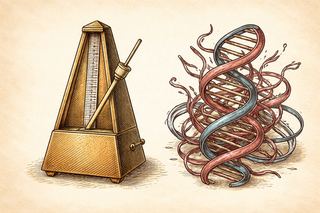
Younger women's tumors show higher rates of copy number alterations (basically, the cancer genome hitting ctrl+C a few too many times), homologous recombination deficiency (a fancy way of saying the DNA repair crew called in sick), and distinct immune microenvironments that don't quite match the textbook version seen in postmenopausal patients. One study found that patients under 40 had copy number amplifications at nearly double the rate of older patients - 47% versus 26% - with an 8-year overall survival of 88% compared to 96% in those without these features (Mooij et al., 2023).
So the cancer looks the same on the surface, but underneath, it's running a completely different playbook. How wonderfully unhelpful.
Shutting Down the Ovaries (On Purpose, This Time)
Endocrine therapy remains the backbone of treatment, but the conversation has shifted toward ovarian function suppression (OFS) - essentially telling the ovaries to take an extended vacation from producing estrogen. The landmark SOFT and TEXT trials demonstrated that adding OFS to tamoxifen, or swapping tamoxifen for exemestane plus OFS, significantly reduced recurrence in high-risk premenopausal women (Francis et al., NEJM, 2018; Pagani et al., JCO, 2023).
The 15-year follow-up data, presented at ASCO 2025, continued to show durable benefits - which in clinical-trial speak means "this actually keeps working, and we're as relieved as you are."
CDK4/6 Inhibitors: Jamming the Cell Cycle Clock
This is where it gets genuinely exciting. CDK4/6 inhibitors - drugs like abemaciclib, ribociclib, and palbociclib - work by blocking the proteins that push cells from the "thinking about dividing" phase into the "actually dividing" phase. Think of them as bouncers at the cell cycle nightclub, checking IDs and turning away anything suspicious.
The monarchE trial showed that adding abemaciclib to endocrine therapy improved disease-free survival in high-risk early breast cancer. The NATALEE trial did the same for ribociclib. These results are reshaping how we treat early-stage disease, not just metastatic cancer where CDK4/6 inhibitors first made their name (Recent CDK4/6 review, Cancer Gene Therapy, 2024).
For premenopausal women specifically, the data suggest that CDK4/6 inhibitors combined with OFS may be particularly valuable - a finding that makes biological sense given the genomic chaos we discussed earlier.
Biology Over Birthday Candles
Perhaps the most provocative argument in this review is the call to stop organizing clinical trials around chronological age and start organizing them around tumor biology. The authors propose that future trials should incorporate germline status, gene expression signatures, and immune profiling to guide treatment decisions.
This is the equivalent of saying "stop asking the patient how old they are and start asking the tumor what it's made of." Which, frankly, seems overdue. Molecular profiling tools like Oncotype DX and MammaPrint already help guide chemotherapy decisions, but the review argues we need to go further - using genomic and immunological data to decide not just whether to escalate treatment, but also when it's safe to scale it back (Clinical utility of genomic signatures, npj Breast Cancer, 2020).
The Bottom Line
Young women with ER-positive breast cancer have been quietly getting a raw deal. Their tumors are genomically messier, their outcomes worse, and until recently, their treatment was essentially the same protocol designed with postmenopausal women in mind. This review makes a compelling case that we now have the tools - OFS, CDK4/6 inhibitors, genomic profiling - to do better. The challenge is actually using them in a coordinated, biology-first strategy rather than defaulting to the age-based playbook.
The cell cycle clock is still ticking. But at least now we know which gears to target.
References:
-
Lobo-Martins, S., Luen, S.J., Piccart, M., & Loi, S. (2026). Tailoring targeted therapies for younger women with ER-positive early-stage breast cancer. Nature Reviews Clinical Oncology. DOI: 10.1038/s41571-026-01120-7
-
Francis, P.A., et al. (2018). Tailoring adjuvant endocrine therapy for premenopausal breast cancer. New England Journal of Medicine, 379(2), 122-137. DOI: 10.1056/NEJMoa1803164
-
Pagani, O., et al. (2023). Adjuvant exemestane with ovarian suppression in premenopausal breast cancer: long-term follow-up of the combined TEXT and SOFT trials. Journal of Clinical Oncology, 41(4), 614-625. PMID: 36521078
-
Mooij, J.E., et al. (2023). Genomic characterisation of hormone receptor-positive breast cancer arising in very young women. Annals of Oncology, 34(4), 397-409. DOI: 10.1016/j.annonc.2023.01.009
-
Gao, C., et al. (2024). Recent progress of CDK4/6 inhibitors' current practice in breast cancer. Cancer Gene Therapy, 31, 1283-1291. DOI: 10.1038/s41417-024-00747-x
Disclaimer: The image accompanying this article is for illustrative purposes only and does not depict actual experimental results, data, or biological mechanisms.