The forecast inside a small cell lung cancer tumor looks grim today: thick clouds of drug-resistant signaling, a persistent high-pressure system of rogue kinases, and absolutely zero chance of chemotherapy getting through. Overnight temperatures in the tumor microenvironment have dropped to hostile, and our on-the-ground correspondent - a cisplatin molecule who asked to remain anonymous - reports being completely neutralized before reaching the target.
But a team of researchers just found the weatherman who's been faking the forecast. His name is BMX, and he's been running quite the operation.
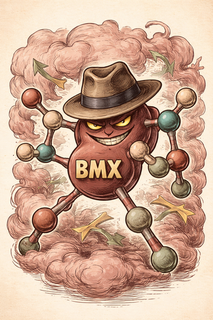
Meet the Villain: A Kinase With a Side Hustle
BMX - short for bone marrow tyrosine kinase on chromosome X, because scientists love names that double as tongue twisters - is a member of the Tec kinase family. Normally, BMX hangs around hematopoietic tissues and endothelial cells doing respectable cellular work. But in small cell lung cancer, BMX has gone full crime boss.
Here's what Wu and colleagues discovered: BMX is running a protection racket for a protein called E2F1 [1]. E2F1 is a transcription factor that controls cell division, DNA repair, and migration - basically all the skills a cancer cell needs to laugh off chemotherapy. Normally, the cell's recycling system (the ubiquitin-proteasome pathway, which is basically a molecular paper shredder) would chew up excess E2F1 and keep things in check. But BMX intervenes, slapping a phosphorylation tag on E2F1 that essentially reads: "Do Not Shred."
The Plot Thickens: A Signaling Relay Race Nobody Asked For
The mechanism reads like a heist movie. BMX doesn't protect E2F1 directly - it runs the job through intermediaries. First, BMX activates ERK1/2 (the getaway driver). ERK1/2 cranks up Cyclin D1 and CDK4/6 (the safecracking team). Then CDK4/6 phosphorylates E2F1 at two specific spots - Ser332 and Ser337 - which prevents the ubiquitin system from tagging it for destruction [1].
The result? E2F1 accumulates like unpaid parking tickets, switching on genes for proliferation, DNA repair, and invasion. When cisplatin comes knocking, the cancer cells have already patched their DNA and bolted the doors.
This is particularly devastating in SCLC because the tumor's usual E2F1 supervisor - a protein called RB (retinoblastoma protein) - is almost universally missing. RB is lost in roughly 100% of SCLC cases [2]. So E2F1 was already unsupervised, and BMX just handed it a promotion and a corner office.
Why SCLC Is the Most Frustrating Cancer at the Party
Small cell lung cancer is the disease that tricks you into optimism. Initial chemotherapy response rates hit 60-70%, and doctors briefly feel like heroes. Then, within three months, about 60% of extensive-stage patients relapse with resistant disease [2]. Median overall survival for extensive-stage SCLC sits at a brutal 12-13 months, and the five-year survival rate hovers around 7% [2].
The cancer essentially takes notes during the first round of chemo, figures out the playbook, and comes back armored. Until now, the molecular details of that armor-plating process were murky.
Enter the Hero: A Molecule Called IHMT-15137
Wu's team didn't just identify the problem - they built a weapon. IHMT-15137 is a potent, selective BMX inhibitor that dismantles the protection racket [1]. Without BMX activity, E2F1 loses its phosphorylation shield, gets tagged with ubiquitin, and meets its fate in the proteasome shredder.
The results were striking. In patient-derived cells, patient-derived organoids, and chemoresistant cell lines, IHMT-15137 combined with cisplatin triggered cell cycle arrest, apoptosis, and DNA damage while shutting down migration and invasion. In mouse xenograft models, the combination therapy significantly shrank tumors without major toxicity [1].
The combo approach matters here. IHMT-15137 isn't replacing chemotherapy - it's removing the cancer's cheat codes so that chemotherapy works again.
The Bigger Picture: A Crowded (But Welcome) Treatment Landscape
This discovery arrives during a genuine SCLC research renaissance. Tarlatamab, a bispecific T-cell engager targeting DLL3, recently showed median survival exceeding 25 months in extensive-stage disease [3]. Durvalumab extended limited-stage median survival to nearly 56 months [2]. And independently, Wen et al. demonstrated that CDK4/6 inhibitors - already approved for breast cancer - can overcome SCLC chemoresistance through an autophagy-dependent mechanism involving the same CDK4/6 players [4].
The convergence is striking: multiple research groups, approaching from different angles, keep bumping into the same molecular machinery. When the evidence starts pointing at CDK4/6 and E2F1 from every direction, it's less of a coincidence and more of a conviction.
The Cliffhanger
IHMT-15137 still needs clinical trials in humans. The leap from mouse models to patients is the graveyard where many promising molecules go to rest. But the strength of this work - patient-derived organoids, multiple resistant cell lines, clear mechanistic dissection - gives it a better-than-average shot at surviving the translation.
For the 30,000-plus Americans diagnosed with SCLC each year, the weather forecast might finally be changing.
References
-
Wu T, Qi S, Shi C, et al. BMX inhibition overcomes small cell lung cancer chemoresistance by stabilizing E2F1 via ERK1/2-Cyclin D1/CDK4/6 axis. Signal Transduct Target Ther. 2026;11(1):125. DOI: 10.1038/s41392-026-02644-1. PMCID: PMC13057077
-
Kim SY, Park HS, Chiang AC. Small Cell Lung Cancer: A Review. JAMA. 2025;333(22):1957-1968. DOI: 10.1001/jama.2025.0560
-
Ahn MJ, Cho BC, Felip E, et al. Tarlatamab for patients with previously treated small-cell lung cancer. N Engl J Med. 2023;389(22):2063-2075. DOI: 10.1056/NEJMoa2307980
-
Wen Y, Sun X, Zeng L, et al. CDK4/6 Inhibitors Impede Chemoresistance and Inhibit Tumor Growth of Small Cell Lung Cancer. Adv Sci. 2024;11(38):e2400666. DOI: 10.1002/advs.202400666. PMCID: PMC11481398
Disclaimer: The image accompanying this article is for illustrative purposes only and does not depict actual experimental results, data, or biological mechanisms.