Ever hired a contractor who promised to "just replace a few tiles" and somehow ended up ripping out your plumbing, rewiring the electricity, and leaving the kitchen unusable? That's basically what chronic stress does to a tiny region of your brain called the amygdala - except the contractor is cellular aging, the plumbing is your sugar metabolism, and the kitchen is your ability to not feel anxious about everything.
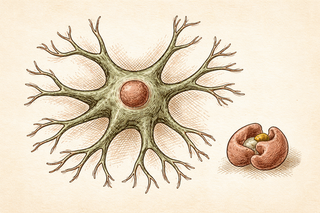
A team of researchers led by Aojie He and colleagues just published a paper in Cell Metabolism that connects three things you probably never thought were related: stressed-out brain cells, anxiety, and high blood sugar. And the culprit? Astrocytes - the star-shaped support cells in your brain - that have essentially retired on the job.
When Your Brain's Support Staff Quits Working
So here's what's happening. Your brain has these cells called astrocytes. They're not neurons (the flashy signal-senders that get all the credit), but they're basically the entire maintenance crew. They feed neurons, clean up chemical spills, manage the blood-brain barrier - the works. In the amygdala, your brain's anxiety headquarters, these astrocytes are especially busy.
What this study found is that chronic stress makes amygdala astrocytes go senescent. That's biology-speak for "they've stopped dividing, started complaining, and are actively making things worse for everyone around them." Think of it as cellular retirement, except instead of moving to Florida, they stay put and start secreting inflammatory junk that messes up the whole neighborhood.
The Enzyme That Started It All
The molecular drama begins with an enzyme called hexokinase 2 (HK2) - basically the gatekeeper of glucose metabolism. HK2 kicks off glycolysis, the process that turns sugar into usable energy. Under chronic stress, a transcription factor called PBX1 dials down HK2 production in astrocytes. Less HK2 means the astrocytes can't properly process glucose, and they slide into senescence (Hu et al., 2022).
When the researchers deleted HK2 specifically in astrocytes, the mice developed anxiety-like behaviors and high blood sugar - even without being stressed. The enzyme was doing double duty, and losing it broke both systems simultaneously.
The Serine Shuttle Gets Derailed
Here's where it gets really clever. Astrocytes normally synthesize an amino acid called L-serine and pass it along to neurons, which convert it into D-serine. D-serine is a co-pilot for NMDA receptors - critical signaling hubs involved in synaptic plasticity, learning, and regulating autonomic nervous system output (Wolosker & Bhatt, 2014).
Without enough HK2, astrocytes can't make enough L-serine. The supply chain to neurons collapses. Neurons run low on D-serine, and the amygdala's ability to balance sympathetic ("fight or flight") and parasympathetic ("rest and digest") signals to the pancreas goes haywire. The sympathetic side wins, insulin secretion gets suppressed, and blood sugar shoots up.
Your brain is literally telling your pancreas to panic because the mail room stopped delivering supplies.
Two Surprisingly Simple Fixes
The paper doesn't just describe the problem - it offers two potential solutions that actually worked in mice.
Option one: L-serine supplementation. If the problem is that astrocytes can't make enough L-serine, just... give them more. Supplementing L-serine restored the shuttle, calmed the anxiety behaviors, and brought blood sugar back down. Elegant.
Option two: Dasatinib plus quercetin (D+Q), a senolytic cocktail that selectively clears senescent cells. This combo has been making waves in aging research, with early human trials showing promise in Alzheimer's risk reduction and cognitive decline (eBioMedicine, 2025). In this study, D+Q wiped out the senescent astrocytes, and both anxiety and hyperglycemia improved. Taking out the bad contractors fixed the renovation.
Why This Actually Matters for Humans
Roughly 1 in 10 adults worldwide has type 2 diabetes, and chronic stress is an increasingly recognized risk factor (Lisco et al., 2024). We've known for decades that stress raises blood sugar through cortisol and adrenaline. But this paper adds a completely new layer: a brain-to-pancreas circuit, mediated by aging astrocytes and a disrupted amino acid shuttle, that directly drives hyperglycemia through autonomic imbalance.
That's not just academically interesting - it's therapeutically actionable. If astrocyte senescence in the amygdala is a driver of stress-induced diabetes, then senolytics or targeted metabolic supplements could potentially break the cycle. We're talking about treating a metabolic disease by fixing the brain, which is the kind of crossover episode nobody expected but everyone needed.
Right now, this is mouse data, and plenty of promising mouse findings have face-planted on the way to the clinic. But the mechanistic chain here - PBX1 suppresses HK2, HK2 loss triggers senescence, senescence disrupts serine shuttling, serine loss unbalances autonomic pancreatic control - is detailed enough to give it real traction (Guayasamin et al., 2025); (Li et al., 2024).
If your stress has ever given you both anxiety and a suspicious fasting glucose reading, well, now you know there might be a very specific set of tired astrocytes to blame.
References
-
He A, Zhu Y, Liang C, et al. Amygdala astrocyte senescence drives stress-induced anxiety and hyperglycemia. Cell Metabolism. 2026. DOI: 10.1016/j.cmet.2026.03.006. PMID: 41935525
-
Hu Y, Mai W, Chen L, et al. Dual roles of hexokinase 2 in shaping microglial function. Nature Metabolism. 2022. DOI: 10.1038/s42255-022-00707-5. PMID: 36536134
-
Guayasamin M, Depaauw-Holt LR, et al. Early-life stress induces persistent astrocyte dysfunction associated with fear generalisation. eLife. 2025. DOI: 10.7554/eLife.99988. PMCID: PMC11798576
-
Lisco G, Giagulli VA, et al. Chronic stress as a risk factor for type 2 diabetes. Endocrine, Metabolic & Immune Disorders - Drug Targets. 2024. DOI: 10.2174/1871530323666230803095118. PMID: 37534489
-
Li Z, Jiang YY, et al. Bridging metabolic syndrome and cognitive dysfunction: role of astrocytes. Frontiers in Endocrinology. 2024. DOI: 10.3389/fendo.2024.1393253. PMCID: PMC11116704
-
Senescent astrocytes: a new player in brain aging and cognitive decline. Brain Sciences. 2026. DOI: 10.3390/brainsci16010076. PMCID: PMC12839264
Disclaimer: The image accompanying this article is for illustrative purposes only and does not depict actual experimental results, data, or biological mechanisms.