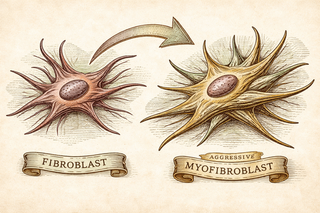
The fibroblast never planned on a career change. For years, it sat quietly in atrial tissue, minding its own business, patching up minor wear and tear like a dependable road crew filling potholes. But somewhere along the route between a breast tumor and the heart's upper chambers, a signal arrived - a chemical convoy of inflammatory messengers - and that mild-mannered fibroblast transformed into something far more aggressive. Welcome to the strangest commute in oncology: how breast cancer recruits your heart's repair cells into building the scaffolding for atrial fibrillation.
The Playbook Nobody Saw Coming
For a long time, cardiologists and oncologists operated like rival coaching staffs who never watched each other's game film. Cancer doctors focused on tumor kill rates. Heart doctors tracked rhythm strips. But a growing body of evidence, highlighted by Van Wagoner's editorial in the European Heart Journal, is forcing both sidelines to huddle up, because breast cancer and atrial fibrillation (AF) share a surprisingly deep tactical playbook (Van Wagoner, 2025).
The numbers alone demand attention. In a landmark SEER-Medicare analysis of over 85,000 breast cancer patients, 3.9% developed new-onset AF within a year of diagnosis. During the first 60 days? The rate spiked to 0.6% per month - roughly double the background rate in matched controls. And the more advanced the cancer, the worse the odds: Stage IV patients faced a hazard ratio of 4.21 compared to Stage I (D'Souza et al., 2022).
That's not a coincidence. That's a coordinated offensive.
Fibrosis: The Double Agent
Here's where the strategy gets devious. The same molecular signaling pathways that tumors exploit to grow and spread - PI3K/AKT, MAPK, TGF-β - are also the ones that drive fibrotic remodeling in atrial tissue. Think of TGF-β1 as a corrupt general issuing orders to both fronts simultaneously. In the breast, it helps tumors evade immune surveillance. In the heart, it tells fibroblasts to bulk up into collagen-spewing myofibroblasts, laying down scar tissue that disrupts the atria's electrical wiring (Wang et al., 2024).
Inflammatory cytokines - TNF-α, IL-6, IL-1β - act as the supply lines. Cancer cranks out systemic inflammation like a factory running triple shifts, and that inflammatory load doesn't politely stop at tumor borders. It floods the bloodstream, reaching the atria and activating fibroblasts that were perfectly content doing nothing.
The result? An atrium slowly strangled by its own repair machinery, its electrical signals stuttering through a maze of fibrotic tissue. That's AF - and cancer just handed it the blueprints.
The Estrogen Gambit
There's a particularly cruel twist for breast cancer patients. Estrogen, it turns out, is one of the heart's best defensive coordinators. Estrogen receptors activate protective PI3K/ERK1/2 signaling and actively block the pro-fibrotic pathways triggered by angiotensin II and endothelin-1. Translation: estrogen keeps your atria from scarring up.
Now consider that many breast cancer treatments - aromatase inhibitors, ovarian suppression, tamoxifen - are specifically designed to slash estrogen levels. You're stripping away the heart's anti-fibrotic shield precisely when cancer-driven inflammation is ramping up the fibrotic assault. It's like pulling your goalkeeper off the field while the opposing team brings on a second striker.
Shared Blueprints, Not Shared Blame
A fascinating genetic study recently mapped the shared architecture between these two conditions, identifying 15 pleiotropic SNPs and key genes like DNMT3A that influence both diseases. But here's the plot twist: Mendelian randomization analysis showed that neither disease causes the other. Instead, they share deep molecular infrastructure - the same vulnerable wiring that cancer exploits to grow is the wiring that makes atrial tissue susceptible to fibrotic remodeling (Li et al., 2025).
As Merino framed it in his editorial response: the relationship is more causal than casual, but the causation runs through shared terrain rather than a direct highway (Merino, 2022).
Why This Changes the Game
New-onset AF after breast cancer diagnosis triples cardiovascular mortality risk. Not cancer mortality - cardiovascular mortality (D'Souza et al., 2022). That means we're saving patients from their tumors only to lose some of them to their hearts.
The counter-strategy is already forming. Beta-blockers and ACE inhibitors have shown protective effects against AF development in cancer patients. The emerging field of cardio-oncology is pushing for integrated monitoring - rhythm surveillance from the moment of cancer diagnosis, not as an afterthought when a patient shows up with palpitations six months into chemo.
Van Wagoner's work underscores a fundamental shift in how we think about cancer's collateral damage. The tumor isn't just fighting your immune system. It's running a fibrotic insurgency in your atria, hijacking your heart's own repair cells, and exploiting every molecular shortcut it can find. Knowing the opponent's playbook is the first step toward shutting it down.
References
-
Van Wagoner DR. Breast cancer, fibrotic signalling, and development of atrial fibrillation. Eur Heart J. 2025. DOI: 10.1093/eurheartj/ehag185
-
D'Souza M, Smedegaard L, Madelaire C, et al. Incidence, risk factors, and mortality of atrial fibrillation in breast cancer: a SEER-Medicare analysis. Eur Heart J. 2022;43(4):300-312. DOI: 10.1093/eurheartj/ehab791
-
Merino JL. Atrial fibrillation and breast cancer: casual or causal relationship? Eur Heart J. 2022;43(4):313-315. DOI: 10.1093/eurheartj/ehab807
-
Wang L, Zhang Y, Luo M, et al. Epidemiology, risk factors and mechanism of breast cancer and atrial fibrillation. Cardio-Oncology. 2024;10:64. DOI: 10.1186/s40959-024-00298-y
-
Li M, et al. Genetic analysis reveals the shared genetic architecture between breast cancer and atrial fibrillation. Front Genet. 2025;16:1450259. DOI: 10.3389/fgene.2025.1450259
Disclaimer: The image accompanying this article is for illustrative purposes only and does not depict actual experimental results, data, or biological mechanisms.