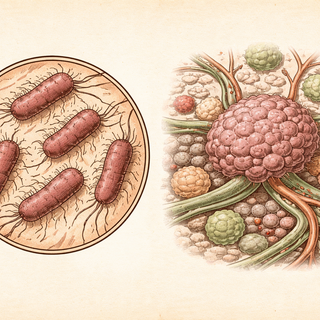
Sometimes the best employee is the one nobody expected. Scientists took E. coli Nissle 1917 - a harmless probiotic strain that's been chilling in supplements for decades - and turned it into a microscopic nitric oxide factory that lives inside tumors and helps your immune system actually do its job.
The Problem: Your Immune System Keeps Getting Locked Out
Here's the frustrating thing about cancer. Your body has an incredibly sophisticated security system - CD8+ T cells, dendritic cells, the whole crew - that should be demolishing tumor cells. But tumors are sneaky little operators. They build themselves an immunosuppressive fortress (scientists call it the tumor microenvironment, or TME) complete with abnormal blood vessels that restrict immune cell access and molecular "keep out" signs that exhaust your T cells into uselessness (Regulation of T Cells in Cancer by Nitric Oxide, Cells, 2021).
It's like your immune cells show up to fight but the tumor changed all the locks and turned off the lights.
Checkpoint inhibitors like anti-PD-L1 therapy were supposed to fix this by ripping down those "keep out" signs. And they work - sometimes. For some patients. In some cancers. The response rates hover around 20-40% for most solid tumors because the underlying neighborhood is still hostile territory.
The Fix: Bacteria With a Gas Problem (On Purpose)
Enter Xu, Zhang, and colleagues from a team published in Nature Biotechnology (Xu et al., 2026). They took that friendly probiotic E. coli Nissle 1917 and gave it a synthetic genetic circuit - basically a biological software update - that turns the bacteria into relentless nitric oxide (NO) production machines.
The engineering is genuinely clever. Normal E. coli tightly regulates arginine production through a repressor called ArgR. The team deleted ArgR, which is the biological equivalent of removing the governor from an engine. Then they supercharged arginine regeneration by adding extra copies of ArgG and ArgH (enzymes that recycle arginine) alongside a nitric oxide synthase borrowed from Bacillus subtilis. The result? A self-sustaining loop where the bacteria keep pumping out NO without running out of fuel.
Think of it as converting a Honda Civic into a nitrous-boosted drag racer, except the nitrous is the medicine.
What the Gas Actually Does
Nitric oxide is one of biology's weirdest molecules. It's a gas. It's a signaling molecule. At the right concentration, it's basically a renovation crew for the tumor microenvironment (Normalization of the tumor microenvironment by harnessing vascular and immune modulation, Experimental Hematology & Oncology, 2023).
When ECN-NO colonized tumors in mice, three things happened:
First, the chaotic tumor blood vessels straightened out. This "vascular normalization" meant immune cells could actually get in. Picture a traffic jam suddenly clearing because someone fixed all the broken stoplights.
Second, dendritic cells - the immune system's intelligence officers - flooded the tumor. These cells grab tumor antigens and present them to T cells, essentially handing out mugshots of the cancer.
Third, when the researchers added anti-PD-L1 therapy on top of the bacterial treatment, CD8+ T cells went from exhausted bystanders to fully armed responders. The combination produced durable tumor regression across multiple solid tumor types in mice. Not just slowed growth. Regression.
Why This Matters Beyond Mice
The idea of using engineered bacteria against cancer isn't brand new. Previous work showed that E. coli Nissle 1917 could be modified to convert ammonia into L-arginine inside tumors, boosting T cell infiltration (Canale et al., Nature, 2021). Other teams have engineered the same strain to deliver checkpoint-blocking nanobodies directly at the tumor site (Gurbatri et al., Science Translational Medicine, 2020). And a 2024 clinical trial confirmed that these bacteria selectively colonize human tumors after oral delivery (Ho et al., Nature Communications, 2024).
What makes the NO approach stand out is that it tackles the TME from multiple angles simultaneously - vascular access, immune recruitment, AND checkpoint responsiveness - rather than hitting just one target. It's the difference between picking one lock and remodeling the entire building.
Of course, we're still in mouse territory. And NO is famously dose-dependent - too little does nothing, too much causes damage. The built-in safety features (kill switches and containment modules) are promising, but the jump from mice to humans is littered with therapies that looked spectacular in rodents and fizzled in clinical trials.
Still, a probiotic bacterium that parks itself in your tumor, pumps out a gas that fixes the blood vessels, calls in the immune cavalry, and makes checkpoint drugs work better? That's not just clever engineering. That's biology doing things we couldn't have imagined a decade ago.
References
-
Xu, S., Zhang, T., Song, Y., et al. Sustained nitric oxide production by engineered E. coli remodels the tumor microenvironment and potentiates immunotherapy. Nature Biotechnology (2026). DOI: 10.1038/s41587-026-03054-y
-
Canale, F.P., Basso, C., Antonini, G., et al. Metabolic modulation of tumours with engineered bacteria for immunotherapy. Nature 598, 662-666 (2021). DOI: 10.1038/s41586-021-04003-2
-
Gurbatri, C.R., Lia, I., Vincent, R., et al. Engineered probiotics for local tumor delivery of checkpoint blockade nanobodies. Science Translational Medicine 12, eaax0876 (2020). DOI: 10.1126/scitranslmed.aax0876
-
Ho, C.L., Choi, H., Lim, I.L., et al. Engineering tumor-colonizing E. coli Nissle 1917 for detection and treatment of colorectal neoplasia. Nature Communications 15, 646 (2024). DOI: 10.1038/s41467-024-44776-4
-
Mendes Mathias Augusto, D., Montes de Oca Balderas, H. Regulation of T Cells in Cancer by Nitric Oxide. Cells 10(10), 2655 (2021). PMCID: PMC8534057
Disclaimer: The image accompanying this article is for illustrative purposes only and does not depict actual experimental results, data, or biological mechanisms.