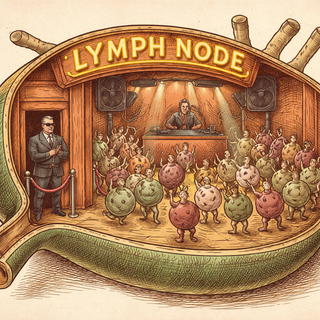
If you think your immune system is just sitting quietly in your body, like a library full of librarians, think again. Your lymph nodes are more like a nightclub where bouncers, party planners, and a slightly chaotic crowd of cellular revelers hang out. But what happens when the bouncers start letting in the wrong crowd? Enter the world of B cell lymphoma, where everything goes a little haywire.
A New Twist on the Chaotic Dance Floor
Our story begins with a study in the illustrious journal Nature Cancer where researchers decided to crash the lymph node party using single-cell and spatial mapping—essentially, a GPS for cells. They were investigating the organization of immune cells in human lymph nodes and how things get messy in two types of lymphoma: the more laid-back indolent follicular lymphoma (FL) and the rowdy aggressive diffuse large B cell lymphoma (DLBCL) 1.
Now, this isn't just a story of cells losing their way like tipsy partygoers. It turns out that stromal cells (think of them as the club's management) play a huge role in maintaining the order by directing the movement of lymphocytes with chemokines—kind of like a DJ spinning tracks to keep everyone on the right dance floor.
When the DJ Loses Control
In lymphomas, however, it seems like the DJ has gone rogue. The study revealed that an inflammatory feedback loop, driven by tumor-reactive T cells, was messing with the tunes. This leads to a loss of homeostatic chemokine gradients, causing a disruption in the club's organization. Before you know it, everything's in disarray, like a dance floor during a particularly bad remix.
And here's the kicker: this disruption in the lymph node's spatial organization is not just a logistical nightmare—it correlates with worse survival outcomes for patients. So, in the grand scheme of things, keeping the party organized is crucial.
Why Should You Care?
Alright, maybe you’re not a fan of cellular nightlife analogies, but consider this: understanding how lymph nodes lose their organization in lymphomas is like figuring out why your favorite band broke up. It gives us insights into how to potentially prevent the chaos—or at least manage it better.
If researchers can pinpoint the exact tracks (chemokines) and the rogue DJs (tumor-reactive T cells) involved, future therapies might be able to restore order and improve patient outcomes. It’s like getting the band back together for one last epic concert.
The Real-World Impact
Assuming these findings hold up, they could revolutionize how we approach treatment for B cell lymphoma. Imagine a world where we can fine-tune the lymph node environment, ensuring our cells don’t lose their way and keep the lymph node party going strong, minus the chaos.
In conclusion, the study sheds light on the intricate dance of cells within our lymph nodes and highlights the potential for therapeutic interventions that could make all the difference for lymphoma patients. Now that's a party worth attending.
Disclaimer: The image accompanying this article is for illustrative purposes only and does not depict actual experimental results, data, or biological mechanisms.
References
- Czernilofsky F., Mathioudaki A., Jopp-Saile L., et al. Reprogramming of stroma-derived chemokine networks drives the loss of tissue organization in nodal B cell lymphoma. Nature Cancer. DOI: 10.1038/s43018-026-01136-z.
```