Your immune system is, hands down, the most impressive security apparatus ever engineered. It identifies threats, dispatches killer cells, and remembers old enemies like an elephant with a grudge. But cancer? Cancer figured out how to spoof the badge, disable the cameras, and bribe the guards - all at once.
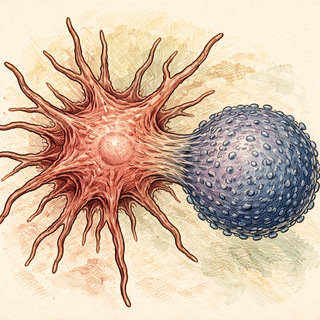
A new review published in Annals of Medicine by Liu and colleagues pulls back the curtain on one of immunology's most promising (and frustrating) frontiers: cross-presentation, the process by which your dendritic cells teach your killer T cells what tumor cells look like so they can go hunt them down (Liu et al., 2026). The problem? Tumors have gotten disturbingly good at sabotaging the whole operation.
The Middlemen Your Immune System Can't Live Without
Here's how anti-tumor immunity is supposed to work. Dendritic cells (DCs) - think of them as your immune system's intelligence agents - patrol your tissues, gobble up bits of dead or dying tumor cells, and then do something remarkable. They take those tumor fragments, load them onto special display molecules called MHC class I, and parade them in front of CD8+ cytotoxic T lymphocytes. This is cross-presentation, and it's essentially your body's way of showing killer T cells a mugshot and saying, "Find this guy."
There are two routes this can happen: the cytosolic pathway, where antigen escapes into the cell's interior and gets chopped up by proteasomes before being displayed, and the vacuolar pathway, where everything stays inside digestive compartments (Embgenbroich & Burgdorf, 2023). Either way, the end result is the same - T cells get activated and go on the offensive.
A particular subset of dendritic cells called cDC1s are the MVPs here. They're basically born to cross-present. And researchers recently discovered that a protein called WDFY4 is essential for this whole process - mice without it simply cannot reject tumors, even though their cDC1 cells look perfectly normal otherwise (Theisen et al., 2018). It's like having a fully staffed security office where nobody remembered to install the monitors.
Tumors: The Ultimate Con Artists
Of course, cancer cells didn't get where they are by playing fair. The review highlights a two-pronged sabotage strategy that's almost admirably devious.
Prong one: Tumors downregulate their own MHC class I molecules - essentially ripping the name tag off their shirt so T cells can't recognize them. Studies show MHC-I loss occurs in 65-90% of cancers, depending on the type. That's not a glitch; that's a business strategy.
Prong two: Tumors flood the neighborhood with immunosuppressive chemicals - prostaglandin E2 (PGE2), VEGF, IL-6, IL-10 - that essentially tranquilize the dendritic cells trying to do their job (Xie et al., 2025). PGE2 alone is a one-molecule wrecking crew: it cripples T cell metabolism, blocks IL-2 signaling, and turns the tumor microenvironment into a place where immune cells go to retire early.
The result? Your killer T cells never get the memo that there's a tumor to kill. Cross-presentation fails, immunosurveillance collapses, and the tumor grows unchecked. It's the immunological equivalent of disconnecting the fire alarm before committing arson.
Fighting Back with Dendritic Cell Vaccines
But scientists aren't just sitting around watching tumors win. The review covers an exciting arsenal of DC-based vaccines designed to jumpstart the cross-presentation process manually.
The poster child is Sipuleucel-T (Provenge), approved by the FDA in 2010 for metastatic prostate cancer - the first-ever therapeutic cancer vaccine. It works by taking a patient's own immune cells, loading them with a tumor antigen, and putting them back. Patients lived a median of 4.1 months longer, with survival at three years jumping from 21.7% to 31.7% (Kantoff et al., 2010).
Newer approaches are getting creative: mRNA-pulsed DC vaccines, nanoparticle delivery systems that target cDC1s directly, and in situ vaccination strategies that combine radiation with immune-boosting agents like FLT3L to activate dendritic cells right at the tumor site. Some teams are even engineering DCs with chimeric antigen receptors to supercharge their antigen-capturing abilities.
The Catch (There's Always a Catch)
The biggest challenge remains the tumor microenvironment itself - that immunosuppressive swamp of cytokines and regulatory cells that shuts down even the most enthusiastic vaccine-primed T cells. Making great DC vaccines is one thing; getting them to work inside a tumor that's actively suppressing everything is another.
That's why combination therapies are the hot ticket right now. DC vaccines paired with checkpoint inhibitors (anti-PD-1, anti-CTLA-4) are showing real promise in clinical trials across melanoma, glioblastoma, and lung cancer. The logic is elegant: use the vaccine to wake up the T cells, then use checkpoint blockers to keep them awake once they arrive at the tumor.
Cross-presentation remains one of immunology's most tantalizing targets. If we can reliably fix this broken communication line between dendritic cells and killer T cells, we might finally give the immune system what it needs to do what it already wants to do - destroy cancer.
References
-
Liu P, Zhou Z, Su X, Xu Y, Li J. Opportunities and challenges for cancer immunotherapy based on antigen cross-presentation. Annals of Medicine. 2026;58(1):2635774. DOI: 10.1080/07853890.2026.2635774. PMID: 41758201.
-
Embgenbroich M, Burgdorf S. Antigen cross-presentation by dendritic cells: A critical axis in cancer immunotherapy. Seminars in Immunology. 2023;70:101848. DOI: 10.1016/j.smim.2023.101848. PMID: 38035643.
-
Theisen DJ, et al. WDFY4 is required for cross-presentation in response to viral and tumor antigens. Science. 2018;362(6415):694-699. DOI: 10.1126/science.aat5030. PMID: 30409884.
-
Xie Y, et al. The emerging role of dendritic cells in the tumor microenvironment: from antigen presentation to targeted immunotherapy. Cell Death & Disease. 2025;16:462. DOI: 10.1038/s41419-025-08180-0. PMID: 41430039.
-
Kantoff PW, et al. Sipuleucel-T immunotherapy for castration-resistant prostate cancer. New England Journal of Medicine. 2010;363(5):411-422. DOI: 10.1056/NEJMoa1001294. PMID: 20818862.
Disclaimer: The image accompanying this article is for illustrative purposes only and does not depict actual experimental results, data, or biological mechanisms.