Your Gut Is Prime Real Estate - And Someone Finally Sent in an Inspector
Every neighborhood has a vibe. Some blocks are full of friendly faces who keep the sidewalks clean and wave at you in the morning. Others? Well, let's just say the property values are tanking and nobody wants to talk about what's going on at the corner lot. Your gut is basically a sprawling microbial metropolis - trillions of tiny tenants crammed into a warm, moist, zero-square-footage studio apartment called your intestine. And right now, science has a serious zoning problem: we haven't had a quick, cheap way to figure out who's living there and whether the neighborhood is going downhill.
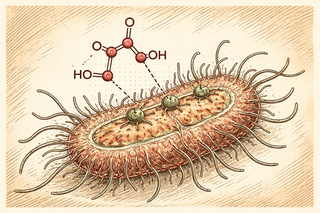
Enter GUT-SCAN. No, that's not a rejected superhero name. It stands for Gut Unique Typing via Spectral and Chemical Analysis using Boronic Acid Nanosensor, and yes, someone definitely spent a weekend reverse-engineering that acronym. Published in Nature Communications, a team led by Kuicheng Zhao and colleagues just handed us what amounts to a microbial census tool that's fast, affordable, and - here's the kicker - actually works (Zhao et al., 2026).
So What's the Big Deal With Gut Bugs?
Right, quick detour. Your gut microbiome is like a biological fingerprint - unique to you, shaped by everything from your diet to your dog. And certain bacterial lineups are strongly linked to colorectal cancer (CRC). Bacteria like Fusobacterium nucleatum have been caught red-handed at tumor sites so often that researchers basically treat them as accomplices (Castellarin et al., 2012). A landmark 2024 study in Nature even showed that a specific clade of F. nucleatum dominates the CRC niche like it owns the place (Zepeda-Rivera et al., 2024).
The problem? Current methods for profiling gut bacteria - 16S rRNA sequencing, metagenomics, the whole molecular biology toolkit - are slow, expensive, and require lab equipment that costs more than your car. Not exactly something you'd roll out at a community health screening.
A Chemical Nose for Your Gut
Here's where GUT-SCAN gets clever. Instead of sequencing DNA, it uses chemistry. Specifically, boronic acid derivatives - molecules that reversibly bind to sugars and other diol-containing compounds on bacterial surfaces. Different bacteria have different surface chemistries (think of it as each species wearing a slightly different cologne), and boronic acids can sniff out those differences.
The team built an 18-channel sensor array: six different boronic acid compounds tested across three pH levels (6.0, 7.4, and 8.2). Each bacterium produces a unique pattern of fluorescence responses across all 18 channels - a chemical fingerprint, basically. Feed those patterns into a machine learning algorithm and boom: 100% accuracy distinguishing between gut-derived bacterial species.
Not 97%. Not "pretty good for a prototype." One hundred percent.
From Bacteria ID to Cancer Staging
But wait - can it actually tell you something clinically useful? The researchers went further. They showed GUT-SCAN could quantify specific CRC-associated bacteria in mixed samples and, critically, discriminate between different stages of colorectal cancer. That's not just "you might have cancer" - that's "here's roughly where you are in the process," which is the kind of information that changes treatment decisions.
This matters because CRC is the third most common cancer worldwide, and early detection is everything. Recent machine-learning approaches using stool microbiome data have hit detection rates around 90% - tantalizingly close to colonoscopy's 94% (Li et al., 2025). A multichannel sensor array published in Analytical Chemistry previously demonstrated proof-of-concept for this kind of recognition-engineering approach to gut microbiota sensing (Wang et al., 2023). GUT-SCAN takes that ball and sprints with it.
Why Should You Care?
Because this thing is cheap, fast, and doesn't need a genome sequencer. Imagine a world where your annual checkup includes a quick sensor-based gut microbiome scan - no fasting, no sedation, no awkward hospital gown. The platform's simplicity means it could theoretically be deployed in low-resource settings where CRC screening barely exists.
Is it ready for your doctor's office tomorrow? No. Clinical validation in large, diverse populations is still needed, and translating from lab-cultured bacteria to the chaotic mess of an actual human stool sample is a non-trivial leap. But as a proof of concept, GUT-SCAN is the kind of elegant, practical innovation that makes you think: why didn't anyone do this sooner?
Your gut neighborhood just got its first affordable home inspection service. And it might just save some lives.
References:
-
Zhao, K., Zhu, X., Liu, F., et al. (2026). Fingerprint profiling human gut microbiota through boronic acid-based sensor array and its application on colorectal cancer classification. Nature Communications. DOI: 10.1038/s41467-026-71350-x. PMID: 41951622
-
Zepeda-Rivera, M., Minot, S.S., Bouzek, H., et al. (2024). A distinct Fusobacterium nucleatum clade dominates the colorectal cancer niche. Nature, 628, 424-432. DOI: 10.1038/s41586-024-07182-w
-
Li, Z., et al. (2025). Gut microbiome-based machine learning model for early colorectal cancer and adenoma screening. Gut Pathogens. DOI: 10.1186/s13099-025-00750-z. PMID: 41063289
-
Wang, Y., et al. (2023). Recognition Engineering-Mediated Multichannel Sensor Array for Gut Microbiota Sensing. Analytical Chemistry. DOI: 10.1021/acs.analchem.2c04997
-
Castellarin, M., Warren, R.L., Freeman, J.D., et al. (2012). Fusobacterium nucleatum infection is prevalent in human colorectal carcinoma. Genome Research, 22(2), 299-306. DOI: 10.1101/gr.126573.111
Disclaimer: The image accompanying this article is for illustrative purposes only and does not depict actual experimental results, data, or biological mechanisms.