Meanwhile, in the walnut-sized gland quietly minding its own business south of the bladder, a territorial dispute is unfolding. A cluster of cells has gone rogue - not dramatically, not all at once, but in the slow, methodical way that natural selection rewards: one mutation at a time, one survival advantage stacked on another, until what was once a law-abiding patch of tissue now runs its own little breakaway republic.
The question urologists keep wrestling with isn't whether to look for these rebels. It's where to stick the needle.
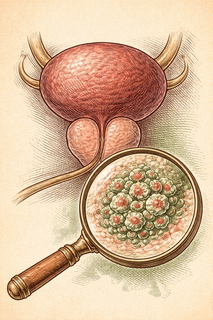
The Biopsy Turf War
For years, the standard approach to prostate cancer diagnosis combined two strategies: MRI-targeted biopsies (aiming straight at suspicious spots on imaging) plus systematic biopsies (poking around the rest of the prostate in a grid pattern, like searching a parking lot one space at a time). It works, but it's the biological equivalent of tearing up half the lawn to find one mole hole.
A letter from Alexander Light, Hashim Ahmed, and Taimur Shah at Imperial College London, responding to work by Baboudjian, Uleri, Anract, and colleagues in European Urology Oncology, digs into a smarter alternative: perilesional biopsy [1, 2]. Instead of blindly sampling the whole gland, you sample the neighborhood around the suspicious lesion - the immediate surrounding tissue where trouble is most likely brewing.
Umbra, Penumbra, and the Eclipse of Systematic Biopsy
The conceptual backbone here comes from a beautifully Darwinian observation. In 2022, Brisbane and colleagues analyzed over 30,000 biopsy cores from more than 2,000 men and mapped cancer's geography around MRI-visible lesions [3]. They borrowed astronomical terminology: the umbra is the lesion itself (the dark center of the eclipse), and the penumbra is the ring of tissue just outside it.
Their finding was striking: 90% of clinically significant prostate cancer cores sat within 10 millimeters of the MRI-visible lesion. Sixty-five percent lived inside the umbra, and another 26% lurked in the penumbra. The remaining tissue? Mostly innocent bystanders.
This makes evolutionary sense. Tumors don't teleport. They expand outward from their point of origin, colonizing adjacent territory like any successful invasive species. The cells at the leading edge of a tumor are the ones under the strongest selective pressure, picking up new mutations and adaptations as they push into fresh tissue. If you want to understand the full genetic story of someone's cancer - including its most aggressive clones - the perilesional zone is where the plot thickens.
The Evidence Piles Up
The PERI-PRO randomized trial recently put this to a proper test, enrolling 380 biopsy-naive men with suspicious MRI findings [4]. The result: targeted-plus-perilesional biopsy detected clinically significant cancer at exactly the same rate as the traditional combined approach (58% vs. 58%), while causing significantly fewer complications. Less bleeding, less pain, shorter procedure times. Same answers, fewer holes. Evolution would approve of that efficiency.
Real-world data tells a similar story. A Portuguese center analyzing 617 patients found that 81% of clinically significant disease concentrated in the index lesion and its perilesional zone, with contralateral biopsies changing management in only 6.3% of cases [5]. Meanwhile, Noujeim and colleagues in Brussels demonstrated that a 10mm perilesional sampling template matched the detection rates of the full combined approach [6].
The 2024 European Association of Urology guidelines took notice, recommending targeted-plus-perilesional biopsy for patients with MRI-visible lesions. Baboudjian and colleagues' TARGET trial - a prospective multicenter study pitting perilesional against systematic sampling - aims to deliver the definitive answer [2].
Why This Matters Beyond the Needle
Here's where the evolutionary lens gets really interesting. Prostate cancer is notoriously multifocal - multiple independent tumor clones can set up shop in the same gland, each with its own mutational playbook. About 37% of patients harbor tumors with distinct genetic profiles across different foci. The biopsy debate is really a question about sampling strategy in a spatially heterogeneous ecosystem.
The perilesional approach bets that the clinically meaningful action - the clones fit enough to grow, invade, and potentially metastasize - clusters predictably around what MRI can already see. Distant, low-grade foci that systematic biopsies occasionally catch? They're often the evolutionary dead ends: slow-growing, indolent populations that natural selection hasn't favored with aggressive traits. Finding them can trigger treatment cascades that do more harm than good.
Light, Ahmed, and Shah's commentary highlights this tension between diagnostic completeness and clinical utility - a reminder that finding more cancer isn't always the same as finding better information.
The Bottom Line
The prostate is a small organ with a big sampling problem, and perilesional biopsy looks increasingly like the Goldilocks solution: enough coverage to catch what matters, restrained enough to avoid the collateral damage of over-detection. Tumor evolution follows predictable spatial rules, and our biopsy strategies are finally starting to respect that geography.
Natural selection built these tumors one mutation at a time. The least we can do is be equally thoughtful about where we look for them.
References
-
Light A, Ahmed HU, Shah TT. Re: Michael Baboudjian, Alessandro Uleri, Julien Anract, et al. Targeted, Perilesional, and Distant Biopsies in Prostate Cancer. Eur Urol Oncol. 2026. DOI: 10.1016/j.euo.2026.03.025. PMID: 42002483.
-
Baboudjian M, Sordelli F, Patard JJ, et al. Targeted and Perilesional or Systematic Biopsies in Prostate Cancer: The TARGET Clinical Trial Protocol. Eur Urol Oncol. 2026. DOI: 10.1016/j.euo.2026.02.003. PMID: 41813528.
-
Brisbane WG, Priester AM, Ballon J, et al. Targeted Prostate Biopsy: Umbra, Penumbra, and Value of Perilesional Sampling. Eur Urol. 2022;82(3):303-310. DOI: 10.1016/j.eururo.2022.01.008. PMID: 35115177.
-
Deng R, et al. Comprehensive Evaluation of Targeted and Perilesional Biopsy in Biopsy-Naive Patients With Prostate Positive Magnetic Resonance Imaging: PERI-PRO Noninferiority Randomized Controlled Trial. J Urol. 2026;215(4). DOI: 10.1097/JU.0000000000004863. PMID: 41270377.
-
Bastos SS, Oliveira V, Dias J, et al. The importance of targeted plus perilesional prostate biopsy in prostate cancer management (diagnosis and treatment) - real world evidence of a tertiary centre. Int Urol Nephrol. 2026. DOI: 10.1007/s11255-026-05029-z. PMID: 41579321.
-
Noujeim JP, Belahsen Y, Lefebvre Y, et al. Optimizing multiparametric magnetic resonance imaging-targeted biopsy and detection of clinically significant prostate cancer: the role of perilesional sampling. Prostate Cancer Prostatic Dis. 2023;26(3):575-580. DOI: 10.1038/s41391-022-00620-8. PMID: 36509930.
Disclaimer: The image accompanying this article is for illustrative purposes only and does not depict actual experimental results, data, or biological mechanisms.