When we last left our heroes, the plucky engineered immune cells known as CAR T cells had conquered lymphoma and myeloma with the swagger of a championship team on a winning streak. But AML - acute myeloid leukemia - remained the villain they couldn't quite crack. The tumor microenvironment was hostile, the target antigens were shared with normal cells, and every promising approach seemed to fizzle at the finish line. Enter KITE-222, a fresh contender targeting a protein called CLL-1, stage left, cape billowing. Spoiler alert: this episode doesn't end with a victory lap.
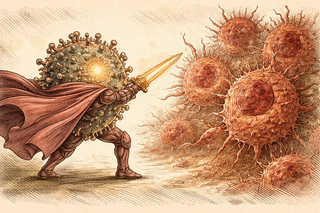
The Setup Was Actually Pretty Smart
Here's what made KITE-222 interesting on paper (literally). CLL-1, or C-type lectin-like molecule 1, sits on the surface of myeloid leukemia cells but - and this is the key selling point - it's absent from normal hematopoietic stem cells. That matters enormously. Previous CAR T targets in AML, like CD33 and CD123, had an annoying habit of also showing up on the stem cells your bone marrow desperately needs. Targeting them was like trying to weed a garden with a flamethrower.
So Kite Pharma built an autologous CAR T product aimed at CLL-1 and ran a Phase 1 dose-escalation trial across three dose levels in twelve patients with relapsed or refractory AML (Daver et al., 2025). The doses ranged from 30 million to 300 million CAR-positive T cells. Manufacturing worked. Safety was manageable - nobody got severe cytokine release syndrome, which is basically the immune system equivalent of a bar fight. Only one patient had serious neurotoxicity. On the toxicity front, this was a win.
The "But" You Saw Coming
And yet. Despite the CAR T cells expanding in patients' blood - proving they were alive, awake, and theoretically ready to fight - clinically meaningful responses just... didn't happen. Two patients in the highest dose group came tantalizingly close: their CLL-1-positive blasts were nearly wiped out of the bone marrow. Job done, right? Not quite. The CLL-1-negative blasts were still there, lounging around like they'd never gotten the eviction notice.
This is antigen escape in action, and it's been the recurring villain of this whole series. AML blasts are not a uniform army wearing matching jerseys. They're a heterogeneous mob where some cells express CLL-1 and some don't. Kill the ones wearing the target, and the ones without it simply take over. It's whack-a-mole at the molecular level.
AML: CAR T Therapy's Toughest Opponent
To appreciate why this matters, consider the scoreboard. CAR T therapy has produced response rates above 80% in certain B-cell lymphomas. In AML? We're looking at roughly 30% of patients showing any response at all, and durable remissions remain stubbornly rare (Zhang & Zhu, 2025). The problem isn't that the science is wrong - it's that AML is playing a fundamentally different game.
Unlike B-cell cancers, where CD19 is reliably plastered across virtually every malignant cell, AML doesn't offer a universal surface marker. CLL-1 expression is variable. CD33 and CD123 hit normal cells too hard. The tumor microenvironment in AML actively suppresses immune function. It's less "find the target and shoot" and more "find a target that's only sometimes there, in a room full of smoke, while the floor is lava."
What Happens Next Season
The KITE-222 story isn't a failure so much as an expensive lesson that confirms what the field has been suspecting: single-antigen CAR T approaches probably won't cut it in AML. The path forward likely involves dual-targeting or multi-antigen CARs that can hit leukemia cells regardless of which surface proteins they're displaying. Recent work presented at ASH 2024 showed promising results with CLL-1 CARs in larger Chinese cohorts, including responses in patients with extramedullary disease. Adapter CAR-T platforms that can flexibly switch between targets are also generating preclinical excitement.
The honest takeaway? KITE-222 did exactly what a Phase 1 should do - it proved the therapy was safe to give and revealed precisely why it didn't work well enough. That "why" - CLL-1 heterogeneity and antigen escape - now gives the field a sharper problem to solve. Sometimes the most useful clinical trial is the one that clearly shows you where the wall is, so the next team knows where to bring the ladder.
AML's CAR T moment is coming. It just needs smarter engineering, not louder immune cells.
References:
-
Daver N, Blachly JS, Ghobadi A, et al. Phase 1 Study of KITE-222, an Autologous CLL-1-directed CAR T-cell Therapy in Patients With Relapsed/Refractory Acute Myeloid Leukemia. Clinical Cancer Research. 2025. DOI: 10.1158/1078-0432.CCR-25-3745. PMID: 41941266
-
Zhang H, Zhu HH. Breakthroughs of CAR T-cell therapy in acute myeloid leukemia: updates from ASH 2024. Experimental Hematology & Oncology. 2025;14(1):52. DOI: 10.1186/s40164-025-00651-6. PMID: 40217514
-
Honing CAR T cells to tackle acute myeloid leukemia. Blood. 2025;145(11):1113. DOI: 10.1182/blood.2024027631
-
Hernández-López A, Téllez-González MA, Mondragón-Terán P, Meneses-Acosta A. Strategies to Overcome Antigen Heterogeneity in CAR-T Cell Therapy. Cells. 2025;14(5):320. DOI: 10.3390/cells14050320
Disclaimer: The image accompanying this article is for illustrative purposes only and does not depict actual experimental results, data, or biological mechanisms.