The pathologist was halfway through her third coffee when the mass spectrometer spat out something that made her set the mug down. Buried in the proteomic data from 759 tumor samples, six proteins were practically screaming about which stage III colon cancer patients would relapse - and which ones could probably skip months of grueling chemotherapy.
The Problem Nobody Talks About at Dinner Parties
Here's a fun number to chew on: roughly 55% of stage III colon cancer patients are already cured by surgery alone. They don't need the follow-up chemotherapy. They get it anyway, because right now, doctors can't reliably tell who's in the clear and who's got a ticking time bomb in their gut. That means more than half the people enduring oxaliplatin-induced neuropathy (look it up - it's as unpleasant as it sounds) are doing it for nothing. Only about 30% of patients actually benefit from adjuvant treatment, while another 20% will recur no matter what you throw at them (Argyriou et al., 2019).
So yeah, we've been playing a very expensive, very toxic guessing game. And a team of researchers just dealt us a better hand.
Meet the Magnificent Six
Aref, Pathan, and colleagues did something clever: they ran tumor samples through data-independent acquisition mass spectrometry - basically a machine that catalogs every protein in a tissue sample like an obsessive librarian sorting books by weight, charge, and vibe. They compared tumor tissue to normal adjacent tissue (the healthy neighbor living next to the cellular chaos) and hunted for proteins whose levels correlated with who relapsed and who didn't (Aref et al., 2025).
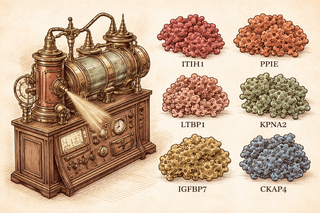
Out of thousands of candidates, six proteins made the final cut: ITIH1, PPIE, LTBP1, KPNA2, IGFBP7, and CKAP4. If that looks like someone fell asleep on their keyboard, welcome to proteomics naming conventions. But these six aren't random. KPNA2, for instance, is a known troublemaker - a nuclear transport protein that's been flagged as a poor prognostic marker across melanoma, lung, cervical, and liver cancers (Alshareeda et al., 2019). IGFBP7 has been linked to immune infiltration patterns in gastric cancer. These proteins aren't just along for the ride - they're actively involved in the cellular drama.
Does It Actually Work, Though?
This is where the study gets genuinely impressive. The team built their six-protein risk score using a training cohort of 175 patients, and then - and this is the part that separates real science from PowerPoint optimism - they validated it in two completely independent groups (386 and 198 patients, respectively).
In the training cohort, high-risk patients had a hazard ratio of 5.7 for recurrence. That's not a gentle nudge - that's the difference between "probably fine" and "probably not." In both validation cohorts, the hazard ratio held at 1.8, which is still clinically meaningful and, more importantly, consistent across different patient populations and institutions.
When they combined the proteomic score with standard clinical risk factors (things like T-stage and lymph node involvement), the accuracy got even better. The integrated score identified a subgroup of patients with very low recurrence risk across all three cohorts. These are the patients who might not need six months of chemotherapy destroying their nerve endings.
Why This Matters More Than You'd Think
The proteomics approach used here - DIA mass spectrometry - represents a shift in how we think about biomarkers. Unlike genomic tests that look at DNA mutations or gene expression panels, proteomic profiling measures the actual functional molecules doing the work in your cells (Moulder et al., 2024). DNA is the blueprint; proteins are the building. Sometimes the blueprint says one thing and the construction crew does something entirely different.
What makes this study stand out in a crowded field is the validation across three independent cohorts from different institutions and countries. A lot of biomarker studies look great in their discovery dataset and then quietly fall apart when tested elsewhere - the scientific equivalent of a restaurant that's amazing in the review photos but disappointing in person. This one held up (Koncina et al., 2024).
What Happens Next
Before anyone starts demanding their oncologist run a six-protein panel, there's a catch. This is still a retrospective study. The proteins predict recurrence, but we don't yet know if using the score to change treatment decisions actually improves outcomes. That requires prospective clinical trials - the gold standard that takes years and costs a fortune, but separates "interesting finding" with "change-your-practice evidence."
The researchers know this. They're calling for treatment-stratified trials to test whether low-risk patients can safely skip or reduce chemotherapy, and whether high-risk patients might benefit from more aggressive approaches. With circulating tumor DNA (ctDNA) also emerging as a monitoring tool (Wang et al., 2025), the future of colon cancer management is looking increasingly personalized - and increasingly like we can stop poisoning people who don't need it.
That third coffee? Totally justified.
References:
-
Aref AT, Pathan M, Habib R, et al. Proteomics-Driven Risk Stratification in Stage III Colon Cancer: A Validated Prognostic Signature for Recurrence Prediction using three independent cohorts. Clin Cancer Res. 2025. DOI: 10.1158/1078-0432.CCR-25-3200. PMID: 41954643
-
Alshareeda AT, Negm OH, Green AR, et al. The functional role of the novel biomarker karyopherin α 2 (KPNA2) in cancer. Cancer Lett. 2019. PMCID: PMC7126488
-
Moulder R, Schvartz D, Shevchenko G, et al. Prediction of overall survival in stage II and III colon cancer through machine learning of rapidly-acquired proteomics. Cell Discov. 2024. DOI: 10.1038/s41421-024-00707-7. PMCID: PMC11319451
-
Koncina E, Desterke C, Selloum S, et al. Integrated meta-analysis of colorectal cancer public proteomic datasets for biomarker discovery and validation. BMC Cancer. 2024. PMCID: PMC10833860
-
Argyriou AA, Briani C, Cavaletti G, et al. Adjuvant therapy for stages II and III colon cancer: risk stratification, treatment duration, and future directions. Curr Oncol. 2019. PMCID: PMC6878933
-
Wang H, Kramer A, Greuter MJE, et al. CtDNA-guided de-escalation of adjuvant chemotherapy in stage III colon cancer. Ther Adv Med Oncol. 2025. DOI: 10.1177/17588359251384238
Disclaimer: The image accompanying this article is for illustrative purposes only and does not depict actual experimental results, data, or biological mechanisms.