Triple-negative breast cancer is the villain nobody roots for. It's aggressive, it's sneaky, and it refuses to carry the molecular handles - estrogen, progesterone, and HER2 receptors - that doctors normally grab onto when selecting treatments. About 30% of TNBC patients who receive neoadjuvant chemotherapy (chemo given before surgery) achieve a pathologic complete response, meaning the tumor vanishes entirely. For the other 70%, cancer cells survive, lurk in what researchers call "residual disease," and frequently come roaring back as metastatic cancer (Echeverria et al., 2019).
The big question has always been: how do these cells survive the chemical onslaught?
Not Mutants. Shape-Shifters.
Here's where the story gets a plot twist worthy of a season finale. A team led by Yu Zhang and Rachael Natrajan built a massive single-cell atlas - 129,433 cells from fourteen patient-derived xenograft (PDX) models of TNBC that had survived neoadjuvant chemotherapy. Using single-cell transcriptomics, they essentially wiretapped every surviving cancer cell's internal communications (Zhang et al., 2026).
What they found wasn't a single cunning escape artist. It was a whole ensemble cast. Four transcriptionally distinct cell states co-existed within residual tumors, each enriched for different survival programs: developmental pathways, hypoxia signaling, interferon response, and chromosomal instability/DNA damage repair. Two of these states - the hypoxia and interferon signaling populations - carried the hallmarks of drug-tolerant persister (DTP) cells, those maddening cancer cells that don't mutate their way to resistance but instead slip into a reversible, almost hibernation-like state until the drugs clear out.
Think of it like this: instead of building one bunker, the tumor runs four different safe houses simultaneously, each with its own disguise kit.
KDM5B: The Dimmer Switch on Your DNA
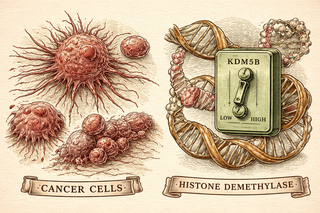
One of the key characters in this drama is KDM5B, a histone demethylase - basically an enzyme that controls how tightly certain genes are wound up. KDM5B strips methyl groups from histone H3 at lysine 4 (H3K4), effectively turning down the volume on nearby genes. Previous work has shown that cancer cells with high KDM5B expression settle into a slow-cycling persister state, biding their time before reigniting tumor growth (Roesch et al., 2013). An inhibitor targeting KDM5 demethylases has already been shown to reduce the survival of these drug-tolerant cells (Vinogradova et al., 2016), hinting that this epigenetic dimmer switch could be a druggable target.
What makes the Zhang et al. findings particularly compelling is that KDM5B isn't operating in isolation. It's part of a broader epigenetic rewiring that allows multiple persister states to coexist, each potentially requiring a different therapeutic countermeasure.
The Oxygen-Starved Accomplice
Hypoxia - the low-oxygen environment lurking in the cores of solid tumors - plays a starring supporting role. Tumor regions deprived of oxygen have long been known to shelter treatment-resistant cells, and hypoxia has been shown to stabilize KDM5B through a SUMOylation-dependent mechanism (Yang et al., 2022). In the Zhang study, the hypoxia-enriched persister state was one of the most prominent survivors, suggesting that oxygen-starved tumor neighborhoods essentially act as nurseries for these dormant rebels.
Why This Matters Before Chemo Even Starts
Perhaps the most unsettling finding: these survival programs aren't something tumors invent on the fly when chemotherapy shows up. The dysregulated pathways enriched in residual disease were already present in chemotherapy-naive patients. They were maintained all the way through to distant metastases. And they predicted both prognosis and treatment response.
Translation: the seeds of resistance are planted before the first dose of chemo is ever infused. The tumor already has its escape routes mapped.
The Road Ahead
The fact that these persister states are reversible - not hardwired mutations - is actually the silver lining. Previous work demonstrated that residual TNBC tumors revert to a chemo-sensitive state when treatment stops and that their dependence on oxidative phosphorylation during the persister phase creates a vulnerability window (Echeverria et al., 2019). The Zhang study adds crucial resolution: there isn't just one persister program to target, but four. Future therapeutic strategies may need combination approaches - epigenetic modulators, metabolic inhibitors, and microenvironment-targeting agents deployed simultaneously - to shut down all four safe houses at once (Cabanos & Hata, 2024).
The tumor thought it was running a sophisticated witness protection program. Science just found all the addresses.
References
-
Zhang Y, Ahmadi Moughari F, Mavrommati I, et al. Co-occurrence of transcriptionally distinct persister cell states underpins neoadjuvant therapy resistance in triple-negative breast cancer. Genome Medicine. 2026. DOI: 10.1186/s13073-026-01643-9. PMID: 41957609
-
Echeverria GV, Ge Z, Seth S, et al. Resistance to neoadjuvant chemotherapy in triple-negative breast cancer mediated by a reversible drug-tolerant state. Science Translational Medicine. 2019;11(488):eaav0936. DOI: 10.1126/scitranslmed.aav0936. PMCID: PMC6541393
-
Vinogradova M, Gehling VS, Engstrom LD, et al. An inhibitor of KDM5 demethylases reduces survival of drug-tolerant cancer cells. Nature Chemical Biology. 2016;12(7):531-538. DOI: 10.1038/nchembio.2085
-
Roesch A, Vultur A, Bogeski I, et al. Overcoming intrinsic multidrug resistance in melanoma by blocking the mitochondrial respiratory chain of slow-cycling JARID1B-high cells. Cancer Cell. 2013;23(6):811-825. DOI: 10.1016/j.ccr.2013.05.003
-
Cabanos HF, Hata AN. Drug tolerant persister cell plasticity in cancer: a revolutionary strategy for more effective anticancer therapies. Signal Transduction and Targeted Therapy. 2024;9:218. DOI: 10.1038/s41392-024-01891-4
-
Yang GJ, Wu J, Leung CH, et al. Hypoxia stimulates SUMOylation-dependent stabilization of KDM5B. International Journal of Molecular Sciences. 2022;23(3):1013. DOI: 10.3390/ijms23031013
Disclaimer: The image accompanying this article is for illustrative purposes only and does not depict actual experimental results, data, or biological mechanisms.