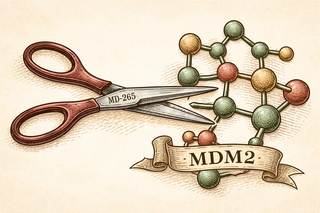
Every protein has a look, and MDM2 - the most obnoxious bouncer in cancer biology - has been strutting through leukemia cells in the same untouchable outfit for decades, shoving your body's best tumor-suppressing protein into the cellular dumpster like a reality TV villain discarding last season's wardrobe. Researchers just handed it a forced makeover. They've designed a molecular stylist called MD-265 that pins a bright neon "DESTROY ME" tag right on MDM2's lapel, and suddenly the cell's own cleanup crew cannot wait to escort it out.
The Bouncer Problem
Here's the situation on the ward floor, so to speak. In acute myeloid leukemia (AML), about 80-85% of patients actually have a perfectly functional copy of p53 - that's the protein your cells rely on to hit the emergency brake when something goes wrong. The problem isn't that p53 is broken. It's that MDM2, an E3 ubiquitin ligase, keeps grabbing p53 and feeding it to the proteasome like a bouncer tossing out the one person who could actually shut down the party (Kandarpa et al., 2026).
Doctors have tried MDM2 inhibitors - drugs that block MDM2 from grabbing p53. Idasanutlin made it all the way to a Phase III trial (the MIRROS trial), and while it boosted response rates, it didn't improve overall survival. The fundamental issue? When you block MDM2, the cell panics and makes more MDM2. It's like telling the bouncer he can't touch anyone, so the club hires fifteen more bouncers (Montesinos et al., 2022).
Enter the Molecular Tailor
This is where PROTAC technology gets genuinely clever. PROTACs (Proteolysis-Targeting Chimeras) are bifunctional molecules - think of them as a tiny matchmaker with one hand grabbing MDM2 and the other hand grabbing an E3 ligase called cereblon. Once those two are introduced, cereblon slaps a ubiquitin tag on MDM2, and the proteasome - your cell's shredding machine - chews it up. No more bouncer. No feedback loop. No fifteen replacement bouncers (Zhang et al., 2022).
MD-265, developed by Shaomeng Wang's group at the University of Michigan, does this at concentrations that would make a pharmacologist blush. We're talking MDM2 depletion at 1 nanomolar - that's roughly one molecule per billion water molecules doing the job. In cell lines, MD-265 hit IC50 values of 0.7 nM in RS4;11 leukemia cells, making it over 200 times more potent than the conventional inhibitor MI-1061 (Liu et al., 2025).
What Happened When They Tested Real Patient Cells
The new study from Kandarpa and colleagues did something that matters enormously at the bedside: they tested MD-265 in 105 primary leukemic stem cell samples - cells taken directly from patients, not cell lines that have been growing in a dish since before most of us had smartphones.
The median IC50 was 16 nM. That's still roughly 150-fold more potent than MI-1061 in the same samples. The cells that didn't respond? They carried TP53 mutations - which makes perfect sense, because if p53 itself is broken, it doesn't matter how many bouncers you fire. The alarm system is already disconnected.
In patient-derived xenograft (PDX) models - where actual human leukemia is grown in mice to test drugs under realistic conditions - MD-265 achieved significant tumor regression. This is the kind of data that makes you sit a little straighter during tumor board.
Why This Matters for the Person in the Hospital Bed
I've watched patients navigate AML treatment. It's brutal, and the options for relapsed or refractory disease are painfully limited. What makes MD-265 different isn't just potency on paper - it's the biology underneath.
When MDM2 inhibitors stabilize p53, they also jack up MDM2 levels, creating a tug-of-war the drug eventually loses. MD-265 sidesteps this entirely by destroying MDM2 protein without increasing its production. Western blots from the preclinical studies tell the story clearly: p53 goes up, MDM2 goes down. No arm wrestling (Liu et al., 2025).
In mouse models, weekly dosing achieved complete tumor regression with no observable toxicity. When tumors eventually regrew (because cancer is nothing if not persistent), a second round of MD-265 knocked them back down again - something inhibitor-treated tumors refused to do because they'd already developed resistance mutations.
The Fine Print
Before anyone starts planning a victory lap: this is preclinical and ex vivo work. "Works in patient cells in a dish" and "works in mice" are important chapters, but they're not the final one. The jump to human clinical trials will test whether MD-265's pharmacokinetics hold up, whether side effects emerge at therapeutic doses, and whether the 15-20% of AML patients with TP53 mutations will need a different strategy entirely.
But for the majority of AML patients whose p53 is intact but gagged by MDM2, this PROTAC approach is one of the more rational and elegant strategies to emerge in recent years. Sometimes the best way to fix a problem isn't to block the troublemaker - it's to make the troublemaker disappear.
References
-
Kandarpa M, Peterson LF, Potu H, et al. Activity of PROTAC MDM2 degrader in primary leukemia cells and PDX models. Leukemia. 2026. DOI: 10.1038/s41375-026-02957-8. PMID: 41986621
-
Liu Y, et al. Discovery of MD-265: A Potent MDM2 Degrader That Achieves Complete Tumor Regression and Improves Long-Term Survival of Mice with Leukemia. J Med Chem. 2025. DOI: 10.1021/acs.jmedchem.4c01818. PMCID: PMC12077404
-
Montesinos P, et al. Idasanutlin plus cytarabine in relapsed or refractory acute myeloid leukemia: results of the MIRROS trial. Blood Adv. 2022;6(15):4385-4397. PMID: 35413116
-
Zhang X, et al. MDM2-Based Proteolysis-Targeting Chimeras (PROTACs): An Innovative Drug Strategy for Cancer Treatment. Molecules. 2022;27(24):8828. DOI: 10.3390/molecules27248828. PMCID: PMC9570454
-
Wang S, et al. Dual functionality of MDM2 in PROTACs expands the horizons of targeted protein degradation. Biomarker Res. 2025. DOI: 10.1186/s40364-025-00826-7
Disclaimer: The image accompanying this article is for illustrative purposes only and does not depict actual experimental results, data, or biological mechanisms.