Classified ad: Wanted - one punctual extracellular vesicle, size roughly "smaller than your patience on hold with insurance," must report to a designated nanowell, carry useful molecular gossip, and stop smearing fluorescence all over the place.
That, more or less, is the problem this new paper is trying to solve. Extracellular vesicles, or EVs, are tiny membrane-wrapped packages that cells release into body fluids. They carry bits of protein, RNA, and other molecular clues from their home cell, which is why cancer researchers keep eyeing them like detectives eyeing a witness who definitely knows something. The catch? EVs are absurdly small, wildly heterogeneous, and annoying in the way only very important biological particles can be annoying [2,5,6].
In this study, Joong Bum Lee and colleagues built a cleaner way to analyze single EVs instead of averaging a whole messy crowd together [1]. And honestly, the big idea is delightfully simple: give each vesicle its own parking spot.
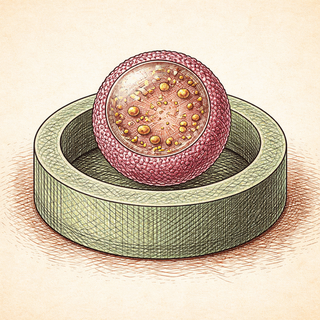
The Tiny Parking Lot Trick
A lot of EV assays capture particles on a continuous surface. Sounds reasonable. It is also a great way to create chaos. If signals appear all over the surface, you wind up asking questions that feel less like science and more like a casino argument. Is that fluorescence from one EV? Two? Background junk? A protein hitchhiker? Who invited that blob?
The authors used an array of tiny nanowells - microscopic pits that can each hold a vesicle at a defined location. Then they used a PDMS "translation" step to wipe away excess particles sitting between wells. In plain English: EVs that land in the right spots stay, and the random loiterers get escorted off the premises [1].
That matters because the analysis becomes spatially unambiguous. The signal gets counted where a well exists, not wherever fluorescent glitter happened to stick. The team reports more than 99% capture at the designed locations in grid patterns, low background, and accurate fluorescence readouts tied to a bright-field nanowell mask [1]. Which is scientific language for: finally, the tiny chaos goblins are standing where you can actually measure them.
Why Single EVs Are Worth the Hassle
Bulk analysis of EVs is a bit like blending an entire fruit salad and then claiming you now understand apples. Sure, technically the apples were in there. Good luck saying anything smart about the kiwi.
Single-EV analysis matters because different vesicles can carry very different cargo, even when they come from the same sample [2,3,5]. Some may have clinically useful markers. Others may be biological wallpaper. If you're trying to detect something like HER2-positive breast cancer EVs, averaging everything together can bury the signal you care about under a mountain of molecular small talk [1,4].
That is exactly why the field has been pushing toward more precise single-particle approaches, from super-resolution nanoscopy to AI-assisted fluorescence profiling [3,4]. The overall theme is pretty consistent: cancer is messy, EVs are messy, and if your measuring tool is also messy, congratulations, you now have a three-layer dip of confusion.
What This Paper Actually Pulled Off
The impressive bit here is not just that the wells look neat. The platform tracked programmed EV mixture ratios with near-unity slopes, which means the measurements lined up very closely with what the researchers intentionally put into the system [1]. That is the kind of result method developers dream about and then try to act normal after seeing.
They also showed HER2 positivity in breast cancer EVs, adapted the method to plasma-derived EVs, expanded it to multichannel fluorescence imaging, and even used it with mixed cargos of EVs plus nanoparticles [1]. So this is not just "look, a cute microarray." It is a flexible measurement framework.
And that flexibility is a big deal because EV diagnostics live or die on reproducibility. Reviews in the field keep hammering the same point: EVs are promising, but standardization, heterogeneity, and signal-to-noise problems keep slowing translation into routine clinical use [2,5,6]. In other words, the biology is exciting, but the workflow has sometimes looked like it was assembled from optimism, centrifuges, and vibes.
Why You Should Care, Even If Nanowells Are Not Your Usual Bar Topic
If this kind of spatially controlled single-EV capture holds up across larger studies, it could make liquid biopsy tools more reliable. That's the real prize. Cancer-linked EVs circulate in accessible fluids like blood, and they may carry useful information about tumor status without needing a chunk of tissue removed from somewhere your body was quite attached to [5,6].
The future version of this story is pretty easy to picture: better EV assays could help sort meaningful tumor-derived signals from background noise, improve monitoring, and maybe catch biologically important changes earlier [4,5]. Not tomorrow. Not magically. But this paper pushes the field one step away from "we saw a blur" and one step closer to "we know which vesicle said what."
For a study about tiny bubbles landing in tiny holes, that is a pretty solid plot twist.
References
- Lee JB, Conteduca D, Jeong MH, Im H. Spatially Controlled Capture and Site-Resolved Analysis of Single Extracellular Vesicles. Small. 2026. DOI: https://doi.org/10.1002/smll.202514514
- Hendrix A, Lippens L, Pinheiro C, et al. Extracellular vesicle analysis. Nat Rev Methods Primers. 2023;3:56. DOI: https://doi.org/10.1038/s43586-023-00240-z
- Saftics A, Abuelreich S, Romano E, et al. Single Extracellular VEsicle Nanoscopy. J Extracell Vesicles. 2023;12(7):e12346. DOI: https://doi.org/10.1002/jev2.12346 PMCID: https://pmc.ncbi.nlm.nih.gov/articles/PMC10329735/
- Zhang XW, Qi GX, Liu MX, Yang YF, Wang JH, Yu YL, Chen S. Deep Learning Promotes Profiling of Multiple miRNAs in Single Extracellular Vesicles for Cancer Diagnosis. ACS Sens. 2024;9(3):1555-1564. DOI: https://doi.org/10.1021/acssensors.3c02789
- Greening DW, Xu R, Rai A, et al. Clinical relevance of extracellular vesicles in cancer - therapeutic and diagnostic potential. Nat Rev Clin Oncol. 2025;22:924-952. DOI: https://doi.org/10.1038/s41571-025-01074-2
- Recent advances in bioreceptor-based sensing for extracellular vesicle analysis. Biosens Bioelectron. 2025;280:117432. DOI: https://doi.org/10.1016/j.bios.2025.117432
Disclaimer: The image accompanying this article is for illustrative purposes only and does not depict actual experimental results, data, or biological mechanisms.