Here's the thing about a garden gone to seed - you can't fix it by just looking at the soil. You need to check the roots, the water table, what's pollinating what, and whether that vine creeping across the fence is actually strangling your tomatoes. Cancer works the same way. For decades, researchers examined one biological layer at a time - just genomics, or just proteomics - like a gardener who only ever looks at the leaves and wonders why the roots keep rotting.
Multi-omics changes the game. It's the approach of looking at everything simultaneously: your genome (the seed catalog), your epigenome (which seeds actually got planted), your transcriptome (what's actively growing), your proteome (the actual fruit), and your metabolome (the compost pile, if we're being honest). Stack those layers together with clinical records and medical imaging, and you get something close to a full satellite view of the whole overgrown lot (Reel et al., 2021).
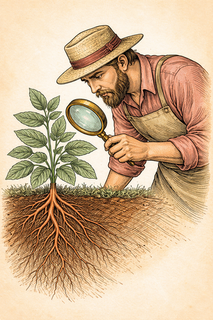
The problem? That's an obscene amount of data. We're talking billions of data points per patient. No human gardener, no matter how dedicated, can eyeball their way through that tangle.
Enter the Robot Gardener
This is where AI earns its keep. Deep learning models, graph neural networks, and transformer architectures - the same tech family that powers chatbots and image generators - are now being aimed at cancer biology like a very expensive leaf blower at a very complicated pile of leaves.
And it's working. AI systems integrating multi-omics data have powered real advances in early cancer detection, figuring out which patients will respond to which treatments, and understanding why some tumors develop drug resistance - that infuriating moment when the weeds learn to ignore your herbicide (Kang et al., 2025). Recent work has shown that deep learning can combine genomic, transcriptomic, proteomic, and even radiological data to classify cancer subtypes with startling accuracy, essentially telling you not just that something's growing where it shouldn't, but exactly what species of trouble you're dealing with (Yang et al., 2025).
The Glass Greenhouse Problem
There's a catch, though, and it's a big one. Most of these AI models are black boxes. They'll tell you "this patient likely won't respond to immunotherapy" but won't explain why - like a gardener who rips out your roses and just says "trust me." Clinicians, understandably, want receipts.
That's why explainable AI, or XAI, has become the field's most urgent subplot. Techniques like SHAP and Grad-CAM are being developed to make AI's reasoning transparent, essentially forcing the algorithm to show its work. Without that transparency, these tools will remain academic curiosities rather than clinical essentials - nobody's going to let a robot prune their prize garden without understanding the logic (Liu et al., 2026).
Your Very Own Virtual Garden
The most soil-your-pants exciting part of this review? Digital twins. Imagine a complete computational replica of your personal cancer - a virtual garden that mirrors every weed, every soil condition, every microbe in your particular plot. Researchers are building patient-specific simulations that can model how your tumor might respond to different treatments before a single pill is swallowed or needle inserted.
It's still early days - the digital twin market in healthcare is projected to grow at a blistering 25.9% annually through 2030 - but the vision is extraordinary: running a hundred treatment simulations on your digital doppelganger to find the approach that works best for your specific patch of biological chaos (Venkatesh et al., 2025).
The Stubborn Weeds Remain
Challenges persist, naturally. Data standardization is a mess (every hospital's garden is cataloged differently). Computational demands are enormous. Privacy concerns hover like aphids. And model generalizability - whether an AI trained on one population's data can work for another - remains a thorny problem, pun fully intended.
But the trajectory is unmistakable. We're moving from treating cancer like a single pest to understanding it as an entire ecosystem, and AI is the only tool powerful enough to survey the whole landscape. The garden isn't tamed yet, but for the first time, we've got a crew that can actually see the full extent of the overgrowth - and that's how every good restoration begins.
References
-
Liu, F., Beck, S., Yang, L., Luo, H., & Zhang, K. (2026). Advancing AI for multi-omics and clinical data integration in basic and translational cancer research. Nature Reviews Cancer. DOI: 10.1038/s41568-026-00922-2
-
Kang, J. et al. (2025). AI-driven multi-omics integration in precision oncology: bridging the data deluge to clinical decisions. Clinical and Experimental Medicine. DOI: 10.1007/s10238-025-01965-9 | PMID: 41266662
-
Yang, H. et al. (2025). Deep learning-driven multi-omics analysis: enhancing cancer diagnostics and therapeutics. Briefings in Bioinformatics, 26(4), bbaf440. DOI: 10.1093/bib/bbaf440
-
Venkatesh, K. P. et al. (2025). Exploring the potential of digital twins in cancer treatment: a narrative review of reviews. Journal of Clinical Medicine, 14(10), 3574. DOI: 10.3390/jcm14103574
-
Reel, P. S. et al. (2021). Using machine learning approaches for multi-omics data analysis: A review. Computational and Structural Biotechnology Journal, 19, 3735-3746. DOI: 10.1016/j.csbj.2021.06.030
Disclaimer: The image accompanying this article is for illustrative purposes only and does not depict actual experimental results, data, or biological mechanisms.