Confession: for a long time, we acted like pancreatic cancer was simply "hard to find," when the more honest answer is that we were often looking with tools that spot shape changes late instead of molecular trouble early.
That matters because pancreatic cancer is brutally good at staying quiet until it has already packed its bags and started causing problems elsewhere. The pancreas sits deep in the abdomen, symptoms tend to be vague or absent early on, and by the time standard scans catch a clear mass, the disease may already be several chess moves ahead. According to the American Cancer Society, pancreatic cancer now accounts for about 8% of U.S. cancer deaths, which is a wildly unfair number for an organ most people only remember when someone mentions insulin or a weird enzyme panel.
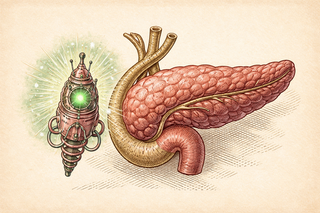
A new review by Li and colleagues dives into one of the most promising fixes: molecular probes. These are targeted imaging agents that bind to molecules linked to pancreatic tumors and make them easier to see on MRI, PET, fluorescence imaging, or combo systems that try to give you both the map and the glowing X on the map at the same time (Li et al., 2025).
Tiny Beacons, Big Job
Think of ordinary imaging as trying to identify a suspicious house by flying over the neighborhood. Molecular imaging is more like tagging the house if it starts buying industrial quantities of duct tape, blackout curtains, and villain monologue stationery.
That is the basic appeal here. Pancreatic tumors do not just look different. They behave differently. They overexpress certain receptors, remodel their surroundings, alter metabolism, and basically turn their local tissue into a sketchy little biome. Molecular probes are built to latch onto those abnormalities. Instead of waiting for a lump to become obvious, you try to catch the tumor while it is still leaving weird biochemical footprints.
Nature loves this trick. Pit vipers detect heat, bats use echolocation, sharks pick up electric fields. Living things rarely rely on one blunt sense when survival is on the line. Meanwhile, in oncology, we have often expected anatomy alone to do all the work. That was optimistic in the same way cargo shorts are optimistic formalwear.
Why Pancreatic Cancer Needs Extra Sneakiness Defense
Recent reviews keep landing on the same frustrating point: early detection is where the real leverage is. Surgery offers the best shot at cure, but only a minority of patients are diagnosed when surgery is still realistic (Wood et al., 2022; Mohamed et al., 2025). Screening the general public is not practical because pancreatic cancer is relatively uncommon, and false positives would create a full-blown medical chaos festival.
So the field is moving toward smarter detection in higher-risk groups and more precise imaging overall. A 2024 MRI case-control study found that scans obtained months before diagnosis often already showed ductal irregularities, focal strictures, atrophy, or subtle signal abnormalities, even when a big obvious tumor was not yet front and center (Parker et al., 2024). That is exactly where molecular probes could help. If anatomy is whispering, a targeted probe might make it stop mumbling.
There is also the surgery angle. Fluorescence-guided approaches are being explored to help surgeons distinguish tumor from normal tissue in real time, which is important in a cancer where clean margins are not exactly a decorative luxury (Piper et al., 2025).
The Cool Part, and the Buzzkill Part
The cool part is obvious: if these probes work reliably, they could improve early detection, sharpen staging, guide surgery, and help match patients to more personalized treatment strategies. In plain English, they could turn pancreatic cancer from "we found it late and guessed fast" into something a bit more like "we found it earlier and acted smarter."
The buzzkill part is also important. Many probes still need better validation, broader clinical testing, cleaner proof that they can distinguish cancer from inflammation like pancreatitis, and a path through the usual gauntlet of safety, cost, and real-world workflow. Cancer biology also loves redundancy. Tumors are the raccoons of disease. Close one trash can, they are already halfway into the next one.
Still, the direction makes sense. Molecular imaging is already reshaping cancer care more broadly by letting clinicians visualize biology, not just anatomy (Rowe and Pomper, 2022). For pancreatic cancer, that shift feels less like a luxury upgrade and more like finally admitting the old flashlight was not enough.
Maybe that is the real plot twist here. Pancreatic cancer has not been invisible. It has been molecularly loud for quite a while. We are just getting better at listening.
References
-
Li J, He W, Dai L, Fan H, Yu X. Molecular Probes for Pancreatic Cancer Diagnosis: Recent Advances and Further Perspectives. Small. 2025. DOI: https://doi.org/10.1002/smll.202513668
-
Wood LD, Canto MI, Jaffee EM, Simeone DM. Pancreatic Cancer: Pathogenesis, Screening, Diagnosis, and Treatment. Gastroenterology. 2022;163(2):386-402.e1. DOI: https://doi.org/10.1053/j.gastro.2022.03.056. PMCID: https://pmc.ncbi.nlm.nih.gov/articles/PMC9516440/
-
Rowe SP, Pomper MG. Molecular imaging in oncology: Current impact and future directions. CA Cancer J Clin. 2022;72(4):333-352. DOI: https://doi.org/10.3322/caac.21713. PMCID: https://pmc.ncbi.nlm.nih.gov/articles/PMC9189244/
-
Mohamed G, Munir M, Rai A, Gaddam S. Pancreatic Cancer: Screening and Early Detection. Gastroenterol Clin North Am. 2025;54(1):205-221. DOI: https://doi.org/10.1016/j.gtc.2024.09.006
-
Piper TB, Schaebel GH, Egeland C, Achiam MP, Burgdorf SK, Nerup N. Fluorescence-guided pancreatic surgery: A scoping review. Surgery. 2025;178:108931. DOI: https://doi.org/10.1016/j.surg.2024.10.022
-
Parker RA III, Suazo M, Ding D, et al. Early features of pancreatic cancer on magnetic resonance imaging (MRI): a case-control study. Abdom Radiol (NY). 2024. PubMed: https://pubmed.ncbi.nlm.nih.gov/38580790/
Disclaimer: The image accompanying this article is for illustrative purposes only and does not depict actual experimental results, data, or biological mechanisms.