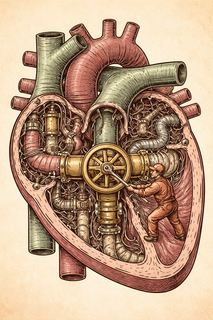
Every house has a main shutoff valve. Turn it, and the water stops flowing, saving your basement from a watery apocalypse. Your heart cells have something similar - a molecular valve called RIPK1 that, when properly tightened, keeps the flood of cell death from swamping the whole neighborhood. The problem? Doxorubicin, one of oncology's most effective (and most feared) chemotherapy drugs, apparently hired a rogue plumber named PPP1R3G to come in and crank that valve wide open.
A new study published in PNAS by Ma, Chen, and Wang has mapped exactly how this plumbing disaster unfolds - and it turns out the damage happens in two devastating waves (Ma et al., 2026).
The $40,000 Side Effect Nobody Budgeted For
Here's a number that should keep hospital CFOs up at night: up to 9% of patients treated with doxorubicin develop heart failure, and those who do face a five-year survival rate south of 50% (Yoon et al., 2018; Rawat et al., 2021). That's worse than many of the cancers the drug is trying to treat. We're essentially paying to cure one disease while inadvertently investing in another - the worst kind of portfolio diversification.
Dexrazoxane remains the sole FDA-approved cardioprotective agent, yet it's woefully underutilized in clinical practice (Cvetković & Scott, 2005; Ganatra et al., 2024). So the market for understanding exactly how doxorubicin wrecks hearts? It's not just academically interesting - it's a multi-billion-dollar gap in the cardio-oncology pipeline.
Act One: The Brake Job Gone Wrong
When doxorubicin first hits your heart cells, your body actually fights back pretty well. A stress-response enzyme called p38 slaps an inhibitory phosphate group onto RIPK1 - think of it as tightening that shutoff valve. RIPK1, which would otherwise trigger a cascade of cell death, sits there neutralized. Temporarily, the system holds.
But doxorubicin doesn't quit after one round. Under sustained chemical stress, PPP1R3G - a protein phosphatase regulatory subunit that nobody was really watching - gets recruited to the scene. Its job? Strip that protective phosphate right off RIPK1. It's the molecular equivalent of a contractor removing your sump pump during a hurricane because "the building code changed."
Once RIPK1 is unleashed, it triggers apoptosis - the orderly, controlled version of cell death. Bad enough on its own, but this is just the opening act.
Act Two: The Feed-Forward Catastrophe
Here's where the economics of this disaster get truly ugly. Activated RIPK1 doesn't just kill cells neatly. It causes mitochondria - the power plants of your heart cells - to start leaking their own DNA into the cytoplasm. That loose mitochondrial DNA (mtDNA) is like a fire alarm that won't stop ringing.
The leaked mtDNA triggers an interferon-beta (IFN-β) signaling circuit, which cranks up production of ZBP1, a Z-DNA-binding protein originally known for sensing viral infections (Kuriakose & Bhatt, 2023). ZBP1 then detects the mtDNA, and instead of sending a calm memo to management, it initiates necroptosis - the messy, inflammatory, blow-the-walls-out version of cell death.
Worse still, this creates a feed-forward loop. More necroptosis means more mitochondrial damage means more leaked DNA means more ZBP1 activation. It's a run on the bank, except the bank is your left ventricle. Recent work has confirmed that ZBP1 sensing of mitochondrial Z-form DNA can drive both necroptosis and ferroptosis through RIPK3-dependent pathways, making ZBP1 a central node in multiple death cascades (Wang et al., 2024).
The Knockout That Changed Everything
The real kicker: when the researchers deleted PPP1R3G in mice, both waves of destruction were dramatically blunted. Apoptosis dropped. Necroptosis dropped. Inflammatory cytokines like TNF-alpha, IFN-beta, and IFN-gamma all fell. The mice survived doxorubicin treatment with their hearts largely intact.
In investment terms, PPP1R3G is the single point of failure in this entire system. Block it, and you cut off the supply chain of cardiac destruction before the first domino falls.
What This Means for the Bottom Line
Current strategies for managing doxorubicin cardiotoxicity - dose capping, serial echocardiograms, dexrazoxane when anyone remembers to use it - are essentially band-aids on a burst pipe (Henriksen, 2018; Lipshultz & Herman, 2024). This study suggests a completely different intervention point: stop PPP1R3G from removing the brake, and you might prevent the entire two-phase collapse from initiating.
For the roughly 32% of all cancer treatment regimens that include an anthracycline, that's not just a scientific insight - it's a potential market correction in how we think about the true cost of chemotherapy (Henriksen, 2018). Every case of chemo-induced heart failure we prevent is a patient who doesn't need a cardiologist, doesn't need a transplant list, and doesn't become a grim line item in the survivorship budget.
The pipes are still leaking. But at least now we know which wrench to grab.
References:
-
Ma, X., Chen, K., & Wang, Z. (2026). PPP1R3G-RIPK1-ZBP1 axis activates early-stage apoptosis and late-stage necroptosis to promote doxorubicin-induced cardiotoxicity. Proceedings of the National Academy of Sciences, 123. DOI: 10.1073/pnas.2603301123
-
Rawat, P. S., et al. (2021). Regulated cell death pathways in doxorubicin-induced cardiotoxicity. Cell Death & Disease, 12, 339. DOI: 10.1038/s41419-021-03614-x
-
Wang, B., et al. (2024). Sensing of mitochondrial DNA by ZBP1 promotes RIPK3-mediated necroptosis and ferroptosis in response to diquat poisoning. Cell Death & Differentiation, 31, 596-608. DOI: 10.1038/s41418-024-01279-5
-
Kuriakose, T., & Bhatt, D. L. (2023). The Z-nucleic acid sensor ZBP1 in health and disease. Journal of Experimental Medicine, 220(8), e20221156. DOI: 10.1084/jem.20221156
-
Ganatra, S., et al. (2024). Dexrazoxane to prevent cardiotoxicity in adults treated with anthracyclines. JACC: CardioOncology, 6(1), 1-17. DOI: 10.1016/j.jaccao.2024.02.004
-
Lipshultz, S. E., & Herman, E. H. (2024). Preventing anthracycline-associated heart failure: What is the role of dexrazoxane? JACC: CardioOncology, 6(1), 18-21. DOI: 10.1016/j.jaccao.2024.01.004
-
Yoon, G. J., et al. (2018). Doxorubicin-induced heart failure in cancer patients: A cohort study based on the Korean National Health Insurance Database. Cancer Medicine, 7(12), 6084-6092. PMC6308087
Disclaimer: The image accompanying this article is for illustrative purposes only and does not depict actual experimental results, data, or biological mechanisms.