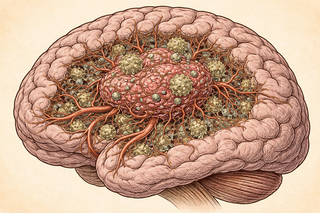
Glioblastoma doesn't just grow. It builds an entire ecosystem around itself - what scientists call the tumor microenvironment. Think of it as the tumor's personal support staff: blood vessels delivering supplies, immune cells that should be fighting but have been convinced to stand down, and a whole network of cellular collaborators passing notes like teenagers in a boring lecture.
A new study published in GigaScience decided to map this entire conspiracy using three different surveillance methods at once. The team from Harbin Medical University combined single-cell RNA sequencing (which reads the activity of individual cells), bulk transcriptomics (which captures the big picture), and spatial transcriptomics (which tells you where everything is actually located). It's like the difference between counting how many people are at a stadium, knowing what each person is saying, and having a seating chart that shows who's sitting next to whom.
Seven Players Worth Watching
Using machine learning - because modern cancer research apparently requires both wet labs and data centers - the researchers identified seven genes that seem particularly important for predicting how patients will fare. These "hallmark-related prognostic signatures" include:
- AEBP1 and ASF1A (involved in cell cycle chaos)
- IL13RA2 (a receptor that immunotherapy researchers already had their eye on)
- OPHN1 (whose ligand-receptor interactions correlated with worse outcomes)
- HDAC5, DCC, and PRPS1 (rounding out the rogues' gallery)
The SHAP analysis - a technique borrowed from explainable AI - confirmed these weren't just statistical noise. These genes are doing something meaningful in the tumor's survival strategy.
The T-Cell Betrayal
Here's where it gets particularly sneaky. Your T-cells are supposed to be the elite assassins of your immune system, hunting down cancer cells with prejudice. But in glioblastoma, something goes wrong along their developmental journey.
The researchers tracked T-cells along their differentiation "pseudotime" - essentially their maturation timeline - and found that three immune checkpoint genes (LAG3, PDCD1, and HAVCR2) get cranked up as T-cells mature. These are the molecular "off switches" that normally prevent your immune system from attacking your own body. Glioblastoma has figured out how to keep flipping these switches, leaving your T-cells standing around like security guards who forgot they were supposed to be guarding something.
Even worse, the study found "synergistic transcriptional regulation" between the tumor's hallmark genes and these checkpoint genes in T-cells. Translation: the tumor and the exhausted T-cells are essentially reading from the same playbook, coordinating their activities in ways that consistently hurt patient survival.
Why This Map Matters
The spatial transcriptomics component revealed that these interactions aren't random. The gene collaborations are happening in specific neighborhoods within the tumor - particular zones where immune suppression is being orchestrated like a military operation.
This matters because immunotherapy approaches that work brilliantly in other cancers have largely flopped against glioblastoma. The Checkmate 143 trial showed that nivolumab - a PD-1 blocker that revolutionized treatment for melanoma and lung cancer - didn't outperform standard therapy in recurrent glioblastoma. Understanding the spatial organization of immune suppression might explain why: you can't win by blocking one checkpoint when there's a coordinated network of suppression happening across multiple cell types and locations.
The Counter-Offensive
Researchers are already testing combination approaches targeting LAG-3 alongside PD-1, based on the logic that knocking out multiple checkpoints simultaneously might overwhelm the tumor's defenses. Early clinical trials are underway, and the multi-dimensional mapping from studies like this one provides crucial intelligence about which combinations might actually have a chance.
The seven-gene signature could also serve as a prognostic tool - helping clinicians identify which patients might benefit from more aggressive or experimental approaches. When you're facing a median survival of 15 months, knowing your opponent's strategy becomes more than academic.
Glioblastoma has been winning this match for decades. Studies that decode its defensive formations, move by move, cell by cell, are how we eventually learn to checkmate it back.
References:
-
Li T, Mi W, Yan H, et al. Dissecting glioblastoma risk signatures in the tumor immune microenvironment based on multi-dimensional transcriptomics. GigaScience. 2026. DOI: 10.1093/gigascience/giag035. PMID: 41880523
-
Arrieta VA, et al. Immunotherapy for glioblastoma: current state, challenges, and future perspectives. Cellular & Molecular Immunology. 2024. Available at: https://www.nature.com/articles/s41423-024-01226-x
-
Woroniecka K, et al. T Cell Dysfunction in Glioblastoma: A Barrier and an Opportunity for the Development of Successful Immunotherapies. PMC. 2021. PMCID: PMC8595795
-
Chen Y, et al. Overcoming immunotherapy resistance in glioblastoma: challenges and emerging strategies. Frontiers in Pharmacology. 2025. Available at: https://www.frontiersin.org/journals/pharmacology/articles/10.3389/fphar.2025.1584688/full
Disclaimer: The image accompanying this article is for illustrative purposes only and does not depict actual experimental results, data, or biological mechanisms.