A handful of overlooked T cells just outperformed the entire cancer immunotherapy starting lineup - and they did it by producing a cytokine nobody took seriously.
That's the punchline. Now let me rewind.
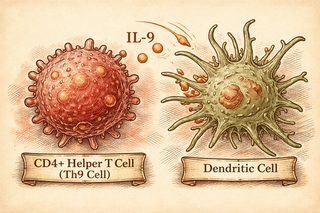
Back in 2008, immunologists identified a new subset of CD4+ helper T cells that mainly pumped out interleukin-9 (IL-9). They called them Th9 cells, gave them a polite nod, and filed them under "probably something to do with allergies and parasites." For years, that's basically where the story stalled. Meanwhile, their flashier cousins - Th1 cells, cytotoxic CD8+ killers, the whole checkpoint inhibitor fan club - grabbed every spotlight, every grant, and every Nature cover.
Then Th9 cells started showing up at the tumor with receipts.
Natural Selection's Sleeper Agent
Here's what makes Th9 cells such a satisfying evolutionary plot twist. Your immune system runs a constant fitness landscape optimization against threats. Different T cell subsets represent different strategies - Th1 cells bring the brute force, Th17 cells specialize in inflammatory scorched earth. Th9 cells? They're the generalist that evolution kept in its back pocket.
When researchers actually bothered to pit Th9 cells against melanoma, they didn't just hold their own against Th1 and Th17 cells - they wiped the floor with them (Lu et al., 2012). Tumor-specific Th9 cells transferred into mice slashed tumor burden more effectively than the supposed heavy hitters. And they pulled this off through an elegant, multi-pronged attack that would make any evolutionary strategist weep with appreciation.
Th9 cells secrete IL-9, which recruits dendritic cells to the tumor via CCL20/CCR6 signaling. Those dendritic cells load up on tumor antigens, shuttle them to draining lymph nodes, and activate CD8+ killer T cells - the actual assassins. So Th9 cells aren't just fighters; they're talent scouts and logistics coordinators rolling a cytokine-fueled Trojan horse right up to the tumor gates (Rivera Vargas et al., 2017).
But wait. Th9 cells also activate mast cells (your immune system's emergency flares), produce IL-21 to supercharge NK cells, and - in a move of pure evolutionary redundancy that would make Darwin proud - pack granzyme-B so they can kill tumor cells directly, just in case their supply chain gets disrupted.
The Arms Race Gets a New Weapon
Cancer, being evolution's other prodigy, doesn't sit still. Tumors have developed an entire playbook for shutting down immune responses - co-opting regulatory T cells, upregulating checkpoint molecules, creating metabolic dead zones that starve infiltrating T cells. It's an immunological cold war, and for years, tumors have been winning most of the skirmishes.
Recent research is tipping that balance. A 2025 study in Nature Immunology found that knocking out YTHDF2 - an RNA reader protein that essentially puts the brakes on Th9 cell development - supercharged Th9 differentiation and dramatically improved CAR-Th9 cell antitumor activity against solid tumors (Xiao, Duan, Hong et al., 2025). Engineering T cells to lose their own internal governors? That's evolution by design, and it's working.
Even more compelling, a Nature Cancer study from the same year revealed that IL-9-producing CD8+ T cells (the cytotoxic cousins of Th9 cells, called Tc9 cells) can control tumors that have already lost their original antigens - the very escape mechanism that dooms most immunotherapies. Tc9 cells accomplish this by recruiting the patient's own CD4+ T cells to mop up the survivors (Xiao, Duan, Liu et al., 2025). It's an immune relay race where the baton never gets dropped, even when the tumor changes the rules mid-game.
And then there's the twist nobody saw coming: IL-9 itself turns out to be a "naturally orthogonal" cytokine, meaning its receptor is barely expressed anywhere except where you want it. A 2026 paper in Immunity showed that T cells engineered with IL-9 receptors had superior stemness, tissue infiltration, and antitumor activity compared to synthetic alternatives (Immunity, 2026). Nature, it seems, had already optimized the design.
Why the B-Team Might Be the A-Team
Xu, Abdoul-Azize, and Apetoh's new review in Seminars in Immunology pulls these threads together into a coherent therapeutic vision (Xu et al., 2026). The strategies on the table include adoptive transfer of Th9 cells, engineering CAR-Th9 cells against specific tumors, and pharmacologically enhancing Th9 differentiation in patients' existing immune repertoires.
The evolutionary logic is irresistible. Th9 cells represent a diversified immune strategy - not one kill mechanism but five, not one pathway but a networked cascade. In the fitness landscape of cancer immunotherapy, that kind of redundancy isn't wasteful. It's exactly what you need against an adversary as adaptable as cancer.
Sometimes the most dangerous competitor isn't the biggest or the loudest. It's the one nobody was watching.
References
-
Xu J, Abdoul-Azize S, Apetoh L. Novel therapeutic strategies leveraging TH9 cell anticancer functions. Semin Immunol. 2026. DOI: 10.1016/j.smim.2026.102026
-
Rivera Vargas T, Humblin E, Végran F, Ghiringhelli F, Apetoh L. TH9 cells in anti-tumor immunity. Semin Immunopathol. 2017;39(1):35-46. DOI: 10.1007/s00281-016-0599-4. PMCID: PMC5222918
-
Lu Y, Hong S, Li H, et al. Th9 cells promote antitumor immune responses in vivo. J Clin Invest. 2012;122(11):4160-71. DOI: 10.1172/JCI65459
-
Xiao S, Duan S, Hong Y, et al. Loss of YTHDF2 enhances Th9 programming and CAR-Th9 cell antitumor efficacy. Nat Immunol. 2025;26:1501-1515. DOI: 10.1038/s41590-025-02235-2. PMID: 40826275
-
Xiao L, Duan R, Liu W, et al. Adoptively transferred tumor-specific IL-9-producing CD8+ T cells activate host CD4+ T cells to control tumors with antigen loss. Nat Cancer. 2025;6:718-735. DOI: 10.1038/s43018-025-00935-0. PMID: 40181089
-
IL-9 as a naturally orthogonal cytokine with optimal JAK/STAT signaling for engineered T cell therapy. Immunity. 2026. DOI: 10.1016/j.immuni.2025.10.024. PMID: 41274289
Disclaimer: The image accompanying this article is for illustrative purposes only and does not depict actual experimental results, data, or biological mechanisms.