If IL-8 showed up for a job interview in metastatic breast cancer, its resume would read: "Excellent at stirring chaos, strong experience in inflammatory management, references available from several deeply unhelpful tumors." That, more or less, is the vibe of a new liquid biopsy study that asks a sneaky question: can a tube of blood tell us not just that cancer is present, but what kind of immune mess it has created and how rough the road ahead might be? [1]
Turns out, yes - at least maybe yes, which is the honest scientific version of a drumroll.
Bloodwork With Better Gossip
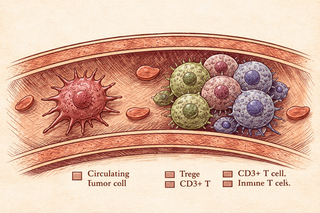
Liquid biopsy is the blood test cousin of a regular tumor biopsy. Instead of jabbing directly into a tumor, researchers look for cancer-related material floating around in blood: tumor DNA, proteins, immune signals, and circulating tumor cells, or CTCs. Those are cancer cells that have broken away and entered the bloodstream like tiny fugitives trying to catch a redeye to somewhere worse. [2,3]
In metastatic breast cancer, that matters because the disease is not just a lump in one place. It is a whole-body problem. The bloodstream becomes less like a neutral highway and more like a sketchy transit hub where cancer cells, immune cells, and inflammatory proteins are all swapping signals behind the vending machines.
What This Study Heard in the Static
The new study followed 60 patients with stage IV metastatic breast cancer before treatment started and used a layered liquid biopsy approach: CTC counting, immune cell profiling, and a 96-protein plasma panel. [1] CTCs showed up in 58.3% of patients, sometimes in alarmingly high numbers. That already matters, because high CTC counts have long been linked to worse outcomes in metastatic breast cancer. [3,5]
But the interesting part was the full band, not just the soloist.
Patients had fewer total leukocytes and fewer CD3+ T cells than healthy donors. Meanwhile, regulatory T cells, or Tregs, were increased. Tregs normally help stop the immune system from going full raccoon-in-a-dumpster and attacking everything in sight. Helpful in normal life, less helpful when cancer has basically hired them as bouncers. These Tregs carried multiple inhibitory markers, including PD-1, CTLA-4, TIGIT, and LAG-3, while effector T cells also showed signs of exhaustion. Translation: the immune security team was on site, but several guards looked sleep-deprived, undertrained, and emotionally checked out.
The blood protein profile added another layer of dissonance. IL-6, IL-8, HGF, ANGPT2, NOS3, CSF1, and galectin-9 were elevated, painting a picture of inflammation plus blood-vessel remodeling plus immune suppression. If you are trying to stop metastasis, that is not a clean rhythm section. That is a jam session where every instrument picked the wrong key on purpose.
Patients with CTCs had higher Treg proportions and higher IL-8, HGF, galectin-9, and TNFRSF12A levels than patients without CTCs. And when the researchers looked at progression-free survival, high CTC count, liver metastases, and triple-negative status predicted shorter time before disease progression. On multivariate analysis, IL-8 and NOS3 stood out as independent predictors. [1]
That makes IL-8 and NOS3 especially interesting. They are not just background noise. They may be part of the melody line that tells you which cancers are moving fast.
Why This Is More Than a Fancy Blood Test
This paper supports a growing idea in oncology: metastatic breast cancer is not only about the tumor itself, but also about the immune and vascular ecosystem the tumor builds around itself. Or, to keep the music metaphor honest, cancer is not just one bad trumpet player. It is an entire off-key ensemble.
Other recent work points in the same direction. Reviews and expert perspectives argue that CTCs are moving from simple counting tools to dynamic biomarkers that can help classify disease aggressiveness, capture tumor heterogeneity, and eventually guide treatment choices in real time. [2-5] A 2025 single-cell study also found that circulating immune cells in breast cancer shift with metastatic burden, especially in myeloid and unconventional T-cell compartments. [4] In other words, the blood is not just carrying cancer. It is carrying the argument cancer is having with the rest of the body.
For patients, that could eventually mean fewer blind guesses. A blood test that combines CTCs, immune profiling, and proteins might help doctors identify who needs closer monitoring, who faces higher near-term risk, or who may benefit from therapies aimed at inflammation, angiogenesis, or immune exhaustion. That is the dream, anyway. Science loves a good dream, then immediately hands it a clipboard and says, "Please validate this in a larger cohort."
The Catch, Because There Is Always a Catch
This was a relatively small study, and it does not prove that targeting IL-8 or NOS3 will help patients. It also does not replace scans, pathology, or standard clinical judgment. Biomarker studies have a long history of showing up to the party looking like the next headliner and leaving as an opening act.
Still, this is the kind of paper that makes you lean forward a little. Not because it solves metastatic breast cancer tomorrow, but because it shows that blood may carry a surprisingly rich score of what the disease is doing today. And if doctors can read that score better, they may get a faster cue to change the tune.
References
-
Kurma K, Bardol T, Mollevi C, et al. Liquid biopsy reveals the immune status and protein profiles linked to CTC burden and clinical outcomes in metastatic breast cancer. J Exp Clin Cancer Res. 2026. DOI: 10.1186/s13046-026-03709-3
-
Pantel K, Alix-Panabières C. Liquid Biopsy: From Discovery to Clinical Application. Cancer Discov. 2021;11(4):858-873. DOI: 10.1158/2159-8290.CD-20-1311
-
Pantel K, Alix-Panabières C. Crucial roles of circulating tumor cells in the metastatic cascade and tumor immune escape: biology and clinical translation. J Immunother Cancer. 2022;10(12):e005615. DOI: 10.1136/jitc-2022-005615. PMCID: PMC9756199
-
Mangiola S, Brown R, Zhan C, et al. Circulating immune cells exhibit distinct traits linked to metastatic burden in breast cancer. Breast Cancer Res. 2025;27(1):73. DOI: 10.1186/s13058-025-01982-2
-
Gerratana L, Gianni C, Nicolò E, et al. Mapping breast cancer therapy with circulating tumor cells: The expert perspective. Breast. 2025. DOI: 10.1016/j.breast.2025.104463
Disclaimer: The image accompanying this article is for illustrative purposes only and does not depict actual experimental results, data, or biological mechanisms.