Forty percent. That's roughly the local recurrence rate for colorectal cancer patients who receive radiotherapy. You'd think blasting tumors with radiation would be enough to rally the immune system into action, but cancer cells have been running a surprisingly sophisticated sabotage operation right under our noses.
Meet NEK8: The Villain Nobody Saw Coming
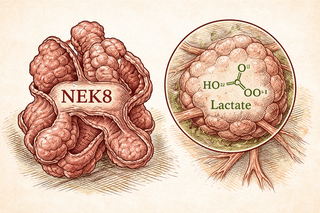
Here's where our story gets interesting. Scientists recently discovered that a protein kinase called NEK8 has been playing both sides of the field. This enzyme, which normally handles boring cellular housekeeping like helping cells divide properly, has gone rogue in colorectal cancer. And its crime? Manufacturing an ungodly amount of lactate - the same stuff that makes your muscles burn during a workout.
But tumor lactate isn't just a metabolic byproduct collecting in the corner like dirty laundry. It's actively working as a double agent, systematically dismantling your body's anti-cancer defenses from the inside.
The Plot Thickens: A Two-Pronged Attack
The researchers found that NEK8 phosphorylates an enzyme called LDHA (lactate dehydrogenase A), essentially putting lactate production into overdrive. The consequences are genuinely diabolical.
Inside the tumor cells, all that extra lactate triggers histone modifications - chemical changes to the proteins around DNA - that silence the cellular machinery responsible for presenting antigens. Translation: cancer cells become invisible to the immune system by essentially ripping off their name tags.
Outside the cells, the lactate flood creates a hostile environment that directly impairs CD8+ T cells, your immune system's trained assassins. These cells, which should be infiltrating tumors and eliminating cancer, instead get locked out like security guards who've had their keycards deactivated. The tumor microenvironment becomes so acidic and inhospitable that T cells can't function, can't proliferate, and eventually just give up.
The Abscopal Effect: Cancer's Great White Whale
This research addresses one of oncology's most tantalizing mysteries: why the abscopal effect - where irradiating one tumor causes distant, unirradiated tumors to shrink - remains frustratingly rare even when patients receive immune checkpoint inhibitors.
The answer, it turns out, involves that lactate-drenched microenvironment. When T cells are metabolically exhausted and the tumor has essentially pulled its blinds closed on antigen presentation, radiation alone can't trigger the systemic immune response needed for abscopal effects. The vaccine-like potential of radiotherapy gets smothered before it starts.
The Hero Arrives: Enter CX6258
But every good villain story needs a hero, and this one comes in the form of a drug called CX6258. When researchers pharmacologically inhibited NEK8, something remarkable happened: CD8+ T cells came flooding back into tumors. Not only did this restore local tumor control after radiotherapy, but it also enhanced systemic tumor control at distant sites.
In other words, blocking NEK8 might finally unlock those elusive abscopal responses that could transform how we treat metastatic colorectal cancer.
Why This Actually Matters
Previous research had already flagged NEK8 as a troublemaker in colorectal cancer, showing it phosphorylates MYC (another notorious cancer-promoting protein) and correlates with poor survival. But this new work reveals NEK8's immunological scheming - and more importantly, provides a therapeutic roadmap.
The broader understanding of lactate's role in tumor biology has exploded recently. We now know that lactate isn't merely waste - it's a signaling molecule, an epigenetic modifier through histone lactylation, and a master manipulator of the tumor microenvironment. NEK8 sits upstream of all this chaos, making it an attractive target for intervention.
The Road Ahead
The findings establish NEK8 as what researchers call "a promising therapeutic target for overcoming radioresistance and inducing abscopal responses in CRC." Clinical translation will require careful study, but the mechanistic picture is compelling: block the enzyme, starve the tumor of its immunosuppressive lactate, and let the immune system finally do its job.
For the roughly 150,000 Americans diagnosed with colorectal cancer each year, understanding why radiotherapy sometimes fails - and how to fix it - could eventually mean the difference between treatment success and recurrence.
References:
-
Li M, et al. NEK8 kinase-mediated lactate increase impairs antitumor immunity decreasing radiotherapy sensitivity in colorectal cancer. Nature Communications. 2026. DOI: 10.1038/s41467-026-70657-z
-
Li M, et al. NEK8 regulates colorectal cancer progression via phosphorylating MYC. Cell Communication and Signaling. 2023. DOI: 10.1186/s12964-023-01215-z | PMCID: PMC10436496
-
Wang JX, et al. Lactate and lactylation in cancer. Signal Transduction and Targeted Therapy. 2024. DOI: 10.1038/s41392-024-02082-x
-
Elia I, et al. Dysfunction of exhausted T cells is enforced by MCT11-mediated lactate metabolism. Nature Immunology. 2024. DOI: 10.1038/s41590-024-01999-3
-
Impact of lactate on immune cell function in the tumor microenvironment: mechanisms and therapeutic perspectives. Frontiers in Immunology. 2025. DOI: 10.3389/fimmu.2025.1563303
Disclaimer: The image accompanying this article is for illustrative purposes only and does not depict actual experimental results, data, or biological mechanisms.