A decent croissant, a reliable plumber, and a fake intestine on a microchip all share one rule: if the internal architecture is wrong, the whole performance falls apart.
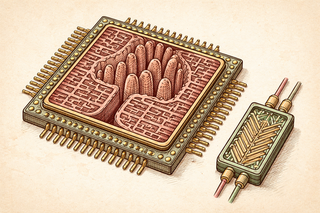
That is the quiet argument hiding inside a new paper on colorectal cancer. We already know organ-on-a-chip models are cooler than old-school flat cell culture. The usual sales pitch is easy: add microfluidics, sprinkle in patient cells, maybe whisper "precision medicine" three times, and presto - future of oncology. But this study by Lu and colleagues makes a more annoying, and probably more useful, point: the shape of the tissue matters, the flow around it matters, and if you want to test chemotherapy realistically, your fake gut should stop looking like a parking lot and start looking like an intestine (Lu et al., 2026).
Flat Cells, Flat Answers
Your intestine is not a smooth tube lined with identical cells behaving politely. It has crypts, which are like tiny cell nurseries tucked downward, and villus-like projections, which increase surface area and help organize who grows, who matures, and who does what. Cancer barges into that setup and turns local biology into a badly managed nightclub.
A lot of lab models flatten this mess into a 2D sheet or a simple blob. Useful? Sure. Realistic? About as realistic as testing a submarine in a bathtub.
Lu and colleagues built a human intestinal tumor-on-a-chip that includes crypt and villus-like 3D structures plus a herringbone fluidic mixer to improve how cells and signals interact. They seeded it with patient-derived epithelial and tumor cells, then watched how those tumors responded to chemotherapy over time. The point was not just "look, we made a chip." The point was "look, tissue geometry and fluid dynamics change the conversation between tumor cells and their neighborhood" (Lu et al., 2026).
That matters because tumors are not lone maniacs. They are social creatures. They survive by negotiating with nearby cells, extracellular matrix, oxygen gradients, nutrients, and stress signals. Reviews over the last couple of years have hammered home that tumor-on-chip systems become much more informative when they recreate that ecosystem instead of treating cancer like a pile of immortal cells with boundary issues (Xu et al., 2024; Hwangbo et al., 2024).
The Spicy Bit: Drug Resistance
Here is the part that should make oncologists lean in and everyone else raise an eyebrow. The chip did not just hold tumor cells in a fancier habitat. It also let the team monitor dynamic drug responses in cells from individual patients, and their early results point to mitophagy as a possible player in chemoresistance.
Mitophagy is basically cellular housekeeping for mitochondria. Sounds wholesome. Very Marie Kondo. Unfortunately, cancer cells can weaponize wholesome things. If damaged mitochondria get cleared in ways that help tumor cells survive treatment stress, then chemotherapy starts looking less like a knockout punch and more like an expensive inconvenience.
That idea fits a broader trend in cancer modeling: once you move from static cultures to more lifelike systems, resistance mechanisms stop hiding behind the furniture. Organoid-on-chip platforms increasingly show that flow, matrix, and multicellular context reshape treatment response in ways flat cultures routinely miss (Wang et al., 2024; Hwangbo et al., 2024).
Why This Could Matter in Real Life
The dream here is not subtle. A patient gets a tumor sample. Researchers grow that patient’s cells in a model that behaves enough like a real intestine to make treatment testing less silly. Doctors then use those results to avoid wasting precious time on drugs the tumor is likely to ignore.
We are not there yet, and anyone promising that next Tuesday is selling either stock or vibes. Organ-on-chip systems still face standardization problems, scaling problems, cost problems, and the small but important issue that biology enjoys humiliating elegant engineering. Even strong reviews in the field keep repeating the same warning: these models are promising because they are more human-like, not because they are magic (Xu et al., 2024; Wang et al., 2024).
Still, there is a reason this area keeps attracting attention. Related gut-on-chip work has already shown that microfluidic intestinal models can capture clinically meaningful treatment biology, including therapy response signals tied to the gut environment itself (Ballerini et al., 2025). That does not prove this colorectal tumor chip is ready for prime time. It does suggest the field is moving from "cute engineering demo" toward "maybe this changes decisions."
And that is the angle people tend to miss. The exciting part is not that someone built a tiny fake gut. The exciting part is that the fake gut is finally getting picky about anatomy, flow, and patient specificity. Cancer has always exploited context. Maybe our models should stop acting surprised.
For once, the overengineered gadget in the room might actually have a point.
References
-
Lu J, Lin X, Zhao J, Shang L, Zhao Y, Sun W. Biomimetic Human Intestinal Tumor-on-a-Chip with Crypts and Villus-Like Structures for Chemotherapy Drug Evaluations. Small. 2026. doi: 10.1002/smll.202514836. PubMed: 41983346
-
Xu H, et al. Tumor-microenvironment-on-a-chip: the construction and application. Cell Communication and Signaling. 2024;22:515. doi: 10.1186/s12964-024-01884-4. PubMed: 39438954
-
Wang H, Ning X, Zhao F, Zhao H, Li D. Human organoids-on-chips for biomedical research and applications. Theranostics. 2024;14(2):788-818. doi: 10.7150/thno.90492. PMCID: PMC10758054
-
Hwangbo H, Chae S, Kim W, Jo S, Kim GH, Lee J. Tumor-on-a-chip models combined with mini-tissues or organoids for engineering tumor tissues. Theranostics. 2024;14(1):33-55. doi: 10.7150/thno.90093. PMCID: PMC10750204
-
Ballerini M, Galiè S, Tyagi P, et al. A gut-on-a-chip incorporating human faecal samples and peristalsis predicts responses to immune checkpoint inhibitors for melanoma. Nature Biomedical Engineering. 2025;9:967-984. doi: 10.1038/s41551-024-01318-z
Disclaimer: The image accompanying this article is for illustrative purposes only and does not depict actual experimental results, data, or biological mechanisms.