Researchers have spent decades watching mice get tumors, treating those tumors, and then publishing papers about it. There's just one small problem: about 92% of cancer drugs that work in mice fail spectacularly in human clinical trials. So either we've been curing mouse cancer really effectively, or maybe - just maybe - we should consider some backup plans.
A new review in Molecular Cancer by Faehling and colleagues does exactly that, making the case for a zoo of alternative cancer models that are cheaper, faster, and don't require you to feel quite as guilty about your research subjects.
The 3Rs: Not Just Something Your Elementary Teacher Said
The "3Rs" framework - Replace, Reduce, Refine - has been guiding ethical animal research for over 50 years. But here's where it gets interesting: the European Medicines Agency and FDA are actually starting to care. In 2023, the FDA passed legislation stating that new drugs no longer require animal testing. Read that again. The regulatory landscape is shifting beneath our feet.
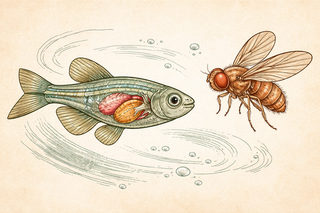
So what's filling the gap? A menagerie of creatures you might find in your backyard, your aquarium, or your pantry's fruit bowl.
The Zebrafish: Tiny, Transparent, and Kind of Perfect
If zebrafish were a startup, they'd have already secured Series C funding. These small, see-through swimmers share roughly 80% of disease-related genes with humans, and their embryos are transparent enough that you can literally watch cancer cells move around inside them with a decent microscope.
The numbers are compelling. A recent study in Nature Communications showed that zebrafish "avatar" models - embryos implanted with actual patient tumor cells - could predict chemotherapy response in colorectal cancer patients with 91% accuracy. That's not a typo. Ninety-one percent.
And unlike mice, you don't need many cells to run these experiments. A single patient biopsy can generate far more zebrafish xenografts than murine ones, making personalized medicine approaches actually feasible rather than just a nice idea for grant applications.
Fruit Flies: A Century of Punching Above Their Weight
Drosophila melanogaster has been contributing to cancer research since 1918, when Mary Stark first described tumors in these tiny insects. It took roughly a hundred years for the scientific establishment to fully appreciate what flies bring to the table.
The fruit fly genome is about 60% identical to ours, but here's the kicker: it's far less redundant. When you knock out a gene in a fly, you actually see what happens, instead of watching backup copies cover for the missing one. Some of the most important cancer pathways - Notch, Hedgehog, Hippo - were first identified in flies, not mice.
Researchers are now creating "avatar flies" carrying specific patient mutations to test drug cocktails. One such approach led to vandetanib, which became the first FDA-approved targeted therapy for medullary thyroid cancer in 2011. From fruit fly to pharmacy shelf.
C. elegans: The Worm That Won Nobel Prizes
This millimeter-long nematode has approximately 1,000 cells, is completely transparent, and shares about 40% of its genes with humans. It's also responsible for six Nobel Prizes, which is more than most research departments can claim.
C. elegans doesn't naturally develop cancer - worms apparently have other problems to worry about - but their PTEN gene homolog has proven invaluable for studying a pathway disrupted in roughly 70% of prostate cancers. The worm's germline provides three distinct tumor models that let researchers study proliferation, differentiation, and cell death with single-cell precision.
The CAM Model: Making Eggs Useful Beyond Breakfast
The chick embryo chorioallantoic membrane (CAM) model sounds complicated, but it's essentially a fertilized egg that hasn't been asked for ethical approval. Before day 17 of development, chicken embryos don't feel pain according to current scientific consensus, making this a genuinely ethical alternative.
Tumor cells grafted onto the CAM retain their biological characteristics remarkably well, and the model has been validated for colorectal, breast, prostate, and brain cancers. It's cheap, fast, and doesn't require maintaining an animal facility.
The Elephant in the Room (Which We're Ironically Not Testing On)
Here's the uncomfortable truth: mouse models of cancer fail to translate to humans at alarming rates. Part of this is biology - mice aren't people, no matter how many times we pretend they are. Part of it is that patient-derived xenograft models require immunocompromised mice, which means you can't test immunotherapies in them. That's a problem when checkpoint inhibitors are among the most promising cancer treatments we have.
The alternative models aren't perfect. Zebrafish don't have lungs. Flies don't have an adaptive immune system. Worms lack what most people would recognize as anatomy. But sometimes imperfect tools that answer the right questions beat perfect tools that answer the wrong ones.
What This Actually Means
The research community is slowly accepting that our over-reliance on mice may have been costing us both time and lives. Alternative models aren't meant to replace mice entirely - they're meant to provide complementary data, reduce unnecessary animal use, and potentially catch drugs that would fail before they enter expensive clinical trials.
Faehling and colleagues are making a straightforward argument: use the right model for the right question. Sometimes that's a mouse. Sometimes it's a fish, a fly, a worm, or an egg. The 3Rs framework isn't just about ethics - it's increasingly about good science.
References:
-
Faehling T, et al. Beyond the mouse: 3R-guided alternative animal models transforming cancer research. Molecular Cancer. 2026. DOI: 10.1186/s12943-026-02601-0
-
Fior R, et al. Zebrafish Avatar-test forecasts clinical response to chemotherapy in patients with colorectal cancer. Nature Communications. 2024. DOI: 10.1038/s41467-024-49051-0
-
Mirzoyan Z, et al. Drosophila melanogaster: A Model Organism to Study Cancer. Frontiers in Genetics. 2019. PMCID: PMC6405444
-
Cerón J. Caenorhabditis elegans for research on cancer hallmarks. Disease Models & Mechanisms. 2023. PMCID: PMC10259857
-
Day CP, et al. Human tissue models in cancer research: looking beyond the mouse. Disease Models & Mechanisms. 2015. PMCID: PMC5560067
Disclaimer: The image accompanying this article is for illustrative purposes only and does not depict actual experimental results, data, or biological mechanisms.