Cancer research loves a good paradox, and here's one that should make you suspicious of every "immunotherapy breakthrough" headline you've read this year: we've spent decades trying to unleash the immune system against tumors, yet almost nobody thought to ask whether the immune system's own headquarters was under siege the whole time.
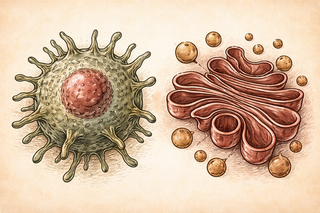
A team from Shanghai Jiao Tong University just published a paper in Cell Stem Cell that essentially says, "Hey, what if we stop obsessing over the tumor for five minutes and fix the factory where immune cells are actually made?" And honestly? The skeptic in me wants to poke holes in it, but the science is annoyingly solid.
The Problem Nobody Was Solving
Here's the dirty secret of cancer immunology: tumors aren't just rogue cells growing where they shouldn't. They're symptoms of a system-wide immune breakdown. Your bone marrow - that spongy stuff inside your bones churning out blood and immune cells like a biological assembly line - gets quietly sabotaged by tumors long before you ever feel a lump.
Primary tumors send molecular smoke signals that recruit immature, suppressive immune cells from the bone marrow, essentially turning your own immune cell factory into a double agent (Patras et al., 2023). Meanwhile, every immunotherapy on the market is laser-focused on either killing tumor cells directly or juicing up immune cells at the tumor site. It's like trying to win a war by only sending troops to the front lines while the enemy quietly takes over your supply depot.
Enter the Trojan Horse (That Avoids Troy Entirely)
Xu and colleagues engineered mesenchymal stem cells (MSCs) - those versatile cellular Swiss Army knives your body already uses for tissue repair - to do something counterintuitive. Instead of sending them toward tumors like most MSC-based therapies attempt, they made cells that actively avoid tumors and beeline straight for bone marrow (Xu et al., 2026).
The trick? They cranked up expression of a protein called GLG1 (Golgi apparatus protein 1, also known as ESL-1), which acts like a VIP pass for bone marrow entry. GLG1 is an E-selectin ligand - think of it as a molecular handshake that tells bone marrow blood vessels, "I belong here, let me in." By overexpressing this protein, the engineered MSCs home to bone marrow with impressive specificity while giving tumors the cold shoulder.
Now, I'll admit - "we made stem cells that go where we want and not where we don't want" sounds like the kind of claim that usually falls apart under scrutiny. Cell targeting in living organisms is notoriously messy. But the concept of leveraging natural adhesion molecules rather than bolting on some synthetic targeting gadget is elegant, if nothing else.
Reprogramming the Command Center
Once parked in the bone marrow, these MSCs don't just sit around collecting rent. They deliver immunomodulatory cargo directly to the bone marrow niche - the specialized microenvironment where immune cells are born, trained, and deployed. The result is what the authors call "systemic immune reprogramming through niche-derived signaling."
Translation: fix the factory, fix the army.
Recent work in Nature has revealed just how architecturally sophisticated these bone marrow niches really are, with specialized blood vessels, signaling molecules, and immune-privileged zones that coordinate everything from stem cell maintenance to immune tolerance (Furuhashi et al., 2025). Messing with this machinery is risky. Getting it right could be transformative.
And here's the part that elevates this from "interesting concept" to "okay, you have my attention": the engineered MSCs protected blood-forming cells from chemotherapy damage while maintaining anti-cancer immune function and not promoting tumor growth. That last bit matters enormously. MSCs have a complicated reputation in oncology - they can suppress immune responses and potentially feed tumors if they end up in the wrong neighborhood (Li et al., 2025). Making them tumor-evasive isn't just a nice feature; it's a safety requirement.
The Verdict (From Someone Who's Seen a Lot of Hype)
Let's be clear about what this is and isn't. This is a preclinical study. The leap from "works in a lab" to "works in your grandmother" is long, expensive, and littered with the wreckage of promising therapies that didn't survive contact with human complexity. The MSC field in particular has a graveyard of clinical trials that couldn't replicate preclinical magic (Zhuang et al., 2025).
But the idea - that we should be protecting and reprogramming the bone marrow niche rather than exclusively carpet-bombing tumors - represents a genuine shift in thinking. Cancer isn't just a local problem. It's a systems failure. And maybe, just maybe, the most important battlefield isn't the tumor at all. It's the bone marrow that was supposed to be defending you in the first place.
References
-
Xu, S., Xu, J., Yang, Q., et al. (2026). Engineered MSCs enable bone marrow-targeted immunomodulation. Cell Stem Cell. DOI: 10.1016/j.stem.2026.03.003
-
Patras, L., Shaashua, L., Matei, I., & Lyden, D. (2023). Immune determinants of the pre-metastatic niche. Cancer Cell, 41(3), 546-566. DOI: 10.1016/j.ccell.2023.02.018
-
Furuhashi, K., Kakiuchi, M., Ueda, R., et al. (2025). Bone marrow niches orchestrate stem cell hierarchy and immune tolerance. Nature. DOI: 10.1038/s41586-024-08352-6
-
Li, T., et al. (2025). Engineered mesenchymal stem/stromal cells against cancer. Cell Death & Disease. DOI: 10.1038/s41419-025-07443-0
-
Zhuang, W.R., et al. (2025). Mesenchymal stem cells in treating human diseases: molecular mechanisms and clinical studies. Signal Transduction and Targeted Therapy. DOI: 10.1038/s41392-025-02313-9
Disclaimer: The image accompanying this article is for illustrative purposes only and does not depict actual experimental results, data, or biological mechanisms.
Get cancer research delivered to your inbox
The best new studies, explained without the jargon. One email per week.