In 1924, Otto Warburg noticed something strange: cancer cells consume enormous amounts of glucose and ferment it into lactate even when plenty of oxygen is available for normal respiration. This was weird. Aerobic glycolysis is wildly inefficient - you get 2 ATP per glucose molecule instead of the 36 you would get from oxidative phosphorylation. Why would rapidly dividing cells deliberately choose the worse energy deal? Nearly a century later, we finally have decent answers, and they are pointing toward new ways to treat cancer.
The Warburg Effect Is Not Stupidity
For decades, the assumption was that cancer cells had broken mitochondria and glycolysis was their only option. This turns out to be mostly wrong. Most cancer cells have perfectly functional mitochondria. They choose glycolysis because it offers advantages that go beyond energy production.
The real insight: cancer cells do not need maximum ATP. They need building materials. Every time a cell divides, it has to duplicate everything - DNA, proteins, lipids, membranes. Glycolytic intermediates feed directly into biosynthetic pathways. Glucose-6-phosphate enters the pentose phosphate pathway to make nucleotides and NADPH. 3-phosphoglycerate fuels serine and glycine biosynthesis. Pyruvate provides acetyl-CoA for fatty acid synthesis.
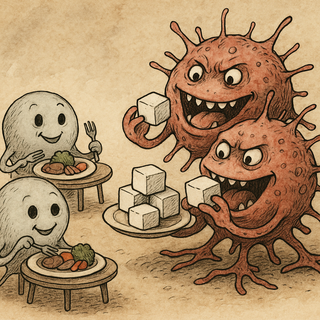
Glycolysis is not an energy strategy - it is a construction supply chain. The ATP is almost a byproduct.
The Metabolic Buffet
Glucose is not the only thing on the menu. Cancer cells are metabolically flexible in ways that make nutritional fads look simple.
Glutamine. Many cancers are addicted to glutamine, using it as an alternative carbon source to feed the TCA cycle (a process called anaplerosis) and as a nitrogen donor for nucleotide and amino acid synthesis. Some tumors consume glutamine so voraciously that they deplete it from surrounding tissue, starving immune cells that also need it. This is metabolic warfare.
Fatty acids. Many cancer cells upregulate de novo fatty acid synthesis through FASN. Others depend on fatty acid oxidation for energy, particularly during metastasis when glucose may be scarce in transit.
Lactate. The Warburg "waste product" is not actually waste. Lactate acidifies the tumor microenvironment (suppressing immune function), promotes angiogenesis, and can be taken up as fuel by neighboring cancer cells. One population glycolyzes and exports lactate; another oxidizes it. Tumors have invented carpooling for metabolites.
PET Scans: The Warburg Effect in the Clinic
The most immediate clinical impact of cancer metabolism is something millions of patients already experience: the PET scan. FDG-PET (fluorodeoxyglucose positron emission tomography) works precisely because cancer cells are glucose hogs. You inject a radioactive glucose analog, wait for cells to take it up, and scan. The bright spots are tumors (and your brain, which also loves glucose, and your bladder, where the tracer accumulates). The Warburg effect is not just a biochemistry curiosity - it is the basis of the most widely used functional imaging modality in oncology.
Targeting Metabolism as Therapy
If cancer cells are metabolically distinct from normal cells, those differences should be exploitable. The logic is sound. The execution has been tricky.
Glycolysis inhibitors. Drugs targeting hexokinase and lactate dehydrogenase have been explored, but glucose metabolism is important for normal tissues too. Therapeutic windows have been narrow.
Glutaminase inhibitors. CB-839 (telaglenastat) showed promising preclinical data but disappointing clinical results. The problem: metabolic redundancy. Block one pathway and cancer cells reroute through another.
IDH inhibitors. The success story. Mutant isocitrate dehydrogenase (IDH1/IDH2) produces an oncometabolite that rewires cellular epigenetics. Ivosidenib and enasidenib target mutant IDH in AML and cholangiocarcinoma - FDA-approved metabolism-targeted therapy that works because it hits a cancer-specific mutation, not a normal pathway.
Metformin. The diabetes drug that oncologists keep studying. Dozens of clinical trials later, the results are mixed. It probably does something to cancer metabolism, but "something" has not translated into consistent clinical benefit.
The Immune Metabolism Angle
The most exciting recent development is recognizing that tumor metabolism and immune evasion are intertwined. Tumors that consume all available glucose and glutamine create a metabolically hostile environment for T cells, which need those same nutrients to mount an attack. Lactate accumulation further suppresses immune function. Targeting tumor metabolism might therefore have a dual benefit: directly harming cancer cells while simultaneously feeding the immune system.
If you are trying to map out the increasingly complex relationships between metabolic pathways, immune cell states, and therapeutic targets, sketching it out visually helps - something like mapb2.io can turn the metabolic spaghetti diagram into an organized mind map before it gives you a headache.
Warburg was right that cancer metabolism is abnormal. He was wrong about why. A century of follow-up research has revealed that metabolic reprogramming is not a bug in cancer cells - it is a feature, and learning to exploit it remains one of oncology's most tantalizing unfinished projects.
References
- Vander Heiden MG, Cantley LC, Thompson CB. Understanding the Warburg effect: the metabolic requirements of cell proliferation. Science. 2009;324(5930):1029-1033. DOI: 10.1126/science.1160809 | PMID: 19460998
- Pavlova NN, Zhu J, Thompson CB. The hallmarks of cancer metabolism: still emerging. Cell Metab. 2022;34(3):355-377. DOI: 10.1016/j.cmet.2022.01.007 | PMID: 35218708
Disclaimer: This blog post is for informational and educational purposes only. It is not medical advice. Always consult a qualified healthcare professional for clinical decisions.
Get cancer research delivered to your inbox
The best new studies, explained without the jargon. One email per week.