Cancer vaccines have been the "next big thing" for about three decades. Every few years, the hype cycle spins up, a few high-profile trials disappoint, and the field quietly goes back to the lab. But something changed during COVID-19. The mRNA platform that Moderna and BioNTech used to develop SARS-CoV-2 vaccines in record time suddenly handed oncology a delivery system that actually works at scale. The cancer vaccine comeback tour is officially underway, and this time it has better equipment.
Why Cancer Vaccines Kept Failing
The old approach had a fundamental problem: tumors are not viruses. A virus presents foreign proteins that your immune system has never seen - easy to train against. A tumor is made of your own cells with subtle mutations. Teaching the immune system to attack something that looks 99.9% like normal tissue without causing autoimmune catastrophe is absurdly difficult.
Previous cancer vaccine attempts mostly used shared tumor antigens - proteins overexpressed on many patients' cancers. The results were underwhelming because these antigens are also present on normal cells, the immune response was tepid, and the delivery platforms (peptides, dendritic cells, viral vectors) were cumbersome and inconsistent.
The mRNA Difference
What mRNA brings to the table is speed, personalization, and potent immunogenicity.
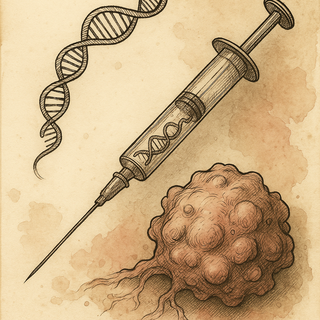
The workflow goes like this: sequence a patient's tumor, identify the mutations unique to that tumor (neoantigens), design mRNA sequences encoding those neoantigens, manufacture the vaccine, and inject it. The patient's own cells then produce the mutant proteins, display them on their surface via MHC molecules, and the immune system learns to recognize and attack cells carrying those mutations.
The entire process from biopsy to injection can happen in weeks. That matters because cancer does not wait around while you manufacture a vaccine.
BioNTech's autogene cevumeran (BNT122), a personalized mRNA neoantigen vaccine, made headlines in combination with atezolizumab and chemotherapy for pancreatic ductal adenocarcinoma. In a phase I trial, patients who mounted a T-cell response to the vaccine had significantly longer recurrence-free survival than non-responders. Pancreatic cancer. The cancer that laughs at almost everything. That got people's attention.
The Moderna-Merck Alliance
Moderna and Merck's mRNA-4157/V940 (now called mRNA-4157) combined with pembrolizumab showed a 44% reduction in recurrence or death compared to pembrolizumab alone in resected high-risk melanoma (KEYNOTE-942). This was a randomized phase IIb trial - not a single-arm, pray-for-a-signal study. The FDA granted it breakthrough therapy designation, and phase III trials are now running across melanoma, non-small cell lung cancer, and other solid tumors.
Each vaccine is personalized, encoding up to 34 neoantigens from the individual patient's tumor. Manufacturing takes about six to eight weeks from tumor sequencing to finished product, which is remarkable given that this is essentially a bespoke pharmaceutical made for one person.
What Still Needs Sorting Out
The manufacturing bottleneck is real. Making a unique vaccine for every patient does not scale the way a one-size-fits-all drug does. Costs are high, turnaround times need to shrink, and quality control for thousands of individual products is a regulatory headache nobody has fully solved.
Then there is patient selection. Tumors with low mutational burden may not provide enough neoantigens for a good vaccine. The algorithms predicting which neoantigens will actually provoke an immune response are improving but imperfect. Timing - after surgery? during treatment? as maintenance? - is being worked out across dozens of ongoing trials.
The Bigger Picture
The mRNA cancer vaccine is not a silver bullet. It is a piece of a combination strategy - likely partnered with checkpoint inhibitors to remove immune suppression while the vaccine trains the attack. Think of it as giving the immune system both a target and permission to fire.
What changed is not the concept of cancer vaccination but the engineering. mRNA is fast to design, relatively cheap to manufacture compared to cell-based therapies, strongly immunogenic, and already proven at billions-of-doses scale. The pandemic built the factory and trained the workforce.
If you are trying to keep up with the dozens of ongoing neoantigen vaccine trials, the data is scattered across clinicaltrials.gov entries, conference abstracts, and press releases. Organizing that into something readable is its own project - mapb2.io is one way to visually map out the trial landscape without losing your mind.
Five years from now, personalized mRNA cancer vaccines will either be standard of care in adjuvant settings for multiple tumor types, or they will have hit an unexpected wall. The early data strongly favors the first outcome.
References
- Rojas LA, Sethna Z, Soares KC, et al. Personalized RNA neoantigen vaccines stimulate T cells in pancreatic cancer. Nature. 2023;618(7963):144-150. DOI: 10.1038/s41586-023-06063-y | PMID: 37165196
- Weber JS, Carlino MS, Lao CD, et al. Individualised neoantigen therapy mRNA-4157 (V940) plus pembrolizumab versus pembrolizumab monotherapy in resected melanoma (KEYNOTE-942). Lancet. 2024;403(10427):632-644. DOI: 10.1016/S0140-6736(23)02268-7 | PMID: 38246194
Disclaimer: This blog post is for informational and educational purposes only. It is not medical advice. Always consult a qualified healthcare professional for clinical decisions.
Get cancer research delivered to your inbox
The best new studies, explained without the jargon. One email per week.