Every cell in your body has a story. It's born, it reads its genetic instructions, it responds to threats, it makes choices that determine whether it lives, dies, or - in the worst-case scenario - goes rogue. The problem? Cells don't leave a paper trail. By the time you look at a cell's gene expression, whatever it was doing five minutes ago is already gone, degraded into molecular confetti. It's like trying to solve a murder mystery where the crime scene cleans itself every few hours.
Enter our heroes: a team of scientists at the Broad Institute of MIT and Harvard who just figured out how to give cells a black box recorder.
The Mysterious Vaults Nobody Understood
Here's where our story takes its first weird turn. Lurking inside nearly every cell in your body are thousands of tiny barrel-shaped containers called vault particles - discovered back in 1986 and named because they look like the arched ceilings of a cathedral under an electron microscope. Each cell has roughly 10,000 of them. They're the largest particles your cells manufacture, they're everywhere in the animal kingdom, and here's the kicker: nobody really knows what they do. Scientists knocked them out in mice and the mice were... completely fine. Vaults are basically biology's most over-engineered mystery box (1).
Fei Chen's lab looked at these hollow, seemingly purposeless protein shells and thought: what if we turned them into storage units?
TimeVault: A Molecular Time Capsule
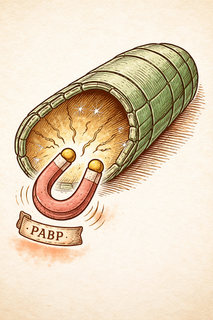
The system they built, called TimeVault, is beautifully simple in concept. They took poly(A)-binding protein (PABP) - a molecule that naturally clings to messenger RNA like a barnacle - and fused it to a protein domain that sticks to the inside of vault particles. As Chen's co-first author Kevin Yu-Kai Chao put it: "It's like a magnet for RNA. Then the vault will capture the magnet" (2).
Once the vault closes, those captured mRNAs are sealed inside like letters in a time capsule. And here's where it gets impressive: unprotected mRNA in a cell's cytoplasm has a half-life of about 17 hours. Inside TimeVault? That jumps to 132 hours - more than a sevenfold improvement. The transcriptome record stays readable for over a week in living cells, with minimal disruption to normal cell behavior (2).
To read the diary, researchers crack open the vaults and sequence whatever RNA is inside. Past and present, side by side.
The Villain Reveals Its Hand
Now the plot thickens. The team pointed TimeVault at one of oncology's most frustrating villains: drug-tolerant persister cells. These are the sneaky few cancer cells that survive targeted therapy - not because they've mutated, but because they were already quietly running some genetic side hustle that made them resistant before the drug even showed up (3, 4).
In EGFR-mutant lung cancer cells treated with EGFR inhibitors, TimeVault captured something previous methods couldn't: a ledger of which genes were active before treatment began. The recorded transcriptomes revealed expression changes in genes not previously linked to cancer resistance - ones that were operating behind the scenes, keeping certain cells alive while their neighbors perished (2).
The real plot twist? When researchers targeted one of these newly identified genes with a second drug, most of the persister cells were eliminated. TimeVault didn't just document the crime scene - it helped catch the accomplice.
Why This Chapter Matters
"It's like a time machine for the cell," Chen said, and that's not hyperbole for once. Until now, studying how cells make decisions over time meant either freezing snapshots at different moments (destroying the cells in the process) or using synthetic recording systems with limited capacity. TimeVault offers something genuinely new: a way to read a cell's history without killing it, then watch what it does next (2, 5).
University of Washington geneticist Jay Shendure called it exactly what the rest of us were thinking: "It's so cool. You're engineering vaults, something we barely understand, [to track RNA]." Caltech's Michael Elowitz described it as a "molecular selfie" - a frozen portrait of everything a cell was up to at a given moment.
The technology currently records single timepoints, so we're not quite at the continuous-surveillance stage yet. But for a structure that scientists have spent 40 years scratching their heads over, vault particles just landed the most interesting job in molecular biology.
Turns out the mystery box was empty for a reason. It was waiting to be filled.
References
-
Kedersha, N.L. & Rome, L.H. (1986). Isolation and characterization of a novel ribonucleoprotein particle: large structures contain a single species of small RNA. Journal of Cell Biology, 103(3), 699-709. DOI: 10.1083/jcb.103.3.699
-
Chao, Y.-K., Wu, M., Gong, Q. & Chen, F. (2026). A genetically encoded device for transcriptome storage in mammalian cells. Science. DOI: 10.1126/science.adz9353 | PMID: 41538410
-
Cabanos, H.F. & Hata, A.N. (2024). Cancer drug-tolerant persister cells: from biological questions to clinical opportunities. Nature Reviews Cancer. DOI: 10.1038/s41568-024-00734-4 | PMID: 39223250
-
Ramirez, M. et al. (2016). Diverse drug-resistance mechanisms can emerge from drug-tolerant cancer persister cells. Nature Communications, 7, 10690. DOI: 10.1038/ncomms10690
-
Platt, R.J. (2026). TimeVault turns vault particles into molecular memory of transcriptional states. Science. PMID: 41789510
Disclaimer: The image accompanying this article is for illustrative purposes only and does not depict actual experimental results, data, or biological mechanisms.
Get cancer research delivered to your inbox
The best new studies, explained without the jargon. One email per week.