There is something deeply medieval about the traditional biopsy. You find a suspicious mass, stick a needle into it (or cut it out entirely), send the tissue to a lab, and wait. It works, but it is invasive, painful, limited to accessible tumors, and gives you a single snapshot of a single location. In 2026, we can land robots on Mars, but diagnosing cancer still often requires physically stabbing the tumor. Liquid biopsy is trying to change that.
Blood Tells Stories
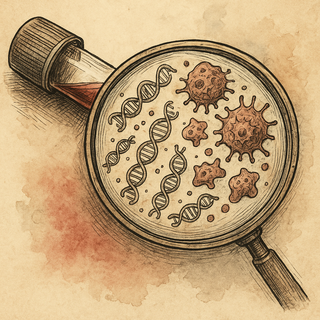
The core idea is elegant: tumors are messy. They shed material into the bloodstream constantly - circulating tumor DNA (ctDNA), circulating tumor cells (CTCs), exosomes, proteins, and RNA fragments. A standard blood draw captures this debris, and modern molecular techniques can detect and analyze it. One tube of blood, no anesthesia, no recovery time, no risk of pneumothorax from a lung biopsy gone sideways.
The most clinically mature approach focuses on ctDNA - tiny fragments of DNA released by dying tumor cells. These fragments carry the same mutations as the tumor itself, which means sequencing them tells you what the cancer looks like genetically without ever touching it.
What It Can Actually Do Right Now
Liquid biopsy is not hypothetical. Several FDA-approved tests are already in clinical use. Guardant360 CDx and FoundationOne Liquid CDx can identify actionable mutations in advanced solid tumors, helping oncologists select targeted therapies. If a patient's lung cancer has an EGFR mutation, you can find it in the blood and prescribe the right drug without waiting for a tissue biopsy.
This is particularly valuable when tissue is hard to get. Brain metastases, deep retroperitoneal tumors, patients who are too frail for invasive procedures - liquid biopsy provides molecular information that would otherwise require risky or impossible procedures.
Beyond mutation profiling, liquid biopsy is being used for monitoring treatment response in real time. ctDNA levels drop when treatment works and rise when resistance develops, often weeks before imaging shows any change. That lead time matters. Catching resistance early means switching therapies before the tumor has fully escaped.
The Holy Grail: Early Detection
Where things get really interesting - and really hard - is multi-cancer early detection (MCED). Companies like GRAIL (with their Galleri test), Exact Sciences, and others are developing blood tests designed to detect cancer before symptoms appear, across multiple cancer types simultaneously.
The Galleri test, for example, analyzes methylation patterns in cell-free DNA to detect signals from over 50 cancer types and predict the tissue of origin. A single blood draw that tells you not just whether you have cancer, but where it is. The NHS is running a large-scale trial, and the results so far are promising for cancers that currently lack screening tools - pancreatic, ovarian, liver - the ones that typically announce themselves only after it is too late.
But the sensitivity problem is real. Early-stage cancers shed vanishingly small amounts of ctDNA. Detecting a handful of mutant DNA fragments among billions of normal ones is like finding a specific grain of sand on a beach. Current MCED tests detect stage I cancers at rates around 15-25%, which improves dramatically for later stages but somewhat defeats the purpose of "early" detection.
The False Positive Question
Any screening test faces the same tension: sensitivity versus specificity. Current MCED tests are designed with high specificity (false positive rates around 0.5-1%) at the cost of lower sensitivity for early-stage disease. The math only works if the population being screened has meaningful cancer prevalence, which is why most tests target people over 50.
What is Coming
The next few years will bring larger validation studies, Medicare coverage decisions, and hopefully clarity on whether population-scale liquid biopsy screening actually reduces cancer mortality - the only endpoint that truly matters. For researchers juggling the avalanche of multi-omic data these tests generate, tools like pdfb2.io help when you are buried in supplementary figures and protocol PDFs across dozens of validation studies.
The trajectory is clear: cancer diagnosis is moving from tissue-first to blood-first, from single-site to systemic, and from reactive to proactive. The blood draw will not replace the biopsy overnight, but it is making the scalpel optional in more situations every year.
References
- Ignatiadis M, Sledge GW, Jeffrey SS. Liquid biopsy enters the clinic - implementation issues and future challenges. Nat Rev Clin Oncol. 2021;18(5):297-312. DOI: 10.1038/s41571-020-00457-x | PMID: 33473219
- Klein EA, Richards D, Cohn A, et al. Clinical validation of a targeted methylation-based multi-cancer early detection test using an independent validation set. Ann Oncol. 2021;32(9):1167-1177. DOI: 10.1016/j.annonc.2021.05.806 | PMID: 34176681
Disclaimer: This blog post is for informational and educational purposes only. It is not medical advice. Always consult a qualified healthcare professional for clinical decisions.
Get cancer research delivered to your inbox
The best new studies, explained without the jargon. One email per week.